Neutrality Colloquium: A Call to Action for Active Neutrality & World Peace

Neutrality Colloquium: A Call to Action for Active Neutrality & World Peace

Geneva, Switzerland | June 26-27, 2025

The Neutrality Colloquium took place on June 26–27, 2025, in Geneva, Switzerland, bringing together 90 experts in diplomacy, international law, peacebuilding, and digitalization, from 27 countries across five continents—including Colombia, Argentina, Costa Rica, the USA, the DRC, Syria, Moldova, Ireland, Japan, and China. Held in hybrid format, the Colloquium served as a critical platform to explore and promote active neutrality as a strategy for peacebuilding, conflict prevention, and global stability amid growing geopolitical tensions, rising militarization, and ongoing humanitarian crises.

This gathering followed the First International Congress on Neutrality, which was held in Bogotá, Colombia, in April 2024. That congress marked a milestone, with participants from 25 countries laying the groundwork for a renewed global conversation on neutrality. The Geneva Colloquium was conceived as a smaller, expert-level forum to build upon that momentum and shape the vision for the Second International Congress on Neutrality, scheduled for 2026.

The event was jointly organized by a coalition of organizations committed to peace and disarmament: Global Veterans Peace Network (GVPN), World BEYOND War, Inter-University Network for Peace (REDIPAZ), International Peace Bureau (IPB), Transnational Institute, the Colombia Peace Agreement, and the Geneva Center for Neutrality, which hosted the gathering. Their collaboration was essential to the success of the Colloquium.

Over two days, participants engaged in five thematic focus groups:

  • Current Neutrality Practices
  • Digital Neutrality in the Age of Cyberwarfare and AI
  • Neutrality and Media
  • Building a New Non-Aligned Movement
  • Neutrality and Common Security in a Militarized World

Each group developed specific recommendations, which were integrated into the final outcomes of the Colloquium: a Modern Neutrality Final Declaration and an Action Agenda to Promote Active Neutrality.

The Declaration stresses that neutrality is not indifference. Rather, it is a strategic, principled approach to international relations—one that prioritizes peace over power projection, sovereignty over dominance, and cooperation over confrontation. In light of the alarming rise in military expenditures—including NATO’s recent commitment to allocate up to 5% of GDP to defense—the declaration calls for redirecting resources from warfare to social, ecological, and economic justice.

“Active neutrality is neither passive nor indifferent. It is a proactive, values-based stance, rooted in non-alignment, non-intervention, and demilitarization. In a context of rising geopolitical rivalries, climate breakdown, and digital warfare, active neutrality means to:

  • Prioritize peace over power projection
  • Promote sovereignty and self-determination, especially for the Global South
  • Reject participation in arms races, military alliances or military interventions
  • Promote dialogue, diplomacy and multilateralism
  • Invest in social, ecological and economic justice instead of war”

The Geneva Colloquium marked a significant step in global efforts to redefine and reinvigorate the role of neutrality in the 21st century. The inputs and outcomes of this event will directly inform the Second International Congress on Neutrality in 2026—ensuring that the principles of active neutrality continue to evolve as powerful tools for peace and justice in our increasingly polarized world.

You can read and download the documents below:
  1. Modern Neutrality Final Declaration
  2. Action Agenda to Promote Active Neutrality
  3. Press Release: Colloquium on Neutrality by Geneva Center for Neutrality Official
  • Modern Neutrality Final Declaration

  • Action Agenda to Promote Active Neutrality

  • Press Release: Colloquium on Neutrality by Geneva Center for Neutrality
Other Articles:

The Helsinki +50 People’s declaration on common security and human rights

Drafted by Nordic Peace Alliance’s working group on Helsinki+50

Preamble

Inspired by the Helsinki Final Act signed on the 1 st of August 1975, we, civil society organizations and individuals from Europe and beyond, call for the reinvention and revitalization of cooperation for common security and human rights in Europe. The conference in Helsinki paved the way for several positive achievements, serving as the closest thing to a peace agreement for post-World War II Europe during the continued Cold War period. The allied victory in WWII led to the formation of the UN and the adoption of indivisible human rights and the UN Charter which is the basis of international law. The Helsinki Final Act built on these achievements and promoted economic, social, cultural, environmental, scientific, and humanitarian cooperation. Thus, the Helsinki Final Act created the necessary environment for détente, arms reduction, and a dynamic peace and human rights movement of global importance.

Continue reading “The Helsinki +50 People’s declaration on common security and human rights”

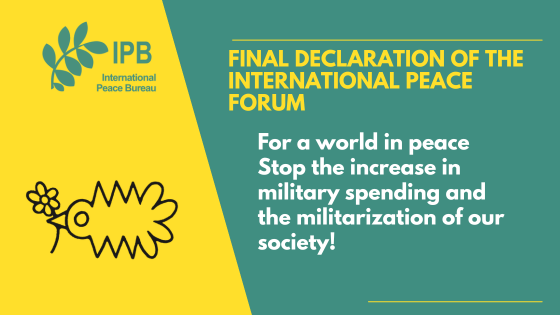
Final Declaration of the International Forum for Peace

For a world in peace

Stop the increase in military spending and the militarization of our society!

The world is at a crossroads. On the one hand, the world capitalist system, imperialism that insists on maintaining a unipolar order, anchored in centuries of colonial domination, with NATO acting as the military, political and ideological arm of that old and unjust international order. On the other side, there are the forces that seek to make way for a new multilateral order, committed to the principles of the UN, which is committed to peaceful coexistence, mutually beneficial cooperation, social progress and solidarity.

Continue reading “Final Declaration of the International Forum for Peace”

IPB Condemns U.S. Strikes on Iranian Nuclear Sites: An Illegal Escalation

Berlin, June 22, 2025

The International Peace Bureau (IPB) strongly condemns the United States’ recent military strikes on Iranian nuclear facilities at Fordow, Natanz, and Isfahan. Carried out in coordination with Israel, these attacks are a dangerous escalation that violates both international law and the U.S. Constitution—and brings the region closer to a devastating war.

Under international humanitarian law, nuclear facilities are protected due to the catastrophic risks they pose to civilians and the environment. Targeting them is inhuman and illegal. There is no credible evidence that Iran is currently pursuing nuclear weapons—U.S. intelligence has confirmed this repeatedly. Military action under these circumstances has no legal justification.

Domestically, the strikes also violate the U.S. Constitution, which grants Congress—not the President—the authority to declare war. Launching attacks without Congressional approval contradicts both the War Powers Resolution and the principles of democratic oversight.

This is more than a legal issue—it is a matter of global security. Attacking nuclear infrastructure risks the release of radioactive materials, retaliatory strikes, and rapid regional escalation. The consequences could be catastrophic—not just for Iran and the Middle East, but for the world. The USA and Iran should cease hostilities and return to serious, long-term negotiations.

NATO members must not follow a U.S. president who acts unlawfully, even within his own constitutional system. They have a responsibility to uphold international law and prevent escalation—not enable it. Silence or complicity only deepens the crisis.

There is no military solution to this crisis. IPB calls for an immediate end to all military operations, respect for international law, and return to diplomacy. Peace and common security can only be achieved through cooperation, not weapons.

Statements are available in English, French, and Russian. Check it below:

Statement in English

Statement:  Call for De-escalation in the India-Pakistan Military Standoff

9 May 2025

The International Peace Bureau (IPB) condemns the heinous attack in Pahalgam -Kashmir on 22 April, where 26 civilians lost their lives, as well as the retaliatory attacks which have killed civilians on both sides of the line of control and in Pakistan’s sovereign territory. IPB condoles with the victims’ families and friends. Terrorism of any kind from any source is unacceptable to civilized society and the international community condemns such acts.

IPB understands that at times of national grief there is a call for retribution. However, we believe that military standoffs escalate an already tense situation and can spiral into full scale wars with disastrous consequences for countries and peoples. These military conflicts destabilize entire regions, disturb the economy, and immiserate people. Once initiated armed conflicts can go on for a long time. Any confrontation between two nuclear-armed powers like India and Pakistan is a threat to the world – as outlined in publications like the 2019 Bulletin of Atomic Scientists’ How an India-Pakistan nuclear war could start – and have global consequences – and both these countries must heed the calls of the international community and cease military confrontations that can lead to a nuclear exchange.

The IPB appeals to both the governments of India and Pakistan to immediately halt all military confrontations, cease the spiral of retributions and return to calm. All indirectly involved states – including the United States, Russia, and China – must likewise call for de-escalation and diplomacy and reject provoking the conflict for their own interests where all are major arms suppliers. There is no substitute for bilateral and regional diplomacy, dialogue, and engagement. World history has repeatedly shown that common security is the most rational and sustainable way to both peace and development.

The IPB hopes that both the Governments of India and Pakistan resort to reason and de-escalate these tensions with immediacy.

[2025 GDAMS] Presidential candidates must present plans for building peace through dialogue and trust, not military expansion

South Korean Civil Society Joint Statement 

Presidential candidates must present plans for building peace through dialogue and trust, not military expansion

  1. Yoon Suk-yeol has been impeached. Throughout his term, Yoon — who advocated for “peace through strength” and designated Democratic People’s Republic of Korea as the “main enemy” — exploited the division system and heightened tensions on the Korean Peninsula for political gain, even at the risk of a localized conflict. Despite insufficient tax revenues, he increased defense spending and fixated on an endless cycle of confrontation. Meanwhile, peace vanished entirely, and the two Koreas spiraled into repeated cycles of hostility and standoffs. All dialogue channels were severed, and even the September 19 Military Agreement-which served as a safety pin to prevent armed clashes-was scrapped. Repeated psychological warfare and military drills near the border have severely endangered the peaceful survival rights of residents in those areas. Yoon Suk-yeol’s “peace through strength” policy has utterly failed.
Continue reading “[2025 GDAMS] Presidential candidates must present plans for building peace through dialogue and trust, not military expansion”

UNODA’s Statement on the Global Days of Action on Military Spending

Izumi Nakamitsu, High Representative for Disarmament Affairs, issued the following message on the occasion of the 2025 Global Days of Action on Military Spending. | 28 April 2025

Each year, the Global Days of Action on Military Spending serve as a stark reminder of the increasingly volatile and tense state of the world. They have become an unfortunate tradition to reflect on the implications of the worrying trajectory of military spending, rising levels of armed violence and increased suffering for many in all regions of the world.

Continue reading “UNODA’s Statement on the Global Days of Action on Military Spending”

Participation Summary: ECOSOC Youth Forum Side Event: “The Impact of the Global Increase in Military Expenditure on the Achievement of the Sustainable Development Goals (SDGs)”

By: Angelo Cardona, Board Member of the International Peace Bureau (IPB) and Co-founder and Co-president of the Iberoamerican Alliance for Peace (Alianza Iberoamericana por la Paz – AIPP)

I had the honor of participating in the ECOSOC Youth Forum’s side event titled “The Impact of the Global Increase in Military Expenditure on the Achievement of the Sustainable Development Goals (SDGs)”, representing the International Peace Bureau (IPB).

Continue reading “Participation Summary: ECOSOC Youth Forum Side Event: “The Impact of the Global Increase in Military Expenditure on the Achievement of the Sustainable Development Goals (SDGs)””

Statement on the 65th Anniversary of the First French Nuclear

Joint Statement on the 65th Anniversary of the First French Nuclear Test in the Algerian Sahara – February 13, 1960

We, the undersigned organizations, representing affected communities, indigenous peoples, advocates for nuclear disarmament, environmental protection, human rights, and peace, gather today to commemorate the 65th anniversary of the first French nuclear test conducted in the Algerian Sahara on February 13, 1960.

Continue reading “Statement on the 65th Anniversary of the First French Nuclear”

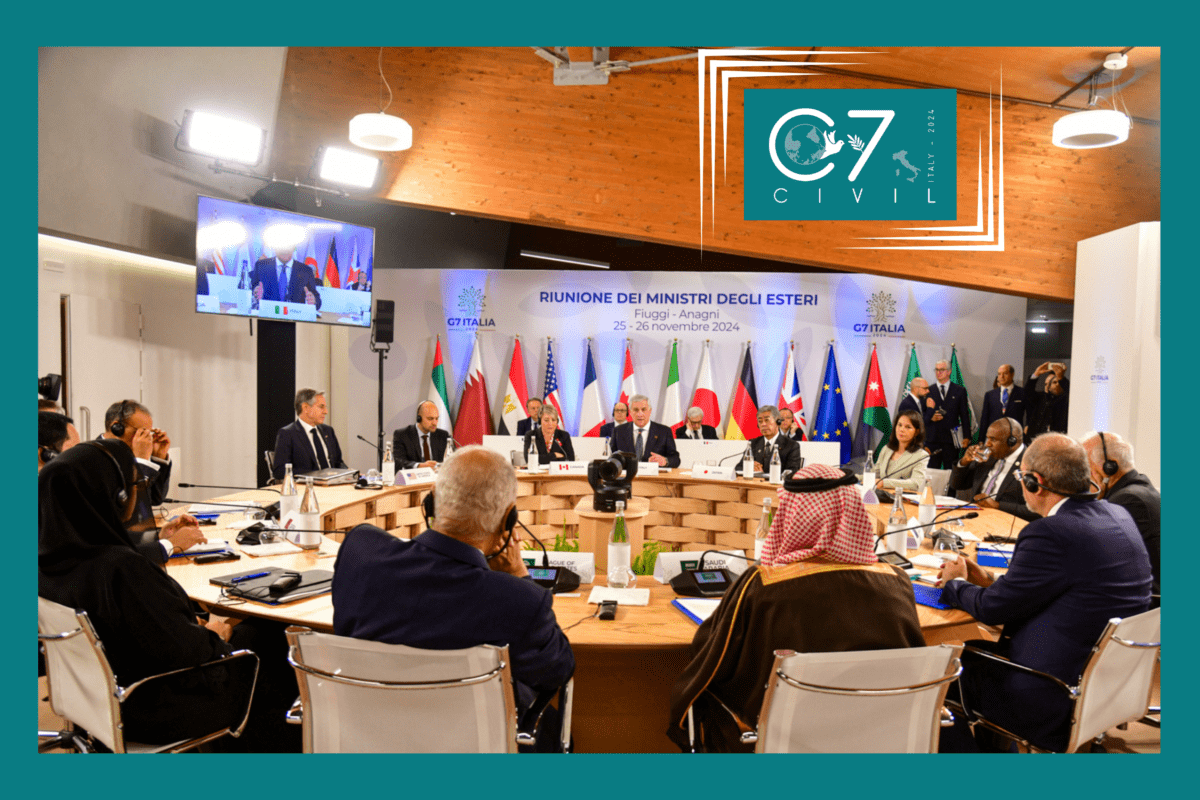
G7 Ministers’ Meeting on Foreign Affairs: The Civil7 Urges G7 for More Clarity and Action for Peace

Press Release by the Civil Society 7 – Original post available here.

Rome, 26 November 2024

The G7 Ministers Meeting of Foreign Affairs, hosted by Italy in the year of its presidency that is drawing to a close, concludes today in Fiuggi.

An increasingly confrontational and dangerous international context demands an unprecedented global effort to re-establish a multilateral system that promotes paths of peace and international law, not drifts toward more war. As the C7 has several times stated, the G7 can be part of the problem, if it unilaterally promotes the interests of the most developed economies, or part of the solution, if it defends human rights and the common interests of humanity and the planet.

The dramatic flagrant and unpunished violations of International Humanitarian Law lead to massive suffering of civilians. The G7 and other States should avoid such a silent complicity that enables the continued devastation of wars. They should instead respect and ensure respect for IHL and its principles of distinction, proportionality and precaution, condemning all violations of IHL by any actor in every conflict and war. We see a disturbing contradiction between the governments’ calls on peace and ceasefires and the transfer of weapons, parts, and ammunition to parties in conflicts.

We therefore reaffirm the need to strengthen and use the UN system of rules, asking the governments to adhere and engage all partners and allies in the international Treaties to prevent war and on disarmament, in respecting the UN Resolutions and to protect the UN institutions, including the particular case of UNRWA.

The fragility of global peace, the persistence of armed conflicts and the increased risk of nuclear weapons use requires the utmost urgency and concrete actions, that we don’t see yet. A stronger political commitment is needed to implement sustainable solutions to tackle critical structural and systemic challenges. We call for shifting the financial resources from military to diplomacy, human security and social expenditure to foster dialogue and fight the systemic causes of inequalities, poverty and vulnerabilities.

A stronger multilateral system, a shared commitment to protect human rights, a fair financial and economic systems are the preconditions for sustainable peace. Therefore, the C7 calls for the G7 countries to urgently take their responsibilities in this perspective for a more peaceful, just and secure future.

Civil7 Press Release

www.civil7.org

Original post available here

Contact: Dario Lo Scalzo, e-mail: communications@civil7.org  mobile: + 349 38 95 415