Statement of the Ukrainian Pacifist Movement: Defending Human Rights and Ending Lawlessness in Territorial Recruitment Centers (TCCs)

We support Ombudsman Dmytro Lubinets and his representative Andriy Kryuchkov in their resistance to the lawlessness of territorial recruitment centers (TCCs). We are concerned about the information attacks on the Ombudsman’s institution and the attempts by offending commanders to shift responsibility for their unlawful actions onto the human rights defenders who exposed them.

As a reminder, in April of this year, Lubinets finally acknowledged that TCC premises have effectively turned into places of detention without any legal grounds. He cited examples of the illegal detention of people in unsanitary and degrading conditions at the Uzhhorod District TCC for up to 50 days, the confiscation of documents and phones, and the deprivation of the right to legal aid and medical assistance. The photos and videos published by Lubinets shocked the nation.

Pacifists have many questions regarding formal brush-offs instead of human rights work by the Secretariat of the Commissioner and Lubinets personally in cases of brutal violations against conscientious objectors in general and our members in particular. We understand the pressure the Commissioner’s institution faces from the army and security service. We remember how he was summoned to the Ministry of Defense in 2024 and pressured not to insist on the unacceptability of legislation regarding tough mobilization that allowed systemic violations of fundamental rights.

However, it deserves respect and support that in some of the most egregious cases, the Commissioner and his representatives still dare to fight against gross and systemic human rights violations by the Armed Forces of Ukraine, or at least publicly tell the truth about terrible abuses, arbitrariness, inhumanity, legal nihilism, deaths, and severe injuries in TCCs.

The fact that after these illegalities are exposed, the perpetrators remain unpunished, investigations are formalistic, victims and human rights defenders face retaliation, and temporarily suspended officers return and continue in the same vein is utterly mind-boggling and demands louder public calls for reform.

We urge the General Staff of the Armed Forces of Ukraine and the Ministry of Defense to review mobilization approaches that are incompatible with Ukraine’s obligations under Articles 3, 5, and 9 of the European Convention on Human Rights, and to stop obstructing the implementation of alternative non-military service in Ukraine during wartime, in line with Ukraine’s EU accession commitments. Pacifists cannot be forced into becoming part of the system of industrialized mass murder that is war and the armies that wage it. Kidnapping and torture should have no place in a democratic state governed by the rule of law, even during wartime.

We can and must defend Ukraine through peaceful, lawful means.

References:

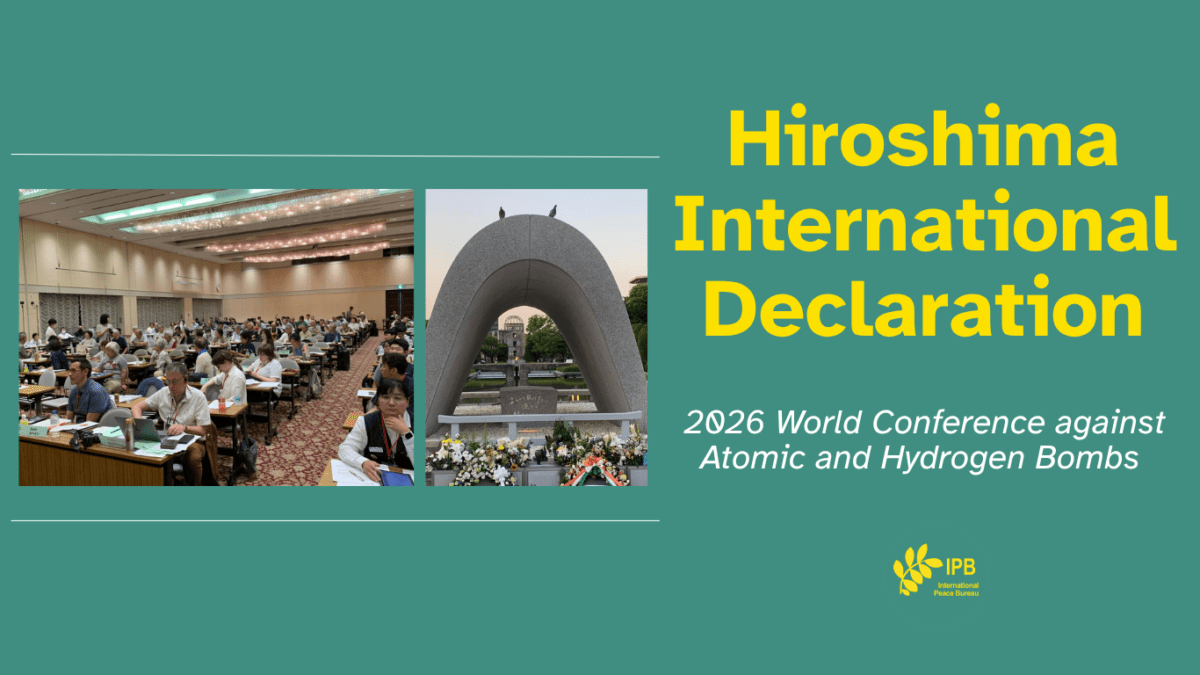
Hiroshima International Declaration

2026 World Conference against A and H Bombs

Declaration of International Meeting

The world now stands at a critical crossroads: between war and nuclear catastrophe on the one hand, and peace and the abolition of nuclear weapons on the other.

The use of force in violation of the Charter of the United Nations is absolutely unacceptable. The United States’ attack on Iran, Russia’s invasion of Ukraine, and Israel’s genocide in Gaza and military offensive to the West Bank must be brought to an immediate end. The nuclear-armed states, including the U.S., the United Kingdom, France, Russia and China, as well as their allies, such as NATO members and Japan, are further deepening their reliance on nuclear weapons, reigniting a nuclear arms race. Nuclear conflicts between India and Pakistan, as well as North Korea’s nuclear armament, are also serious issues. The use of force by nuclear-armed states and their allies increases the real danger of nuclear war.

Continue reading “Hiroshima International Declaration”

IPB Condemns Benin’s Cancellation of the World Social Forum and Repression of International Delegates

UPDATE August 6 – Beninese authorities have since reversed the cancellation. See more here.

The International Peace Bureau (IPB) expresses its deepest concern and regret with the sudden, unexpected, and undemocratic decision of the government of Benin to cancel the World Social Forum and to deny entry to international delegations and caravans. The last-minute decision to block the event, which expected tens of thousands of participants from across Africa and beyond, is yet another sign of the continued global trend of repression of civil society movements.

Continue reading “IPB Condemns Benin’s Cancellation of the World Social Forum and Repression of International Delegates”

Appeal to the German Government and the Parliament: Nuclear Disarmament Must Not Remain an Empty Promise!

30th Anniversary of the ICJ Advisory Opinion on the Illegality of Nuclear Weapons under International Law

Appeal and Press Release

Exactly thirty years ago – on 8 July 1996 – the International Court of Justice (ICJ) issued a landmark advisory opinion. Its key finding: the threat or use of nuclear weapons generally violates the rules of international humanitarian law.

‘The destructive power of nuclear weapons cannot be contained in either space or time. They have the potential to destroy all civilization and the entire ecosystem of the planet.’ (Paragraph 35)

Thus, the ICJ advisory opinion reminds us of what nuclear weapons are: weapons of mass destruction whose purpose is to kill millions of people in a very short space of time. They threaten us all, every day.

Continue reading “Appeal to the German Government and the Parliament: Nuclear Disarmament Must Not Remain an Empty Promise!”

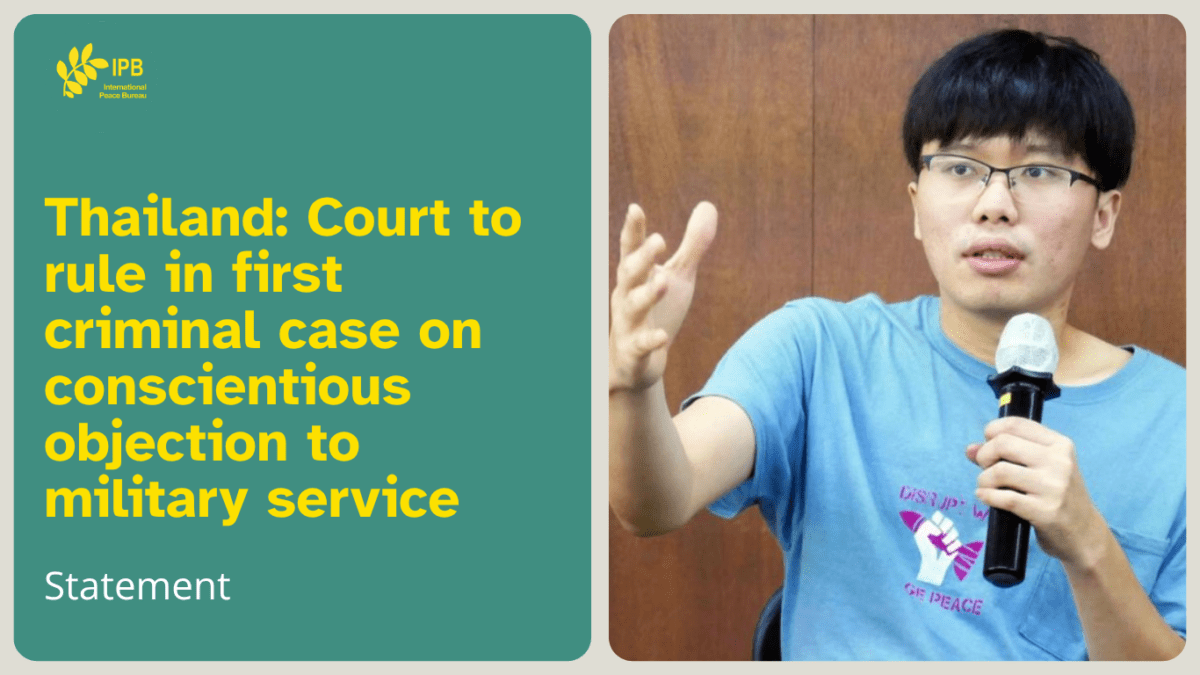
Thailand: Court to rule in first criminal case on conscientious objection to military service

On July 20, the Samut Prakan District Court will deliver its verdict in the case of Netiwit Chotiphatphaisal, Thailand’s first publicly declared conscientious objector to stand trial for refusing military conscription. If convicted under the 1954 Military Service Act, he will face up to three years in prison. Netiwit is a democracy and human rights activist, publisher, and organiser whose activism began in high school and who has publicly maintained this position for twelve years, culminating in this criminal trial.

On his eighteenth birthday, Netiwit declared he would not participate in military conscription. He did not disappear or seek quiet exemption. Every year, he reappeared before the authorities to say the same thing. On April 5, 2024, he went to the conscription centre in Samut Prakan’s Bang Pu district and read a manifesto of refusal, stating that all Thai citizens should have equal freedom to choose whether to serve, and that no one should be coerced into it, “as it is not beneficial to individuals or the nation.” He then declined to enter the lottery. He was charged under Section 45 of the Military Service Act.

During the trial, Netiwit’s lawyer asked the court to refer the question of whether the Military Service Act is constitutional or not to the Constitutional Court, marking the first time conscientious objection had been argued in this way. On May 12, 2026, the Constitutional Court ruled unanimously that the Act’s provisions do not violate constitutional protections of liberty and religious freedom. The criminal case resumed on that basis, and the verdict now falls on July 20.

Continue reading “Thailand: Court to rule in first criminal case on conscientious objection to military service”

Solidarity with Turkish Anti-War and Human Rights Activists

9 July 2026 | By: Stop Rearm Europe (SRE)

*The International Peace Bureau is a member of the SRE.

We stand in solidarity with the activists, journalists, lawyers, and human rights defenders being detained and silenced across Türkiye ahead of the 36th NATO Summit, taking place in Ankara on July 6th and 7th 2026. In the last weeks, Turkish authorities have been systematically targeting anti-war, anti-imperialist and human rights activists. 

The Ankara Governor’s Office announced a ban on the collective use of public spaces between June 28th and July 10th. As a result, planned protests and events such as the Anti-NATO Peace Conference had to be cancelled or moved online. 

Moreover, last week police carried out early morning raids across Ankara, arresting more than 200 people. Authorities stated the operation targeted suspected members of armed groups. However, those detained included LGBTQI+, women, and feminist rights defenders, as well as lawyers, academics, revolutionary youth, labour union representatives, and human rights activists. Around 100 people remain in pretrial detention. 

The Turkish Journalists’ Association has also reported that journalists from news organisations seen as opposition-leaning or independent have been excluded from covering the NATO Summit, with no explanation given.

Together, these measures show how the rights to peaceful assembly and demonstration, as well as press freedom are being suspended in Türkiye, and how the exercise of democratic rights is being restricted. Carried out under the guise of security concerns, this repression is yet another example of the domestic face of militarisation.

The targeting of activists opposing the war machine in Türkiye is not an isolated case. Governments across the world are using intimidation and criminalisation to suppress dissent. Striking examples in Europe include the United Kingdom and Germany, where activists taking direct action against weapons companies are facing unprecedented trials and charges for terrorism. These cases show a pattern: the same forces driving militarisation are criminalising those who resist it. International solidarity is therefore fundamental in the struggle against militarisation. 

Since the 2025 The Hague Summit, NATO is forcing its member states to increase military spending by 5% of their GDPs, a threshold that has come to be known as the “Trump 5% norm”, following months of pressure by the U.S. President to push members toward the figure. NATO’s nature as an institution promoting war and militarisation has thereby become clear once again. 

Similarly, EU institutions are promoting increased investment and spending towards militarised security, from the proposed €131 billion for “defence, security and space” in the new Multiannual Financial Framework, to the €800 billion ReArm Europe plan, financed primarily through national-level debt. However, the notion that increased military budgets make us safer is an illusion: deterrence has never prevented escalation. More military spending will only deepen our social, environmental and political problems:

  • It diverts resources from healthcare, education, climate action, and welfare
  • It erodes workers’ rights
  • It fuels arms races which in turn lead to more conflicts and violence, human rights violations, and displacement

This is why it is so urgent to collectively oppose the plans to ReArm Europe, the new EU Multiannual Financial Framework proposal allocating €131 billion to military spending, and all military alliances, including NATO. 

The struggle against militarisation and war can only be won when we stand in solidarity with each other. We call for:

  • The immediate release of all those detained in Türkiye, 
  • An end to the criminalisation of anti-war activism everywhere,
  • Collective resistance to NATO and the plans to ReArm Europe. 

As leaders in Ankara are gathering to prepare for war, activists are preparing for peace. We support the organisers of the Istanbul Anti-imperalist Peace Summit that took place on July 4th and  the Anti-NATO Peace Conference (online) on July 5, 2026.
IPB Statement on the Detention and Deportation of Executive Director Sean Conner and other Activists in Istanbul on 3 July 2026

Monday, 6 July 2026

The International Peace Bureau (IPB) unequivocally condemns the detention and deportation of its Executive Director, Sean Conner, alongside other activists from Germany, Finland, and Italy. Upon arrival at Istanbul’s Sabiha Gökçen International Airport at 17:27 local time on Friday, 3 July, Sean had his passport and cell phone confiscated and was subjected to two hours of interrogation, including scans of his fingerprints and mugshot photographs. Turkish authorities repeatedly lied about the reasons for the interrogation and claimed that the reason for the check was a flagging by the German authorities, who denied any involvement.

Continue reading “IPB Statement on the Detention and Deportation of Executive Director Sean Conner and other Activists in Istanbul on 3 July 2026”

On June 26, Civil Society Stands with Victims of Torture

Press Release

ST. PAUL, Minn. — To honor the United Nations International Day in Support of Victims of Torture, 120 civil society organizations joined together in a statement of solidarity with survivors. As the world commemorates this date, the authors call upon the United States and global leaders to uphold their obligations under the Convention Against Torture to support survivors, ensure accountability, and reject inhumane and cruel practices.

Continue reading “On June 26, Civil Society Stands with Victims of Torture”

Civil Society Statement on International Day in Support of Victims of Torture – June 26 

On this International Day in Support of Victims of Torture, we stand in solidarity with survivors worldwide and sound the alarm about policies and actions that threaten the legal protections and weaken human rights mechanisms created to prevent and punish acts of torture and abuse. 

Continue reading “Civil Society Statement on International Day in Support of Victims of Torture – June 26 “

Open Letter: “Security for Whom?”

Civil society organisations from across the spectrum urge EU decision-makers to reject the military budget surge and invest in human security instead

Europe faces a choice: fund militarisation or invest in people. Ahead of crucial EU budget negotiations, civil society organisations call on leaders to prioritise health, housing, education, climate action and peacebuilding over a proposed €131 billion surge in defence spending.

Open Letter initiated by TNI, ENAAT, Stop ReArm Europe 

Click here to open and download the letter: “Security for Whom?” Civil society organisations from across the spectrum urge EU decision-makers to reject the military budget surge and invest in human security instead

A slightly adapted version of this letter will be sent to Members of the European Parliament at a later stage. It is still open to signatures from civil society groups and organisations. If your group or organisation wants to sign on, please contact j.solanki[@]tni.org. You can also read the letter here.

Continue reading “Open Letter: “Security for Whom?””
Support Peace Worldwide
Your donation helps advance peace, disarmament, and justice through advocacy, education, and global collaboration.