Welfare not Warfare | Rally In Brussels on 14 June & Month Of Decentralized Action Across Europe!

Organized and coordinated by the Stop Militarization Platform and StopRearmEurope campaign, of which IPB is a member.
If you haven’t already, sign our call to action here and join the European movement against ReArm Europe!

Continue reading “Welfare not Warfare | Rally In Brussels on 14 June & Month Of Decentralized Action Across Europe!”

Stop Using Drone Warfare to Perpetrate Genocides in Palestine and Sudan

May 9, 2026 | Post-event Recording

This webinar examines the problem of drone warfare and possible solutions. A panel of speakers is followed by Q&A.

You are currently viewing a placeholder content from YouTube. To access the actual content, click the button below. Please note that doing so will share data with third-party providers.

More Information

Sponsored by

  • Global Solidarity for Peace in Palestine
  • International Fellowship of Reconciliation
  • International Peace Bureau
  • Pax Christi International
  • Veterans For Peace
  • Weaponized Drone Ban Treaty Campaign
  • World BEYOND War
Continue reading “Stop Using Drone Warfare to Perpetrate Genocides in Palestine and Sudan”

Tectonic Geopolitical Changes: Which Way to Peace and A Nuclear Weapon-Free World

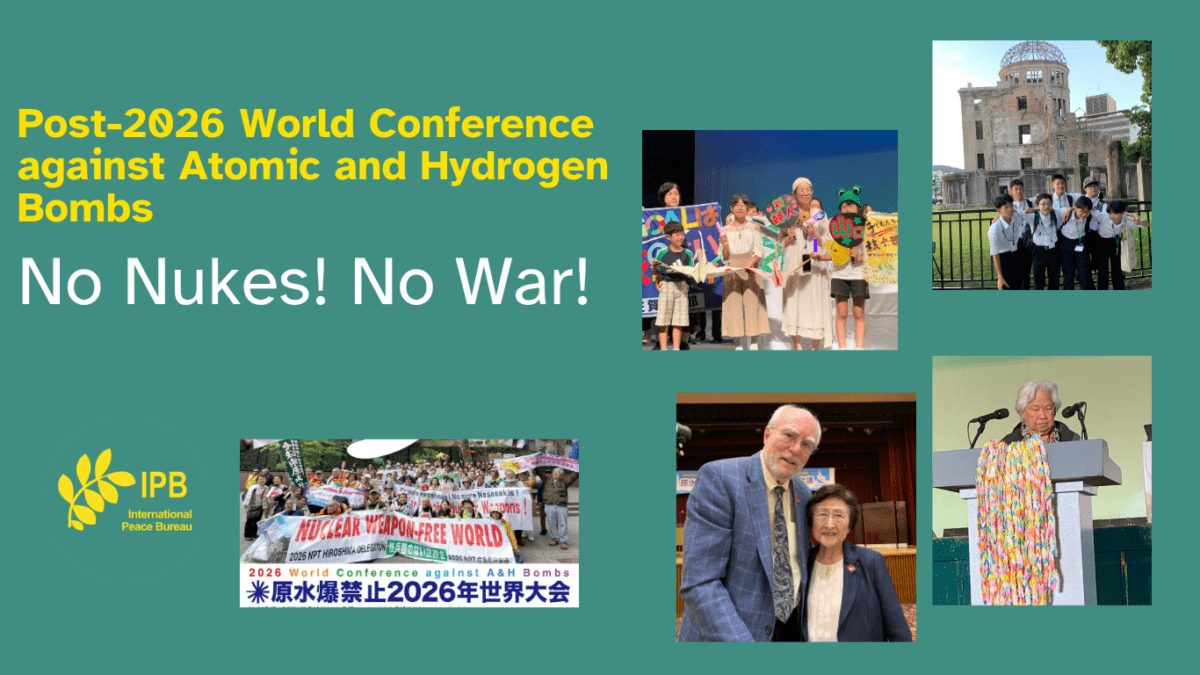
On the Eve of the NPT Review Conference International Civil Society Demands an End to Wars & a Nuclear Weapons-Free World

At a time when the Bulletin of the Atomic Scientists’ Doomsday Clock had been set to 85 seconds to midnight—the closest ever to global catastrophe—and when the viability of the Nuclear Non-Proliferation Treaty (NPT) was under increasing strain, an international coalition of nuclear disarmament and peace organizations gathered on the eve of the 11th NPT Review Conference. The moment reflected what Antonio Gramsci described as a “time of monsters,” in which the old world is dying and the new struggles to be born.

Continue reading “Tectonic Geopolitical Changes: Which Way to Peace and A Nuclear Weapon-Free World”

Save the dates for GDAMS 2026:April 10 to May 9

From Gaza, Sudan and the Democratic Republic of Congo, to Ukraine, Venezuela and Iran, levels of violence, civilian suffering, and violations of international law have reached heinous heights, including the perpetration of genocide.

This surge in conflict is not accidental or inescapable, it reflects a broader resurgence of imperialism and militarization, spearheaded by the US, in which brute force, military might and coercion have become dominant tools of international relations. Powerful states and regional actors continue to wage and fuel wars – not only through direct intervention but also through extensive arms transfers, strategic alliances and geopolitical competition – prioritizing narrow interests over human security and peace.

Continue reading “Save the dates for GDAMS 2026:April 10 to May 9”

Appeal for a Christmastime Peace in Ukraine

As Christmas approaches, the war in Ukraine is still ongoing after nearly four years, with countless lives lost, cities destroyed and grave consequences for the environment. Despite ongoing diplomatic efforts to resolve the war, there are still no signs of a breakthrough. Recent calls for a Christmas ceasefire from Zelenskyy and German Chancellor Friedrich Merz represent a renewed opportunity for an important first step towards peace – a new Christmas Ceasefire. Similar proposals have been made in past years, including by Russia in 2023, without success. 

Continue reading “Appeal for a Christmastime Peace in Ukraine”

IPB Statement Condemning US Escalation against Venezuela

18 December 2025, Berlin, Germany

The International Peace Bureau (IPB) firmly condemns the continued escalation of the US military in the Caribbean against Venezuela, in particular the recently announced “total and complete blockade” of oil tankers leaving and entering the country which is an act of war. Following the recent seizure of a Venezuelan oil tanker, the Trump administration in the US has laid bare their true intentions in the region, which consistently undermine international law and human rights in the interest of US imperialism and domination. 

Continue reading “IPB Statement Condemning US Escalation against Venezuela”

IPB Calls for De-escalation and Dialogue between Japan and China

16 December 2025 | Berlin, Germany

The International Peace Bureau (IPB) expresses deep concern over the growing diplomatic rift between Japan and China, which has escalated in recent weeks with joint Chinese and Russian drills with strategic bombers and fighters and more recently US nuclear-capable bombers accompanying Japanese fighter jets over the Sea of Japan. Japan and China have accused one another of aggressive militaristic behavior including targeting the other with radars. 

Continue reading “IPB Calls for De-escalation and Dialogue between Japan and China”

IPB Calls on Cambodia and Thailand to Urgently Implement a Ceasefire Deal

10 December 2025, Berlin, Germany

The International Peace Bureau (IPB) strongly calls for the immediate implementation of the Kuala Lumpur Peace Accord signed on October 26, 2025, and urges both Thailand and Cambodia to exercise maximum restraint. With field-level tensions rising and initial ceasefire breaches reported, we call on ASEAN, the United Nations, and all regional stakeholders to actively support mediation efforts and engage constructively to prevent further escalation.

Continue reading “IPB Calls on Cambodia and Thailand to Urgently Implement a Ceasefire Deal”

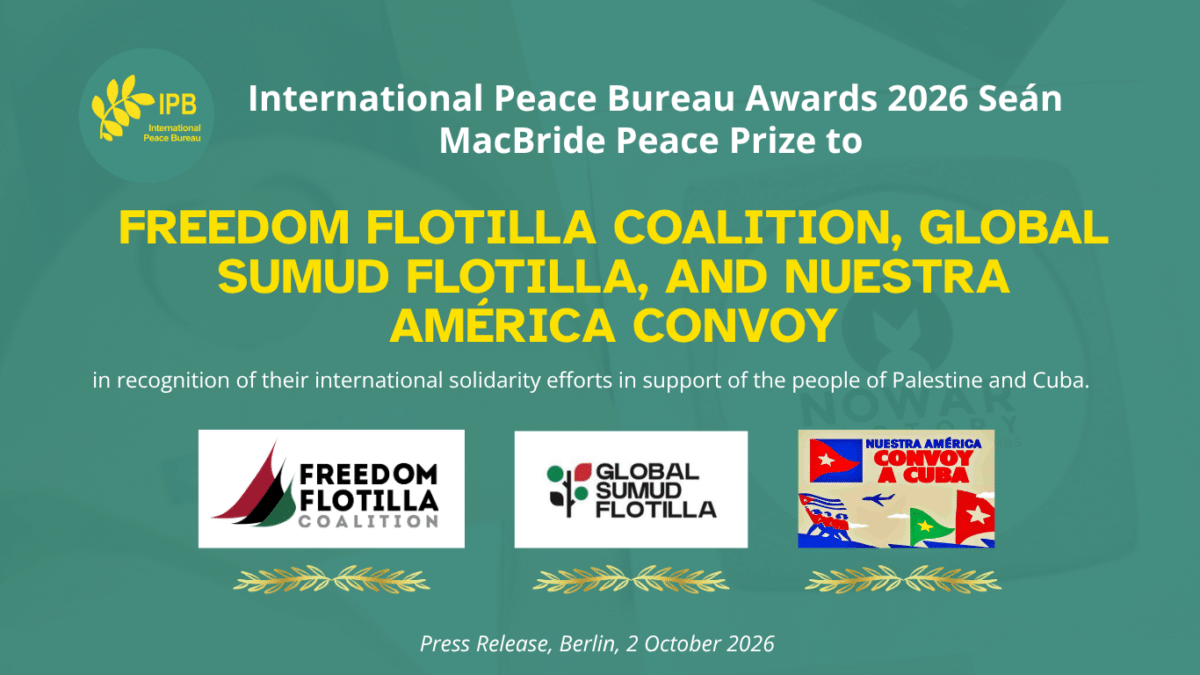
2025 Seán MacBride Peace Prize: A recognition of individual efforts towards peace and justice

21 November 2025, Berlin, Germany

The Seán MacBride Peace Prize, named after the Nobel Peace Laureate and IPB co-founder Seán MacBride, honors individuals and organizations who conduct outstanding work for peace, disarmament, and human rights.

Continue reading “2025 Seán MacBride Peace Prize: A recognition of individual efforts towards peace and justice”

4Days4Peace in Barcelona

4Days4Peace – Barcelona, October 23–26, 2025
Organized by the International Peace Bureau (IPB) and the Centre Delàs d’Estudis per la Pau

From October 23 to 26, 2025, Barcelona hosted 4 Days 4 Peace, a series of events co-organized by the Centre Delàs d’Estudis per la Pau and the International Peace Bureau (IPB), with the support of the Barcelona City Council. The gathering brought together peace builders, researchers, and activists from various fields around the world to exchange perspectives, coordinate strategies, and strengthen the global movement for peace and disarmament.

The event opened on Thursday, October 23, with the Centre Delàs Annual Conference 2025, titled Darkest before dawn. Pacifism in times of genocide and rearmament.” Held at Sala Sandaru, the conference reflected on two years of genocide in Gaza, Western complicity, and the growing normalization of militarism. Participants called for non-violence and alternatives to the policies of rearmament and authoritarianism.

Read more: 4Days4Peace in Barcelona

The conference featured two main sessions: a dialogue on “Business and Complicity in the Genocide and Occupation of Palestine” with Shir Hever and Maha Abdallah, moderated by Laura Ferre Sanjuan (recording available on YouTube here); and a roundtable on “Rising Militarism and Power Politics in the International Arena” with Katerina Anastasiou, Joseph Gerson, and Corazon Valdez Fabros, moderated by Antonella Di Matteo (recording available on YouTube here).

On Friday, October 24, participants took part in workshops and strategy sessions organized around four thematic areas:

  1. Global Disarmament and Militarization – the risks of global rearmament and the need for civil society–led disarmament initiatives was addressed. Topics such as the impact of militarization on austerity policies and public welfare, the diversion of resources from social, environmental and next-generation programs, and ethical concerns related to war and genocide where discussed. Initiatives such as GDAMS, StopRearmEurope, the No to NATO network, the 10% for All campaign agreed to build synergies between the campaigns for stronger collective impact and proposed setting a common global mobilization date to unify efforts and increase visibility.
  2. Geopolitical Shifts and Global Governance Reform – how to strengthen international law, multilateralism, and the UN system to respond to current crises was explored. Proposed future visions included decentralizing global power structures, democratizing global institutions, reforming the UN system and redefining the notion of security. For each of these proposals, the role of IPB was discussed, highlighting the importance of focusing on areas of greatest impact like using IPB’s network to promote peace education, advocacy, and mobilization, facilitating dialogues around Common Security to review and revitalize the concept regionally, strengthening cross-movement cooperation and functioning as a knowledge exchange hub where alternative assessment reports are elaborated, deepening IPB’s distinctive voice.
  3. Solidarity with Palestine and Peoples Impacted by Militarism Worldwide – coordinating civil society action in solidarity with affected communities in Palestine, Sudan, DRC, Cameroon, Myanmar, and Ukraine was the focus of the workshop. Solidarity platforms, webinars, conferences linking movements across regions, workshops integrating different analyses and investigative journalism efforts exposing violations of human rights were highlighted as examples of current strategic actions. Looking forward, it was suggested that solidarity strategies are framed by decolonial and justice-based lenses that prioritize the following: ensuring solidarity is interactive and grounded in local realities, strengthening the promotion of democratic and peace-oriented initiatives and broadening anti-imperialist analysis, among others.
  4. Stronger Together: Linking Peace, Climate, Social, and Gender Justice – examining the interconnected nature of the conflicts and global issues we are facing today. Participants highlighted the need to give space to underrepresented voices, bridge generational and regional divides, and remain mindful of power dynamics that can replicate forms of oppression even within peace movements; they also highlighted the gap between state and human security – noting that as the former expands, the latter often declines – and called for peace work rooted in people’s daily realities. Concrete examples included cooperation between U.S. and Russian students through joint photography projects, union engagement for peaceful redistribution and workplace democracy, and cross-movement trust-building between peace and environmental activists. The Helsinki+50 process was recognized as an opportunity to foster East–West and North–South dialogue. The session concluded with a proposal to organize joint actions around Earth Day (April 26). 

The weekend of October 25–26 was dedicated to the Triennial Meeting and General Assembly of the International Peace Bureau (IPB), the organization’s highest decision-making body. The event brought together 19 Board and Council members in person from the different regions in the world and 16 Board and Council members online, along with several individual members and external observers who joined both onsite and remotely—bringing the total to over 50 participants. Representatives of member organizations and partner networks engaged in formal and informal discussions, reviewed the progress made since the last Annual Council Meeting in 2024 and the last Triennial in 2022, and contributed to shaping IPB’s strategic direction for the coming years.

During the meeting, 19 new organizational members that had applied in 2025 were formally approved, expanding IPB’s global network to a total of more than 400 organizational members and 450 individual members.

Moreover, the 2025 Annual Report of IPB Activities 2024-2025 was presented:

In addition, five resolutions were adopted:

  1. Global Governance Reform in a Shifting Geopolitical Landscape
  2. Building a Common Movement through Cross-Movement Collaboration during Overlapping Crises
  3. The Urgency of Disarmament Revitalization
  4. Digitalizing IPB’s Data Management and Expanding Communication Platforms and Budget
  5. Development of an Advisory Group

The Assembly also approved the financial report for the previous year and adopted the 2026 budget.

4 Days 4 Peace reaffirmed the commitment of IPB and Centre Delàs, as well as all the other participants, to challenge militarization, promote common security, and strengthen solidarity among global peace movements working toward a just and sustainable future.