Translation notice: This is an English translation of the original article published by the Italian Peace and Disarmament Network.
Italian citizens who are eligible to vote can support this citizens’ initiative by signing it online through the official Ministry of Justice portal using SPID or an Electronic Identity Card (CIE). Find out how to sign.
You can sign this citizens’ initiative here: https://firmereferendum.giustizia.it/referendum/open/dettaglio-open/6100008
Coordinamento Campagne Rete Italiana Pace e Disarmo
September 14, 2026
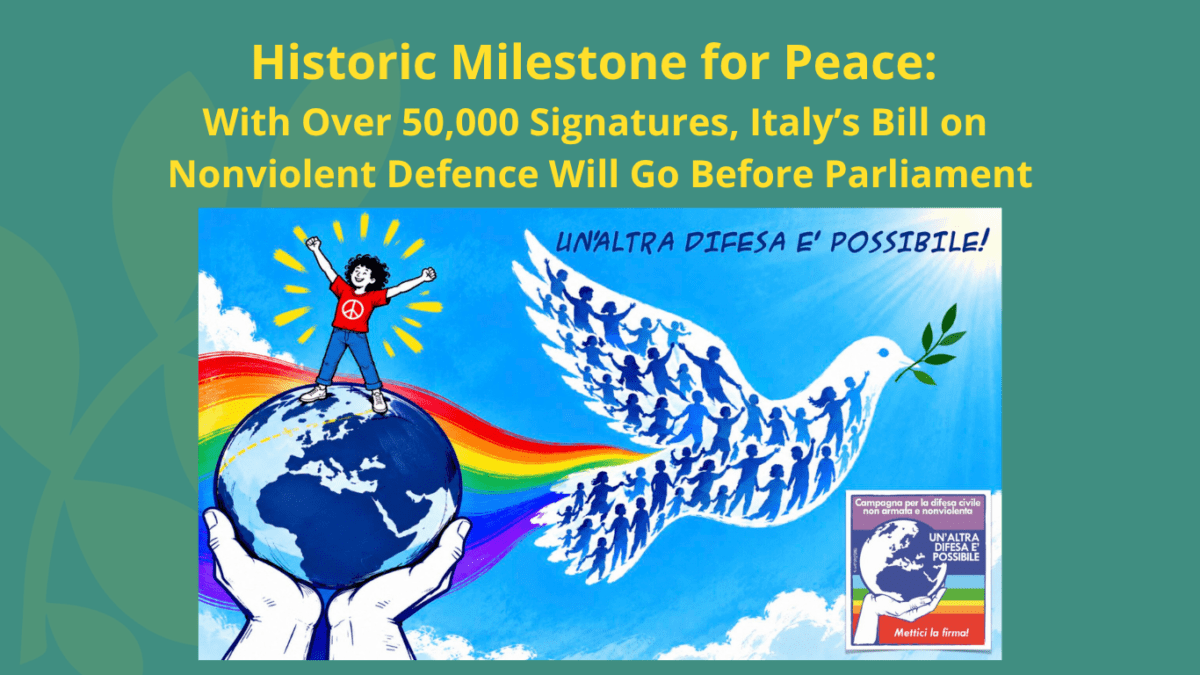
A crucial turning point for the peace and nonviolence movement: yesterday, the “Another Defence Is Possible” campaign surpassed the 50,000 signatures required to submit its citizens’ initiative bill on unarmed and nonviolent civil defence. Signature collection will continue until 18 September and must be supported right up to the deadline: every additional signature strengthens the bill. In the coming days, the signatures will be formally submitted to the Senate, setting the parliamentary process in motion.
We did it. The “Another Defence Is Possible” campaign has reached its target of 50,000 signatures, the number required to bring before Parliament the citizens’ initiative bill establishing a Department for Unarmed and Nonviolent Civil Defence. This milestone was achieved thanks to a collective mobilisation and an extraordinary surge in signatures during the final days of the campaign.
This is a crucial, momentous and historic result. For the first time, a concrete and comprehensive proposal to build an alternative to armed defence—based on conflict prevention, mediation, grassroots diplomacy and cooperation—can be considered by Parliament, giving full effect to Articles 11 and 52 of the Italian Constitution.
Signature collection, however, is not over: the campaign officially confirms that the proposal can still be signed up to and including 18 September (until 11:59 p.m.). In the coming days, the promoting networks will formally submit the signatures. This will also provide an opportunity to assess the campaign’s collective journey and outline the “next steps”. Going well beyond the 50,000-signature threshold is important, because no additional signature is superfluous: the higher the total, the stronger the political mandate and the greater the weight of the proposal when it is debated in Parliament. Broad popular support makes it harder to ignore or set the issue aside and can demonstrate that the proposal for unarmed and nonviolent civil defence has deep roots in society. For this reason, the appeal to sign and encourage others to sign during these final five days remains more vital than ever.
This is a fundamental and transformative issue, which the more than 50,000 signatures collected have placed firmly on the political agenda, including in the run-up to 2027. This achievement gives the campaign and the entire peace movement a practical tool for bringing nonviolent civil defence into public and institutional debate. With the 2027 elections on the horizon, the proposal will be a test on which political forces will be called to take a stand: choosing to allocate resources to conflict prevention, mediation and cooperation, rather than solely to increasing military expenditure, is a fundamental choice concerning the country’s future.
This achievement—an overwhelmingly positive one—belongs to an enormously broad community. First and foremost, thanks go to grassroots organisations and the dozens of local coordinating groups that supported the campaign, as well as to everyone who made space for the proposal at countless events, festivals and camps. Thanks also go to third-sector organisations, civil service bodies and NGOs that supported the initiative; to the dozens of municipalities, mayors and local councillors who adopted resolutions in support of nonviolent popular defence and Civil Peace Corps; and to parishes, community centres, local committees and all the organisations that opened their doors to dialogue. Recognition is also due to those media professionals who showed the sensitivity and curiosity needed to give the campaign a voice, and to the many individual citizens who helped circulate its message and encouraged others to sign, whether through personal conversations or on social media.
It is important to remember that the opening months were the most difficult. Even raising awareness of the existence of the “Another Defence Is Possible” campaign was no easy task, partly because much of the mainstream media devoted so little space to the issue. If today we can celebrate the wave of signatures received in the final days, it is because the patient, widespread work carried out by hundreds of activists and organisations—often out of the public eye—laid the groundwork: the signatures gathered in such a short period are the fruit of months of persistent, decentralised commitment. The promoting organisations extend their deepest gratitude to everyone involved.
Statements from the promoting networks
“The bill on unarmed and nonviolent civil defence enters Parliament backed by the strength of a grassroots mobilisation that saw an extraordinary surge in its final days—a collective determination to support institutions for peace, disarmament and nonviolence. The goal now is to place the idea of another form of defence firmly on the political agenda and at the heart of the national debate, redirecting public funds from preparing for war to building peace. We thank all the voters who added their signatures; the activists who built support in their local communities; the public figures from the arts, culture, science, politics and the media who lent their names and faces to the campaign; the associations, clubs, parishes and groups that mobilised; and every person who, through word of mouth or social media, helped fill the information vacuum surrounding our campaign.”
Mao Valpiana, President of the Nonviolent Movement and coordinator of the “Another Defence Is Possible” campaign
“Reaching 50,000 signatures for unarmed defence—despite the media’s silence about this initiative over recent months—is a major achievement. It demonstrates the widespread opposition in our country to war and military expenditure. We now expect Parliament, instead of adopting further rearmament measures, to debate the bill and respond to the demand rising from citizens: an unarmed form of defence that contributes to building peace.”
Giulio Marcon, Co-spokesperson for Sbilanciamoci!
“At this moment in history, when war is increasingly normalised, society is being militarised and the arms race is presented as the only way to guarantee security, the fact that so many people chose to sign this citizens’ initiative bill sends an extraordinary signal. It is a powerful call for a change of perspective in how we understand defence and how we build genuine peace policies. For the Civil Service system, the implementation of this law would make it possible to enhance and renew the institution’s purpose—the unarmed and nonviolent civil defence of the country—in coordination with the Fire and Rescue Service, Civil Protection and the Civil Peace Corps. Through the proposed Peace and Disarmament Research Institute and the allocation of six per thousand of personal income tax, it would also finally allow us to build a defence system based on civilian, unarmed and nonviolent means, equal to the challenges of our time.”
Laura Milani, President of CNESC (National Conference of Civil Service Organisations)
“We are ready to engage with Parliament and public opinion on the model of defence our country needs. Backed by more than 50,000 signatures, our citizens’ initiative bill for civil, unarmed, popular and nonviolent defence reaches Parliament before the much-heralded ‘Crosetto reform’ of the national military apparatus. While militarism is demonstrating its failure on every front—incapable of resolving conflicts or providing security for peoples—the peace movement is proposing a genuine defence of our society and democracy, faithful to the principles enshrined in Articles 11 and 52 of the Constitution. This broad and united alliance, which has made nonviolence and disarmament its political manifesto, is an important resource for our democracy. At a time when rearmament is being passed off as the only response to a ‘world war fought piecemeal’, writing a different page was no easy task. Yet we have written it, and for us it is the first step in the right direction.”
Alfio Nicotra, Executive Coordinator of the Italian Peace and Disarmament Network

What the proposed law calls for
The bill presented by “Another Defence Is Possible”—a campaign promoted by the National Conference of Civil Service Organisations, Sbilanciamoci! and the Italian Peace and Disarmament Network—would establish a department within the Presidency of the Council of Ministers, bringing together instruments that already exist under Italian law—the Universal Civil Service, Civil Protection and Civil Peace Corps—under a single prevention-oriented strategy. It would also establish a Peace and Disarmament Research Institute and a dedicated national fund, financed in part through proceeds from an optional allocation of six per thousand of personal income tax (IRPEF). It is a constitutionally grounded response based on a simple principle: we must stop funding war and finally begin preparing for peace through means consistent with that goal.
At a time of rising military expenditure and multiplying threats of war, the campaign has shown that security can be discussed in a different way—and that another form of defence, one that is civil, unarmed and nonviolent, is genuinely possible.