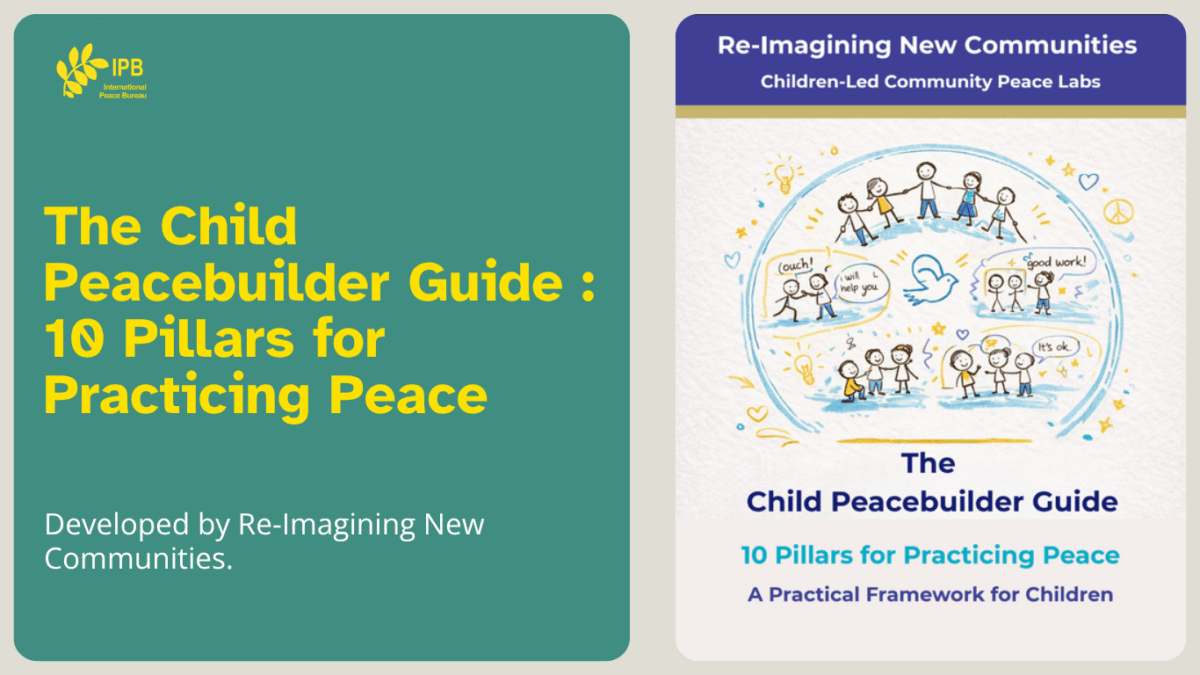
The Child Peacebuilder Guide : 10 Pillars for Practicing Peace

Developed by Re-Imagining New Communities. Inspired by children
participating in Children-Led Community Peace Labs ( CLCP-Labs) by
Sahlim Charles

Think about it. Whenever you type the term “Peace Processes” into a
search engine, what appears are images of high-level negotiations in
conference halls, policy forums, diplomatic roundtables and often
military presence in fragile contexts. This is not accidental; these
images reflect how peace is commonly framed and understood in
global discourse. Peace is often portrayed as elite, institutional and
distant from everyday life.

Yet in the everyday life of a schoolyard, a church/ temple/ shrine/
mosque, or a neighborhood, children are already practicing peace in
ways that are immediate, relational and deeply transformative. When a
child says “I will help you,” “I am sorry,” or “Come, let’s do this together,”
they are not merely behaving well, they are exercising leadership. Theseacts by children remind the global community that peace is not
abstract. It is built in daily interactions, small choices, and shared
responsibility.

Continue reading “The Child Peacebuilder Guide : 10 Pillars for Practicing Peace”

Peace Wave 2026

The Fifth Annual 24-Hour Peace Wave remains a 24-hour-long Zoom featuring peace actions in the streets and squares of the world, moving around the globe with the sun. But participants will have until November 1, 2026, to submit videos of peace activism, filmed at any time in the first 10 months of 2026.

We will then compile the videos into 24 videos of 40 minutes each. We will then announce the date of a Zoom webinar that will have 40 minutes of video and 20 of introduction and live discussion (including your questions) every hour for 24 hours.

Organized by: International Peace Bureau, World BEYOND War, and Stop the War Coalition Philippines.

New Zealand: Military spending prioritised in Budget 2026

By: Peace Movement Aotearoa

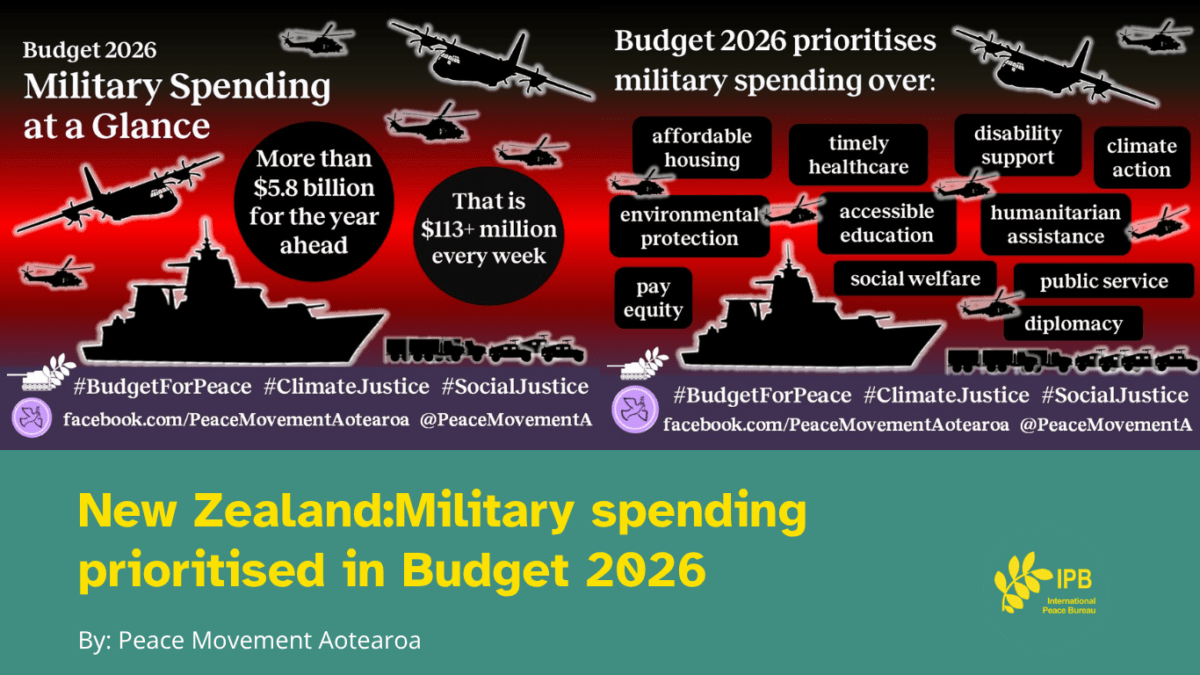
Military spending is prioritised again in this year’s Budget as New Zealand continues to pursue a range of militaristic fantasies as it seeks to be a combat capable “force multiplier” with “enhanced lethality and deterrent effect”.

Amidst cuts to public services to eliminate “wasteful spending”, the rapidly escalating climate emergency and the desperate need for more funding for failing social services, military spending allocated this year increased to $5,882,661,000 [1] – an increase of more than 9.3% over actual military spending in the past financial year, which averages out to more than $113.1 million every week. This once more illustrates a government stuck in the same old thinking about ‘security’, choosing to focus on an outdated narrow concept of military security rather than real security that gives all New Zealanders the chance to flourish.

Continue reading “New Zealand: Military spending prioritised in Budget 2026”

Stop Using Drone Warfare to Perpetrate Genocides in Palestine and Sudan

May 9, 2026 | Post-event Recording

This webinar examines the problem of drone warfare and possible solutions. A panel of speakers is followed by Q&A.

You are currently viewing a placeholder content from YouTube. To access the actual content, click the button below. Please note that doing so will share data with third-party providers.

More Information

Sponsored by

  • Global Solidarity for Peace in Palestine
  • International Fellowship of Reconciliation
  • International Peace Bureau
  • Pax Christi International
  • Veterans For Peace
  • Weaponized Drone Ban Treaty Campaign
  • World BEYOND War
Continue reading “Stop Using Drone Warfare to Perpetrate Genocides in Palestine and Sudan”

Statement of Dr. Enkhsaikhan of Blue Banner at  the Non-Proliferation of Nuclear Weapons Review Conference (NPT Revcon) side event on Nuclear-Weapon-Free Zones (NWFZs)

United Nations, New York, 6 May, 2026

Enkhsaikhan Jargalsaikhan

I will briefly touch upon 2 issues: first, on Mongolia’s policy to establish a single-State nuclear-weapon-free zones (NWFZs) and second, in doing so how to contribute to broadening the role, breadth and reach of zones.  

The first issue. Directly connected with its cold war lesson. Situated between two adversarial nuclear weapon states at that time and hosting military bases of one of them Mongolia turned itself into a nuclear target. Therefore, when Russia was withdrawing its bases it declared the country NWFZ and had committed to work to acquire nuclear-weapon states’ (P5) security guarantees. Since 1998 the issue is on the Assembly’s biennial agenda. The Mongolian Government had issued a number of official memoranda on the issue, the latest for current NPT Revcon.

Continue reading “Statement of Dr. Enkhsaikhan of Blue Banner at  the Non-Proliferation of Nuclear Weapons Review Conference (NPT Revcon) side event on Nuclear-Weapon-Free Zones (NWFZs)”

Tectonic Geopolitical Changes: Which Way to Peace and A Nuclear Weapon-Free World

On the Eve of the NPT Review Conference International Civil Society Demands an End to Wars & a Nuclear Weapons-Free World

At a time when the Bulletin of the Atomic Scientists’ Doomsday Clock had been set to 85 seconds to midnight—the closest ever to global catastrophe—and when the viability of the Nuclear Non-Proliferation Treaty (NPT) was under increasing strain, an international coalition of nuclear disarmament and peace organizations gathered on the eve of the 11th NPT Review Conference. The moment reflected what Antonio Gramsci described as a “time of monsters,” in which the old world is dying and the new struggles to be born.

Continue reading “Tectonic Geopolitical Changes: Which Way to Peace and A Nuclear Weapon-Free World”

Korean A-bomb victims head to UN to tell their stories and seek accountability

Source: Solidarity for Peace and Reunification of Korea (SPARK)

【Below are the Korean, Japanese, and Chinese versions】

A delegation of victims and advocates will head to the US next week to alert the international community about the toll that America’s atomic bombings of Hiroshima and Nagasaki had on Koreans who were forced there during Japanese rule

Han Jeong-soon, the president of the Korean Society for the Second Generation Patients Atomic Bombs, pays her respects at a memorial space featuring plaques with the names of Koreans who died while suffering the aftereffects of the US atomic bombings of Japan, located at a welfare center for Korean A-bomb victims in Hapcheon, South Gyeongsang Province. (Choi Sang-won/Hankyoreh)

Han Jeong-soon, the president of the Korean Society for the Second Generation Patients Atomic Bombs, pays her respects at a memorial space featuring plaques with the names of Koreans who died while suffering the aftereffects of the US atomic bombings of Japan, located at a welfare center for Korean A-bomb victims in Hapcheon, South Gyeongsang Province. (Choi Sang-won/Hankyoreh)

Continue reading “Korean A-bomb victims head to UN to tell their stories and seek accountability”

No war without the US Air Base Ramstein

01.04.26 – Reiner Braun, Berlin – International Peace BureauEnglish and German

Military strike against Iran: Without this U.S. air base in Germany, the attack would not have been possible.

An incomplete compilation by Reiner Braun (IPB)

Weeks before the illegal war of aggression by the USA and Israel against Iran on 28 February 2026, there were numerous indications of its preparation. There was intense activity at Ramstein Air Base. Transport aircraft of the types Boeing C-17 Globemaster III and Lockheed C-130 Hercules were landing and taking off “every minute”, according to the portal austrianwings.info; in between, civilian Boeing 747 freighters of Atlas Air on behalf of the US military.

This was the logistical choreography of a war being fought thousands of kilometres away – but hardly conceivable in this form without the Palatinate hub.

Continue reading “No war without the US Air Base Ramstein”

Pakistan, An Extraordinary Example of Peace Leadership

By: Raza Shah Khan, IPB Board Member

At a time when the world is increasingly fractured by geopolitical rivalries and hardened national positions, the recent tensions between the United States and Iran served as a stark reminder of how quickly crises can spiral into catastrophic conflict. In such moments, the true cost of war is not measured in strategic gains or losses, but in human suffering — borne disproportionately by ordinary citizens.

For a region already burdened by instability, a direct confrontation between the United States and Iran would have had far-reaching consequences. Beyond the immediate theatre of conflict, the ripple effects would likely have included economic disruption, particularly through energy markets, and increased insecurity across the globe. Yet, the gravest impact would have been humanitarian. Civilians — as seen repeatedly in conflicts across Iraq, Syria, and Yemen — inevitably bear the brunt of war: displacement, loss of livelihoods, and the erosion of already fragile public services.

In this fraught context, Pakistan’s diplomatic engagement to facilitate dialogue between Tehran and Washington reflects the kind of leadership that is too often missing in today’s international system. At a time when major powers remain entrenched in positions of confrontation, the willingness to prioritize de-escalation and dialogue is both necessary and commendable.

Maintaining working relationships with both Iran and the United States, Islamabad is uniquely positioned to act as a bridge in moments of crisis. Its engagement underscores an important principle: that even in deeply polarized environments, channels for communication must remain open. Dialogue, however difficult, is always preferable to escalation.

The significance of such efforts extends beyond a single crisis. In an interconnected world, conflicts are no longer contained within borders. Economic shocks reverberate globally, humanitarian crises strain international systems, and insecurity spreads across regions. The consequences of war are shared — but so too must be the responsibility to prevent it.

What is urgently needed today is a renewed commitment to what may be termed “peace leadership.” This requires states to move beyond reactive diplomacy and invest in sustained efforts to build trust, reduce tensions, and prevent conflicts before they erupt. It calls for political courage — the willingness to engage adversaries, absorb criticism, and prioritize long-term stability over short-term gains.

Pakistan’s role in the recent crisis offers a reminder that such leadership is both possible and necessary. It demonstrates that diplomacy, when pursued with intent and clarity, can serve as a powerful tool for stability in an otherwise volatile world.

The lessons are clear. The world cannot afford another protracted conflict in an already fragile region. Nor can it continue to rely solely on power politics to resolve disputes that demand dialogue and compromise.

Peace is not self-sustaining. It requires deliberate effort, sustained engagement, and leadership that is willing to place humanity above hostility.

In an age defined by division, the real test of leadership is not the ability to wage war, but the resolve to prevent it. The choice before the international community is stark: continue down a path of confrontation, or invest in the hard, necessary work of peace.

The cost of getting this wrong will not be measured in policy failures, but in human lives. And that is a price the world can no longer afford to pay.

Disclaimer: This article was originally written by the author(s). The views expressed do not necessarily represent the official position of the International Peace Bureau.

Iran’s Resilience, US’s Hubris, Israel’s Malevolence

Author: Anuradha Chenoy, IPB Board Member

The fragile ceasefire can hold only if Israel is restrained and ceases its aggression against Lebanon.

A two-week ceasefire and negotiations announced on 8 April, after six weeks of the illegal war by the United States (US) and Israel on Iran, and President Donald Trump’s threats of a genocide on “a civilisation,” remain fragile as its terms are already in dispute. Iran’s 10-point proposal includes a ceasefire in Lebanon. Israel disputes this and continues to bomb Lebanon. Trump is presenting different versions. The Islamic Revolutionary Guard Corps (IRGC) has declared that if Israeli attacks on Lebanon do not stop, then Iran will respond. In this context, negotiations between the sides will be challenging since the demands of the sides appear incompatible. Israel will be a spoiler. So, the truce remains fragile. 

The US’s reasons for the war on Iran included regime change, destruction of Iran’s missile production, seizure of enriched uranium, even though Trump claimed to have destroyed this during the June 2025 bombing of Iran. The US objective in the Gulf is to provide security for Israel and the Gulf and project US primacy. In this war, US bases across Gulf countries have been hit and damaged. The US spent $1 billion a day and has not been able to provide security for its Gulf allies. European allies did not support this war and maintained neutrality. US objectives have not been met, and the war exposed the limits of US power and hegemony.

Israel’s objective in this phase of its permanent war is to occupy South Lebanon, as finance minister Bezalel Smotrich called for Israel to extend its border to the Litani River—deep inside Lebanon’s south (Times of Israel, 23 March 2026). For Israel, this war is the continuation of its genocidal war against the Palestinian people and expanding its borders into Syria and Lebanon. To achieve this, Israel has to destabilise Iran and the “Axis of Resistance,” which comprises Iran’s non-state allies. 

Israel’s objectives remain unmet and so it continues bombing Lebanon after the ceasefire. It has ordered ethnic cleansing and one million are displaced from South Lebanon. Hezbollah, the militia that had removed Israel from its occupation of South Lebanon in 2000, continues to resist Israeli attacks. Israel, however, needs the support of the US to continue this war. Right now, the US does not seem to have an appetite to restart the war on behalf of Israel, as US citizens largely oppose the war and Trump is facing declining popularity numbers. 

For Iran, this war is about regime survival, which it has achieved at a high cost of lives and infrastructure destruction. The ceasefire in Lebanon is linked with Iran’s ceasefire proposal. The Iranian 10-point proposal for negotiations includes non-aggression, continued Iranian control over the Strait of Hormuz (to be shared with Oman), acceptance of enrichment, lifting of all sanctions, compensation to Iran, and withdrawal of US forces from the region. The Iranian foreign minister specifically said that this temporary truce does not signify the termination of the war.

The war so far shows Iran’s resilience. Despite the killing of its top leadership, over 2,000 citizens killed, and battered infrastructure, Iran retaliated regionally across seven countries and showcased its resistance. The Iranian regime did not fall and Iran retains its capabilities. 

The reasons for such resilience lie in the nature of the Iranian state, embedded in its history and culture. Iran is a state in resistance. Its core, the IRGC, is tied with the clergy headed by the Ayatollahs, while the Iranian elected parliament coordinates with the two. The US killing Ali Khamenei in his home, not in an underground bunker, symbolised Shiite martyrdom, which is not lost on the Iranian public who remain mobilised behind the state. His son and successor, Mojtaba Hosseini Khamenei, served in the IRGC, in the Iran–Iraq war, worked in his father’s office and is closely connected to the IRGC. 

The popular 1979 Iranian revolution designed the IRGC as special forces to protect the Islamic Republic and the principles of the revolution. The IRGC is a layered structure with multiple capabilities across Iran’s 31 provinces and is integral to the functioning of the system. It is decentralised, adapted to local environments and operates in low-intensity conflicts with specialised subgroups like the Quds (overseas) force, the Basij (internal security) and the Iranian navy. This is the “mosaic” system, where the IRGC functions as modern guerrilla warfare to counter external intervention. 

Iran blocked the narrow Strait of Hormuz as leverage. Twenty percent of global oil, besides fertilisers and other resources, passes through it. Oil prices escalated ($120 at peak) and threatened global recession. Iran was able to sustain the war since 90% of its food requirements are local. While the Gulf states depend on desalination plants for 70%–100% of their drinking water, Iran relies on traditional water sources and only 3% on desalination. Forty-seven years of US sanctions have made Iran self-reliant where basic needs are locally manufactured. Iran was kept out of globalisation and has no active International Monetary Fund loan or outstanding debt. Iran’s borrowings are from oil revenues and bilateral deals with Russia and China. US Treasury Secretary Scott Bessent stated that Washington engineered a dollar shortage in Iran, causing the rial’s freefall that provoked the January protests (Al Jazeera, 13 February 2026) to attain quick regime change after the decapitation of the leadership. This plan failed. 

Iran developed strategic depth over the years by building a network with non-state informal resistance groups (militia) across the region, which include Hamas (Palestine), Hezbollah (Lebanon), Iraqi Shia militias, the Houthis in Yemen and, earlier, the Syrian Assad regime that fell. These are indigenous and autonomous groups and they coordinate with Iranian special forces. They joined the war with Iran. Hezbollah attacked Israel, Iraqi militia attacked US bases, and the Houthis of Yemen committed to support Iran by targeting the key strait of Bab-el-Mandeb on the Red Sea to block shipping lines of the Suez Canal. 

Trump has demanded an open and free passage in the Strait of Hormuz, Iran give up its enriched uranium, stop long-range missile production, and break its contacts with its non-state allies in the region. Iran had earlier rejected these proposals. If the US–Israel insist on these, the ceasefire cannot hold. There is far too much at stake for Iran, as it cannot betray its regional ally, Hezbollah. Iran has been betrayed by the US several times, as they bombed Iran while the talks were ongoing twice before, besides tearing up the United Nations Security Council ratified Joint Comprehensive Plan of Action curbing Iran’s nuclear enrichment. 

The international community has a stake in ending this war since the costs are high globally. The US is in this war to preserve its hegemony and control over oil and oil routes, which give it a leverage over China and Asia, maintain Gulf monarchies and the petrodollar. Israel is in a war for its dream of a greater Israel. Iran is defending its nationhood, existence, and people, and in doing so, defending a multipolar international system. 

The sane world of laws, civility, and respect for civilisation, invested in human security hopes for an end to this war without further damage and hurt. However, there is yet no cause for celebration. The US is not likely to agree to most of Iran’s demands. Israel will play spoiler, continuing the war to gain territory from Lebanon and Syria. Iran cannot give in without fulfilling several of its demands. The ceasefire will hold only if Israel is restrained. The ceasefire and negotiations will require extraordinary will from the sides involved. 

Disclaimer: This article was originally written by the author(s). The views expressed do not necessarily represent the official position of the International Peace Bureau.

This article is also published in the Economic and Political Weekly.