Welfare not Warfare: Europe-wide mobilisation on 14 June against EU and NATO rearmament plans

More than 800 civil-society organisations, trade unions and movements call for demonstrations in Brussels and across the continent — just days before EU heads of state negotiate the bloc’s next long-term budget.

BRUSSELS, 9 June 2026 On Sunday 14 June, Stop ReArm Europe, a Europe-wide coalition of more than 800 civil-society organisations, trade unions and social movements, in collaboration with the Belgian platform Stop Militarisation, will take to the streets of Brussels and dozens of other cities across Europe to oppose the European Union’s and NATO’s drive to rearm. Their main demand: public money must be spent on welfare, not warfare.

The mobilisation comes just days before EU leaders meet on 18–19 June for a European Council that will negotiate the Union’s next seven-year budget — the Multiannual Financial Framework (MFF) 2028–2034 — which the coalition warns is being reshaped to channel tens of billions of euros to the arms industry.

In Brussels, demonstrators will gather at 3pm at Brussels-North station under the banner Welfare not Warfare, before marching towards the institutions driving the rearmament agenda. They will reconvene from 6pm in an open assembly at the Royal Library of Belgium (Keizerslaan 4/Boulevard de l’Empereur 4, Brussels) near Central-Station to plan the next steps of a continent-wide campaign.

Organisers emphasise that 14 June is not an endpoint, but a common focal point, with demonstrations, public meetings and coordinated actions planned throughout the month in Belgium, the Netherlands, Austria, Spain, Finland, Germany, Italy and other countries.

A budget reshaped for war

The coalition opposes the EU’s ReArm Europe plan, announced in March 2025, which set out to mobilise €800 billion for arms — money drawn away from healthcare, education, climate action and social protection.The coalition rejects the idea that Europe’s security can be bought through a massive rearmament project that starves social budgets and escalates confrontation. The security concerns repeatedly highlighted by the EU, cannot in any case be resolved by rearmament.

The Commission’s proposed next budget goes further still: it would allocate around €131 billion to the defence, security and space window of the new European Competitiveness Fund — five times the amount designated in the current budget. The jump to €131 billion is a net increase of at least €100 billion over seven years on the current defence and space envelope. That sum could instead fund the salaries of around 300,000 nurses, or build roughly half a million social homes — a quarter of the 2.25 million-unit housing shortfall the European Investment Bank identified for 2025 alone.

The reach extends beyond that headline figure: civilian programmes for research, mobility and cohesion would also be opened to military use. With the overall EU budget barely growing, the coalition warns, this amounts to a direct transfer from civilian to military spending. Campaigners warn that Europe is embarking on a permanent war economy that deepens conflicts rather than resolving them, will further fuel a global arms race, and increasingly embed militarisation into everyday life — from renewed conscription and expanded reserves to surveillance and the shrinking of democratic space.

They also point to the growing influence of the arms lobby: by the coalition’s count, the European Commission met arms-industry representatives 89 times on rearmament in 2025 (to October), against only 15 meetings with NGOs, trade unions or scientists on the same topics.

Borrowing for arms is also a poor economic decision. Military spending is capital- and import-heavy, so it creates fewer jobs per euro than almost any civilian alternative: studies of military versus civilian spending consistently find that money invested in care, education or housing generates 30–50% more jobs than the same sum spent on weapons. And borrowing to buy arms locks future generations into debt with no productive asset to show for it.

What the coalition is demanding

Stop ReArm Europe is calling on EU and national decision-makers to:

  • invest in healthcare, education, decent work, housing and a just climate transition — not in the militarisation of society;
  • uphold international law and the UN Charter, and defend human and labour rights;
  • prioritise dialogue and diplomacy over confrontation;
  • invest in international solidarity and cooperation as the surest foundation for stable, secure societies; and
  • pursue arms control and nuclear disarmament in order to guarantee peace and human security.

Furthermore, the coalition is urging MEPs to refuse consent to any long-term EU budget that channels €131 billion into defence, security and space while squeezing social and cohesion funding.

“Rearmament is sold to us as security, but the only thing it really secures are the profits of the weapon industries. A society with crumbling hospitals and a destabilised climate is not secure. Spending billions on arms while squeezing care, education and cohesion makes Europe poorer and more dangerous, not safer. On 14 June we are demanding a different set of priorities.” – Katerina Anastasiou, spokesperson for Stop ReArm Europe

The coalition is inviting movements, organisations and elected representatives at European and national level to join the Brussels demonstration and organise actions in their own communities. Local initiatives can be registered on the Stop ReArm Europe campaign’s action calendar, as part of a growing popular mobilisation demanding welfare, not warfare.


Notes to editors

  • Stop ReArm Europe is a pan-European coalition of more than 800 civil-society organisations and movements, spanning peace, climate, debt, trade-union, development, health and human-rights sectors, campaigning to redirect resources “from war to peace” and towards human and common security.
  • Brussels demonstration: Sunday 14 June, 15:00, departing Brussels-North station.
  • Across Europe: decentralised demonstrations and actions are planned through June. A full calendar is available at https://calendar.stoprearm.org/events/
  • The Belgian national mobilisation is organised by the Stop Militarisation Platform under the banner “For social justice, against war” (Pour la justice sociale, contre la guerre), backed by some 40 Belgian organisations including the FGTB/ABVV and CSC/ACV trade unions, CNCD-11.11.11, Greenpeace, DiEM25, Oxfam, Pax Christi, Vrede vzw, CNAPD and Vredesactie.
  • The European Council of 18–19 June will discuss the next Multiannual Financial Framework on the basis of a “negotiation box” prepared by the Cypriot presidency. The Commission’s proposal allocates €131 billion to the defence and space window of the European Competitiveness Fund, a fivefold increase on the 2021–2027 figure of roughly €26 billion.

Media contact

International Peace Bureau (IPB)
Email: info@ipb.org
Web: www.ipb.org

Issued by Stop ReArm Europe Coordination on behalf of its member organisations.
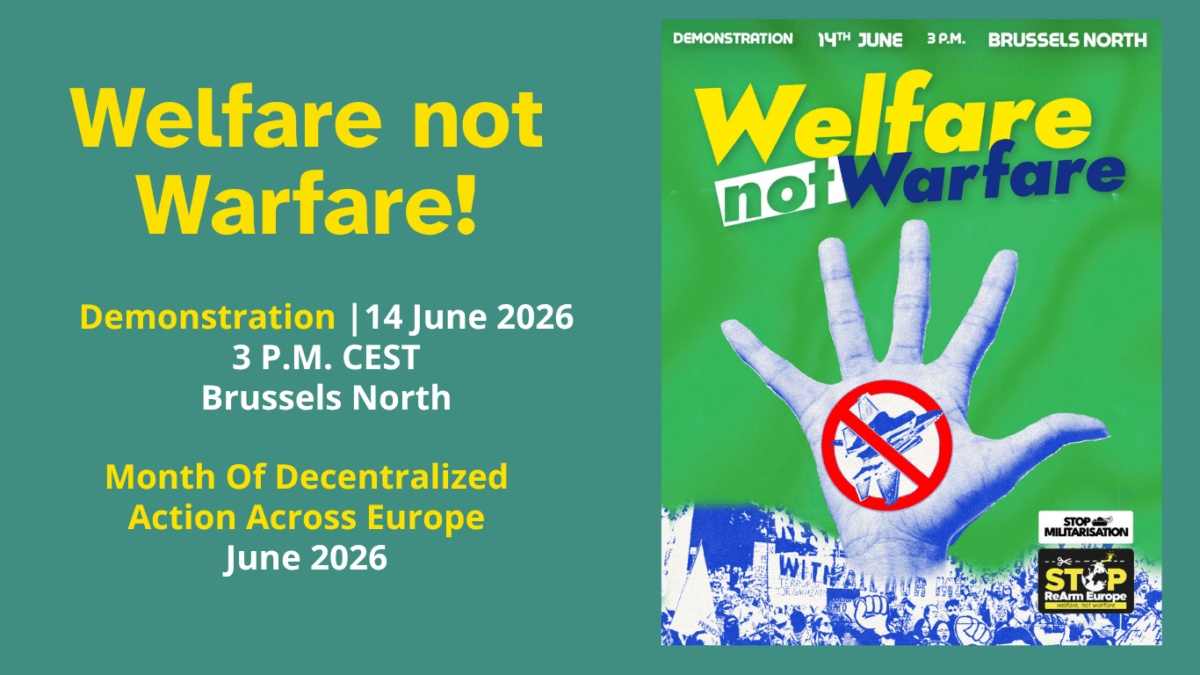
Welfare not Warfare | Rally In Brussels on 14 June & Month Of Decentralized Action Across Europe!

Organized and coordinated by the Stop Militarization Platform and StopRearmEurope campaign, of which IPB is a member.
If you haven’t already, sign our call to action here and join the European movement against ReArm Europe!

Continue reading “Welfare not Warfare | Rally In Brussels on 14 June & Month Of Decentralized Action Across Europe!”

IPB Executive Director Sean Conner’s Common Security Speech

IPB Executive Director Sean Conner’s Common Security Speech in the International Trade Union’s July 28 webinar For Democracy that Delivers Peace and Prosperity for All.

The basic idea behind Common Security is that the security of one is inextricably linked to the security of all; that the security of a state, nation, or peoples cannot be achieved at the expense of the security of another; that security is not a zero-sum game. 

Continue reading “IPB Executive Director Sean Conner’s Common Security Speech”

A GLOBAL CALL TO ACTION: FOR DEMOCRACY THAT DELIVERS PEACE AND PROSPERITY FOR ALL

FOR DEMOCRACY THAT DELIVERS PEACE AND PROSPERITY FOR ALL

As we approach the 80th anniversary of the atomic bombings of Hiroshima and Nagasaki, we, the undersigned organisations, call on governments and international institutions to reaffirm their commitment to a world free from nuclear weapons, honouring the demand of the Hibakusha and 2024 Nobel Peace laureate Nihon Hidankyo, and to prioritize sustainable development over militarism, people of collective power, accelerating military build-up and climate change, and diverting resources away from human development and peacebuilding.

As organisations from the peace, labour, economic justice, and climate movements, we share the belief that collective security can only be ensured through solidarity, by meeting the basic needs of all people.

Continue reading “A GLOBAL CALL TO ACTION: FOR DEMOCRACY THAT DELIVERS PEACE AND PROSPERITY FOR ALL”

IPB Press Release: For Democracy that Delivers Peace and Prosperity for All

27 July 2025, Berlin, Germany

 The International Peace Bureau (IPB), in cooperation with the International Trade Union Confederation (ITUC), Greenpeace, the International Campaign to Abolish Nuclear Weapons, Oxfam, and 350.org, has released a global call to action for nuclear and conventional disarmament, common security, and a prioritization of sustainable development over militarism.

Continue reading “IPB Press Release: For Democracy that Delivers Peace and Prosperity for All”

IPB Statement on Thailand-Cambodia Border Clashes

25 July 2025

The International Peace Bureau (IPB) expresses deep concern over the rising military clashes and political tensions between Thailand and Cambodia, which have resulted in the death of at least 15 civilians and the mass displacement of civilians from border areas. The escalation of long-standing tensions over the border risks further exacerbating civilian suffering and displacement.

The IPB calls for an immediate ceasefire and a return to diplomatic negotiations and conflict resolution as the only tools that can solve the crisis. Nationalist and militaristic rhetoric must be replaced by dialogue and common security. Moreover, IPB calls on ASEAN, particularly neighbour states, in the region and those with military ties to either party to encourage de-escalation and peaceful resolution.

You are currently viewing a placeholder content from Default. To access the actual content, click the button below. Please note that doing so will share data with third-party providers.

More Information
Loader Loading…
EAD Logo Taking too long?

Reload Reload document
| Open Open in new tab

Neutrality Colloquium: A Call to Action for Active Neutrality & World Peace

Neutrality Colloquium: A Call to Action for Active Neutrality & World Peace

Geneva, Switzerland | June 26-27, 2025

The Neutrality Colloquium took place on June 26–27, 2025, in Geneva, Switzerland, bringing together 90 experts in diplomacy, international law, peacebuilding, and digitalization, from 27 countries across five continents—including Colombia, Argentina, Costa Rica, the USA, the DRC, Syria, Moldova, Ireland, Japan, and China. Held in hybrid format, the Colloquium served as a critical platform to explore and promote active neutrality as a strategy for peacebuilding, conflict prevention, and global stability amid growing geopolitical tensions, rising militarization, and ongoing humanitarian crises.

This gathering followed the First International Congress on Neutrality, which was held in Bogotá, Colombia, in April 2024. That congress marked a milestone, with participants from 25 countries laying the groundwork for a renewed global conversation on neutrality. The Geneva Colloquium was conceived as a smaller, expert-level forum to build upon that momentum and shape the vision for the Second International Congress on Neutrality, scheduled for 2026.

The event was jointly organized by a coalition of organizations committed to peace and disarmament: Global Veterans Peace Network (GVPN), World BEYOND War, Inter-University Network for Peace (REDIPAZ), International Peace Bureau (IPB), Transnational Institute, the Colombia Peace Agreement, and the Geneva Center for Neutrality, which hosted the gathering. Their collaboration was essential to the success of the Colloquium.

Over two days, participants engaged in five thematic focus groups:

  • Current Neutrality Practices
  • Digital Neutrality in the Age of Cyberwarfare and AI
  • Neutrality and Media
  • Building a New Non-Aligned Movement
  • Neutrality and Common Security in a Militarized World

Each group developed specific recommendations, which were integrated into the final outcomes of the Colloquium: a Modern Neutrality Final Declaration and an Action Agenda to Promote Active Neutrality.

The Declaration stresses that neutrality is not indifference. Rather, it is a strategic, principled approach to international relations—one that prioritizes peace over power projection, sovereignty over dominance, and cooperation over confrontation. In light of the alarming rise in military expenditures—including NATO’s recent commitment to allocate up to 5% of GDP to defense—the declaration calls for redirecting resources from warfare to social, ecological, and economic justice.

“Active neutrality is neither passive nor indifferent. It is a proactive, values-based stance, rooted in non-alignment, non-intervention, and demilitarization. In a context of rising geopolitical rivalries, climate breakdown, and digital warfare, active neutrality means to:

  • Prioritize peace over power projection
  • Promote sovereignty and self-determination, especially for the Global South
  • Reject participation in arms races, military alliances or military interventions
  • Promote dialogue, diplomacy and multilateralism
  • Invest in social, ecological and economic justice instead of war”

The Geneva Colloquium marked a significant step in global efforts to redefine and reinvigorate the role of neutrality in the 21st century. The inputs and outcomes of this event will directly inform the Second International Congress on Neutrality in 2026—ensuring that the principles of active neutrality continue to evolve as powerful tools for peace and justice in our increasingly polarized world.

You can read and download the documents below:
  1. Modern Neutrality Final Declaration
  2. Action Agenda to Promote Active Neutrality
  3. Press Release: Colloquium on Neutrality by Geneva Center for Neutrality Official
  • Modern Neutrality Final Declaration

  • Action Agenda to Promote Active Neutrality

  • Press Release: Colloquium on Neutrality by Geneva Center for Neutrality
Other Articles:

Common Security in the Indo- Pacific Region

14 October 2024 – In collaboration with the Campaign for Peace, Disarmament, and Common Security, PeaceMOMO, and the dedicated efforts of an international working group of scholars and peace leaders from across the Indo-Pacific, the U.S., and Europe, we are proud to share the Common Security Report in the Indo-Pacific Region.

Continue reading “Common Security in the Indo- Pacific Region”

IPB Condemns Escalation and Calls for Immediate Ceasefire Following Targeted Killings in West Asia

31 July 2024, Germany

The International Peace Bureau (IPB) expresses deep concern over the recent targeted killings in West Asia, including the deaths of Hamas political leader Ismail Haniyeh in Tehran and Hezbollah’s top military commander, Fuad Shukur, in Beirut. These actions are a violation of international law and pose a serious risk of escalating the conflict to a regional level. Such escalations not only endanger regional stability but also have global consequences, as they increase the risk of a wider conflict that could involve the use of nuclear weapons and other weapons of mass destruction (WMDs), leading to catastrophic outcomes worldwide.

These attacks have severely set back efforts towards achieving a ceasefire and a long-term resolution to the conflict, including the return of Israeli hostages. The timing and nature of these actions suggest a deliberate attempt to undermine diplomatic efforts, prolonging the suffering of civilians and obstructing peace processes.

Recent statements by Iran’s new president, Masoud Pezeshkian, and various international responses underscore the fragile state of affairs. IPB urges all stakeholders, including regional and global powers, to work towards a peaceful resolution and avoid actions that could lead to uncontrollable escalation.

IPB emphasizes the critical importance of using diplomatic channels to de-escalate the situation. Resorting to violence only exacerbates the suffering of innocent civilians and brings the region closer to widespread conflict. We call on all states and non-state actors, both within the region and those with direct or indirect involvement, to prioritize peace and stability, respecting international law principles.

We urgently call for a ceasefire and comprehensive negotiations that address the root causes of the longstanding conflict, cycle of violence, and oppression in Palestine and Israel, and throughout West Asia. Long-term peace can only be achieved through dialogue, mutual understanding, and trust-building, ensuring the common security and dignity of all people involved.

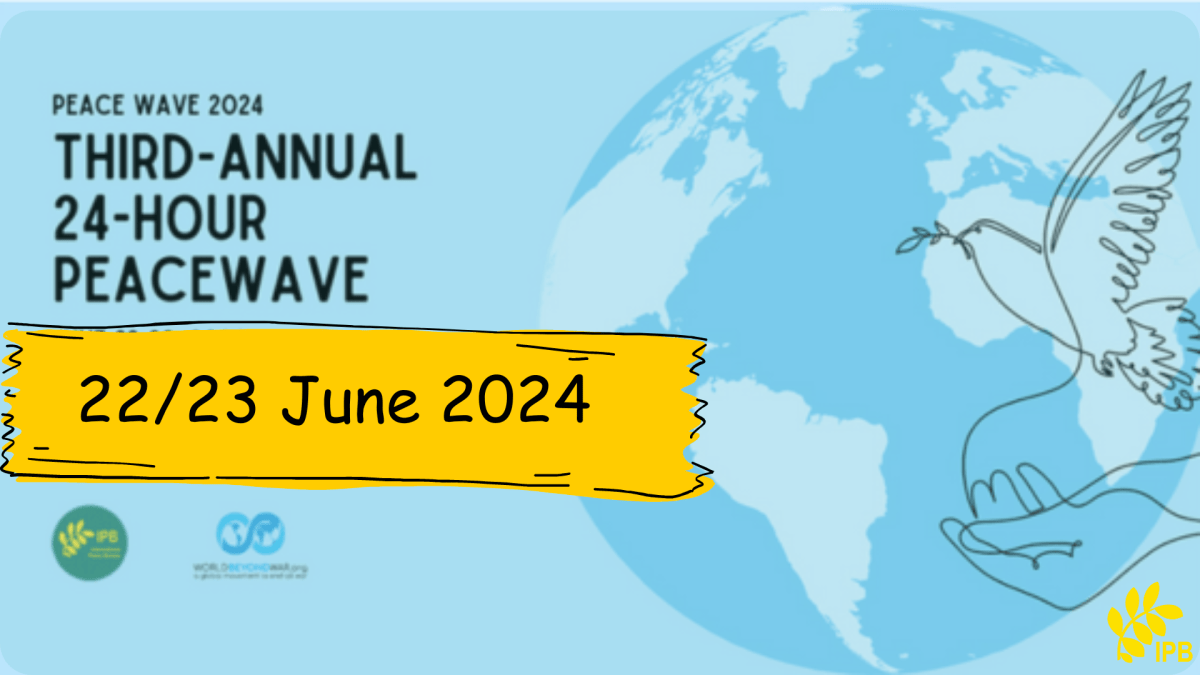
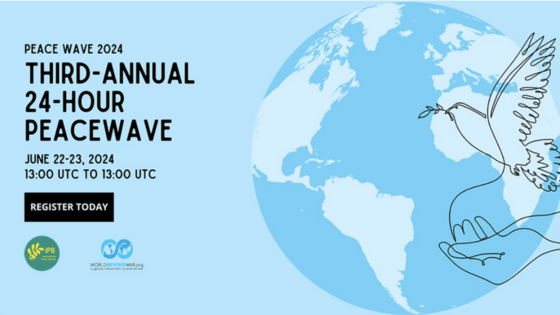
Peace Wave 2024: A Global Movement for Peace and Unity

On June 22-23, 2024, the International Peace Bureau and World BEYOND War held the third annual 24-hour Peace Wave, a global event dedicated to promoting peace and opposing military buildup. This extraordinary event unfolded over a 24-hour Zoom marathon, featuring live peace actions in various locations around the world, moving westward every two hours. Participants engaged in different ways to spread the word of PEACE. Each segment throughout the event concluded with a live Q&A session, fostering real-time interaction and engagement.

The 2024 Peace Wave took place against the backdrop of the RIMPAC military exercises in the Pacific and the lead-up to protests against NATO’s 75th anniversary Summit in Washington, D.C., in July. The event aimed to support global peace initiatives and oppose military alliances like NATO and AUKUS, which are contributing to global military buildup and conflicts.

Event Overview

  • Europe and Africa (13:00 – 15:00 UTC) The Peace Wave kicked off with peace actions in the UK, contributions from Ireland around the topic of neutrality, followed by a panel with activists from Nigeria, Sierra Leone, Ghana, and peace actions from Cameroon and Djibouti. This segment highlighted the diverse approaches to peacebuilding in different cultural and geopolitical contexts.
  • South America (15:00 – 17:00 UTC) The event then moved to South America, featuring actions from Chile, Brazil, Argentina, Peru, and Colombia. A large solidarity March with Palestine was held in Santiago de Chile, the session was enriched with songs.
  • North America (Eastern Time Zone) (17:00 – 19:00 UTC) In the USA and Canada, the Eastern Time Zone saw a variety of activities. A notable segment was led by Kathy Kelly, who moderated discussions and live interactions with peace advocates. In addition to videos of peace walks, live outdoor rallies, and Q&A sessions.
  • Mexico, Central America, and the Caribbean (19:00 – 21:00 UTC) The Peace Wave continued through Mexico, Central America, and the Caribbean, where peace activists held numerous events that emphasized the importance of regional cooperation and grassroots activism in promoting peace and justice.
  • North America (Pacific and Mountain Time Zones) (21:00 – 23:00 UTC) In the Pacific and Mountain Time Zones of the USA and Canada, the Peace Wave featured contributions from activists like Elizabeth Murray, who shared insights from Ground Zero and the Peace Pagoda. Notable segments included a video presentation from the Peace Caravan and an anti-war demonstration in Portland, Oregon.
  • Hawaii and Guam (23:00 – 01:00 UTC) The event moved to Hawaii and Guam, where peace activists engaged and elaborated on their work to promote peace globally. These segments highlighted the strategic importance of these regions in global military dynamics and emphasized the local efforts to promote peace and demilitarization.
  • Australia and New Zealand (01:00 – 03:00 UTC) In Australia and New Zealand, the Peace Wave featured a variety of activities and events. These events underscored the role of cultural heritage and indigenous wisdom in peacebuilding efforts.
  • Japan and South Korea (03:00 – 05:00 UTC) The segment in Japan and South Korea included a video presentation by the Japan Council against A & H Bombs (Gensuikyo) and a pre-recorded video about Japan by Joseph Essertier. This was followed by a live Q&A session with contributors from Gangjeong Village on Jeju Island, highlighting local resistance to militarization and the impact of global military policies on local communities.
  • Southeast Asia (05:00 – 07:00 UTC) In Southeast Asia, peace activists from the Philippines, Cambodia, and Myanmar organized various events, with peace activists engagements. These activities focused on regional conflicts and the need for peaceful resolution through dialogue and cooperation.
  • South Asia (07:00 – 09:00 UTC) The South Asia segment included contributions from Bangladesh, Nepal, India, Sri Lanka, and Pakistan. Highlights included a panel discussion on regional cooperation and peace, featuring messages and videos from various individuals and organizations. This segment emphasized the interconnectedness of regional peace efforts and the importance of collective action.
  • Central Asia and the Middle East (09:00 – 11:00 UTC) The Peace Wave then moved to Central Asia and the Middle East, with activities and contributions from Israel, Palestine, Jordan, and Syria, focusing on the ongoing conflicts and the urgent need for peace and reconciliation in these regions.
  • Russia, Ukraine, the Nordic Region, and Central Europe (11:00 – 13:00 UTC) The final segments included contributions from peace activists from Russia and Ukraine, a video describing the worrying militarisation of the Nordic Region, and several speeches and actions from Kosovo, Romania, Germany, Spain, Switzerland, and Italy. This part of the event featured powerful speeches and demonstrations, highlighting the global nature of the peace movement. Contributions from Ukraine and Russia underscored the need for dialogue and understanding amidst the ongoing conflict.

Context, Significance, and Importance:

In a world often fraught with conflict, violence, and political tension, the role of peace activities and campaigns cannot be overstated. Initiatives like the annual 24-hour Peace Wave, serve as critical platforms for advocating peace, fostering global solidarity, and challenging the pervasive culture of war. These efforts are essential not only for preventing conflicts but also for building a sustainable future grounded in mutual respect and understanding.

 Promoting Awareness and Education: One of the most significant impacts of peace activities is raising awareness about the devastating consequences of war and the benefits of peaceful resolutions. Educational components, such as panel discussions, workshops, and cultural events, help disseminate knowledge about the complexities of conflicts and the importance of diplomacy and negotiation. For instance, during the Peace Wave event, various segments were dedicated to discussing the impacts of military alliances like NATO and AUKUS, and the necessity of global cooperation to address these issues. By educating the public, these campaigns empower individuals to advocate for peaceful policies and support nonviolent solutions in their communities.

Encouraging Global Solidarity and Collaboration: Peace campaigns often bring together a diverse range of participants from different countries and cultural backgrounds, fostering a sense of global solidarity. This unity is vital in addressing the root causes of conflict, such as inequality, injustice, and resource scarcity. The Peace Wave, for example, featured live peace actions from dozens of locations worldwide, including rallies, concerts, and public demonstrations. This global participation not only highlights the universal desire for peace but also demonstrates the power of collective action in challenging the status quo and pushing for systemic change.

Challenging Militarism and the Arms Industry: A core objective of many peace campaigns is to challenge the normalization of militarism and the influence of the arms industry on global politics. By opposing military build-ups and the proliferation of weapons, these activities aim to redirect resources towards more constructive and humanitarian endeavors. The Peace Wave specifically targeted military exercises underscoring the urgent need to reduce military spending and promote disarmament. Such actions spotlight the disproportionate impact of militarization on marginalized communities and the environment, advocating for a shift towards policies that prioritize human security and well-being.

Inspiring Future Generations: Engaging youth in peace activities is essential for sustaining long-term peacebuilding efforts. By involving young people in dialogues, educational programs, and activism, these campaigns nurture a new generation of peace advocates. The inclusive nature of events like the Peace Wave, which features contributions from various age groups and communities, ensures that the message of peace resonates with and inspires future leaders. Empowering young people to champion peace not only secures the continuity of these efforts but also brings fresh perspectives and innovative solutions to the challenges of conflict.

Building a Culture of Peace: Ultimately, peace activities and campaigns contribute to the broader goal of building a culture of peace. This involves transforming societal values, norms, and institutions to prioritize peace over conflict. By celebrating and promoting peace, these campaigns help embed the principles of nonviolence, cooperation, and empathy into the social fabric. Events like the Peace Wave create opportunities for individuals to experience and practice these values, reinforcing the idea that peace is not just the absence of war but a proactive commitment to justice, equality, and human dignity.

Conclusion

The 2024 Peace Wave was a resounding success, bringing together peace activists from around the world in a unified call for peace and demilitarization. The event highlighted the importance of global cooperation, local activism, and the power of collective action in addressing the challenges of militarization and conflict. As the world continues to grapple with these issues, the Peace Wave serves as a beacon of hope and a reminder of the enduring human spirit’s capacity for peace and reconciliation.

You can visit the IPB YouTube Peace Wave 2024 Playlist to watch the full event.