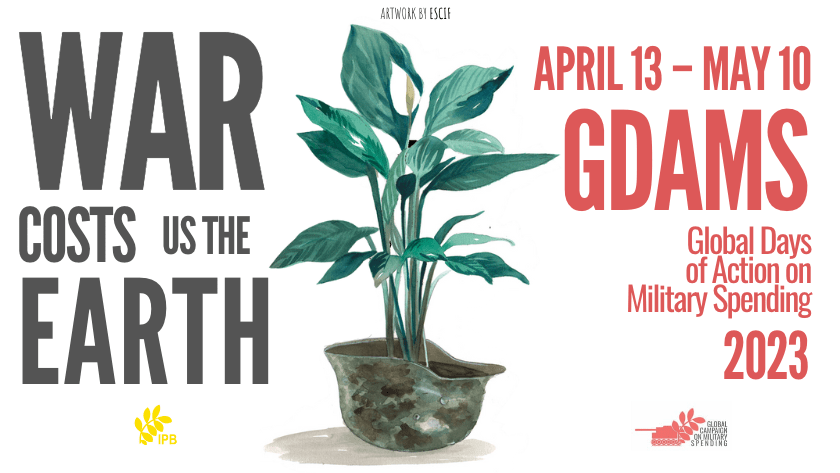
This year of war in Ukraine has meant a huge boost for militarism and military budgets across the world, especially in countries of the Global North. But at GCOMS we believe the response should be quite the opposite: we should drastically reduce military spending and invest in common & human security instead…
The 12th edition of the Global Days of Action on Military Spending will take place from April 13 to May 9, 2023. Join us in protesting military budgets & warmongering, and take action for peace & justice!
These dates include:
April 18: Tax Day in the USA
April 22: Earth Day
April 24: GDAMS press conferences and social media storm on the occasion of SIPRI’s release of new data on military spending
May 9: Europe’s Day of Peace · Actions against the militarization of the EU
How can you get involved?
If you’re part of an organization:
Prepare your own GDAMS action or join activities prepared by other organizations near you. Once you know the details of your action please send us an email so we can add them to our map & agenda and help you spread the word. You can see examples from last year here.
April 24 will be the main day of action once again. Using new military spending data released that day by SIPRI (figures for 2022), we’ll hold press conferences and launch a Social Media Storm. We’ll send instructions for social media actions soon, and if you’re preparing media work in your city/country, we can help you plan it.
Stay active during GDAMS by sharing ideas, articles, actions and debates through your own network and social media, with other GCOMS partners, and with us (Facebook, Twitter and Instagram).
As anindividual:
Join a local group working on the issue, or set one up! Here’s our list of partners.
Do Online Campaigning: join our social media storm on April 24; use your social media to protest military budgets by sharing pictures, news, materials, and actions;
Write an op-ed; Send a letter to representatives in your country responsible for defense budgets.
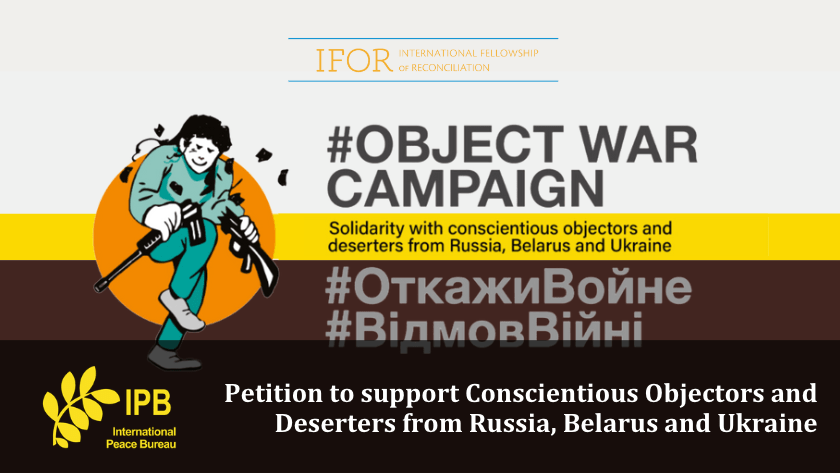
On the occasion of the International Day of Peace, 21st September, Connection e.V., the International Fellowship of Reconciliation, the European Office for Conscientious Objection, and War Resisters’ International are calling for a signature campaign for deserters and conscientious objectors from Russia, Belarus, and Ukraine. The #ObjectWarCampaign calls on all citizens from everywhere to join the global effort to ensure protection and asylum for conscientious objectors and deserters from Russia, Belarus, and Ukraine involved in the current war in the region. They are our hope to refuse war and let peace prevail!
On April 6, 2022, the President of the European Council, Charles Michel, had called on Russian soldiers to desert and promised them protection under refugee law. So far, this promise has not been fulfilled.
Within the scope of #ObjectWarCampaign, a petition has been prepared for everyone to sign in. The petition is addressed to the President of the European Commission Ursula von der Leyen, the President of the European Council Charles Michel, and the President of the European Parliament Roberta Metsola. The petition emphasizes the need to uphold the right to asylum for conscientious objectors and deserters from Russia, Belarus, and Ukraine by hosting states. The petition launched on the WeMove.eu website can now be signed in German, English, French, Italian and Greek.
Ukraine suspended the right to conscientious objection and closed the border for men between 18 and 60. Over 100,000 men have evaded war involvement in Ukraine and fled abroad. Currently, Ukrainian citizens have temporary residence in the European Union. The #ObjectWarCampaign petition demands that the right to conscientious objection to military service is fully guaranteed in Ukraine.
The petition signatures are a crucial sign of support for conscientious objectors and deserters. This campaign highlights the importance of opening borders to those who oppose the war at great personal risk in their countries and calls on everyone around the world to support those who refuse to fight and kill.
Every recruit can be a conscientious objector, every soldier a deserter. Let’s support those who refuse to kill and end war together!
#ObjectWarCampaign #StandWithObjectors
The launch of the petition has been anticipated by an appeal sent in June 2022, to the European Parliament and the Parliamentary Assembly of the Council of Europe -supported by 60 organizations from 20 countries – detailing why protection and support for deserters and conscientious objectors on all sides of the Ukrainian war is necessary and moreover that it is a human right. There have already been discussions about this in the European Parliament.
More information: The appeal to the European institutions can be found here. Background information can be found here.
The INTERNATIONAL PEACE BUREAU supports this campaign, as those who refuse to kill and refuse to take part in violent means of conflict resolution are also contributing to peace.
The UK government is sending depleted uranium shells for use in the Challenger 2 tanks gifted to Ukraine, a move CND has condemned as an additional environmental and health disaster for those living through the conflict.
First reported by Declassified UK, Defence Minister Baroness Goldie admitted in the answer to a written question that armour-piercing rounds containing depleted uranium (DU) were included in its tank package for Kyiv. She added that the rounds “are highly effective in defeating modern tanks and armoured vehicles.”
A byproduct of the nuclear enriching process used to make nuclear fuel or nuclear weapons, DU emits three-quarters of the radioactivity of natural uranium and shares many of its risks and dangers. It is used in armour-piercing rounds as it is heavy and can easily penetrate steel. However on impact, toxic or radioactive dust can be released and subsequently inhaled.
DU shells were used extensively by the US and British in Iraq in 1991 and 2003, as well as in the Balkans during the 1990s.
It is thought that the extensive use of these shells is responsible for the sharp rise in the incidence rate of some cancers like breast cancer or lymphoma in the areas they were used. Other illnesses linked to DU include kidney failure, nervous system disorders, lung disease and reproductive problems. However, a lack of reliable data on exposure to DU means no large-scale study on its true impact exists.
CND General Secretary Kate Hudson said:
“Like in Iraq, the addition of depleted uranium ammunition into this conflict will only increase the long-term suffering of the civilians caught up in this conflict. DU shells have already been implicated in thousands of unnecessary deaths from cancer and other serious illnesses. CND has repeatedly called for the UK government to place an immediate moratorium on the use of depleted uranium weapons and to fund long-term studies into their health and environmental impacts. Sending them into yet another war zone will not help the people of Ukraine.”
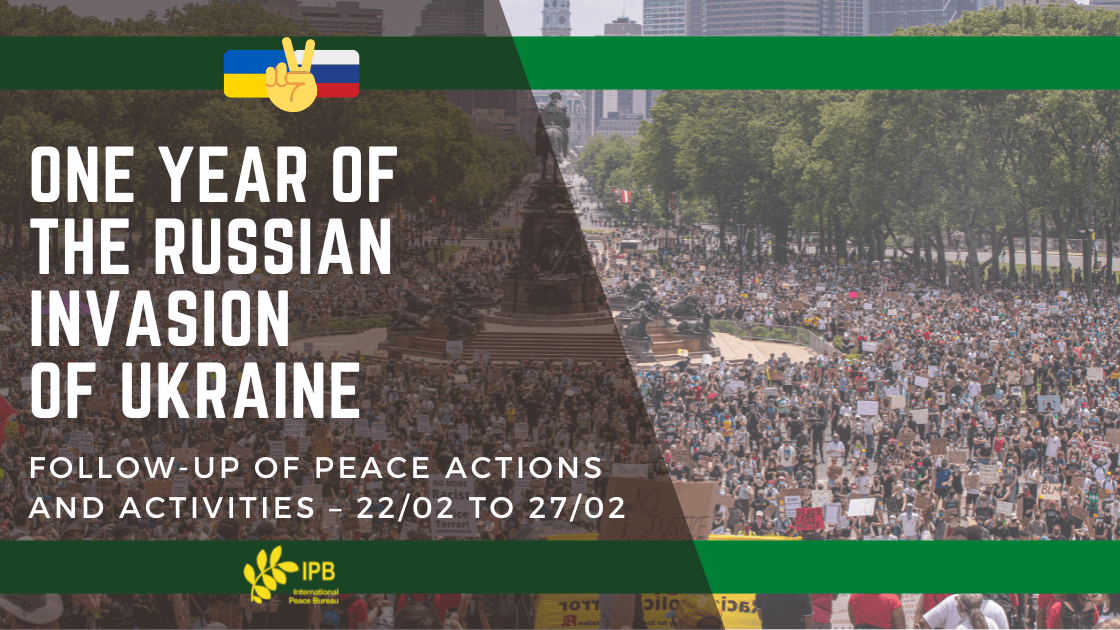
February 24th, 2023 marks the 1-year anniversary of the war in Ukraine. After almost one year, weapons are still not silent. News are still dominated by new attacks and their humanitarian consequences. This cannot continue. Around the one-year anniversary of the Russian invasion of Ukraine, organizations and groups from the peace and disarmament movement organized actions all over the world to show solidarity with Ukraine and call for a ceasefire and negotiations.
We compiled many actions and demonstrations in a list made public to all:
Many of these events were also present on the page of Peace Initiatives of sbilanciamoci.info. It is worth following their page to be updated on their latest news.
Preliminary report on national activities in the ambit of Europe-For-Peace
Here you can find a preliminary report about activities on the occasion of the first anniversary of the Ukraine war. So far we have reports from Italy, UK/London, Belgium/Brussels, and Croatia/Zagreb. More reports from Germany, France, Spain, Portugal, Austria, and also Denmark might be added soon. We thank Martin Koehler for providing us with this preliminary report.
South Korea Action regarding 1 year of Russia’s invasion of Ukraine – PSPD
On February 23, on the occasion of the one-year anniversary of Russia’s invasion of Ukraine, 56 South Korean civil society organizations took action to condemn the Russian invasion and call for a ceasefire.
Our partners of PSPD in Korea are currently translating the statement into English. We thank Sooyoung Hwang for helping us with this translation.
PEACE IS OUR VICTORY
On February 23-24, 2023, the winter session of the Parliamentary Assembly of the Organization for Security and Cooperation in Europe (OSCE) happened in Vienna. The meeting coincides with the launch of the aggression of the Russian Federation against Ukraine.
During the OSCE session, representatives of the Austrian peace movement gather at the Vienna Hofburg and project their demand for peace in Russian, Ukrainian, English, and German on the façade of the building complex where the delegates meet: “Peace is our victory”.
We thank Katerina Anastasiou from transform! Europe with this information on the activities in Vienna.
1,000 march in Helsinki to demand peace in Ukraine
Provided by our partners at Peace Union of Finland, here we have the register made by Yle News webpage.
“Events marking the anniversary of the Russian invasion of Ukraine continued in Helsinki on Saturday. Following a candlelight vigil on the steps of Helsinki Cathedral on Friday, there was a procession through the capital on Saturday afternoon calling for an end to the war and supporting those suffering due to it. […] ‘There are Ukrainians, Russians, and Finns here, and it seems that some foreign tourists have also joined,’ an organizer told Yle.”
We thank Laura Lodenius from the Peace Union of Finland for this information on the activities in Helsinki.
IPB Webinar – 365 Days of War in Ukraine: Prospects Towards Peace in 2023
One year after the beginning of the Ukraine war – the International Peace Bureau in cooperation with the Peace in Ukraine Coalition (USA), Movement de la Paix (France), CND (UK) and Transform! Europe held an international webinar to bring together different voices from different countries to discuss a lasting peace in Ukraine and the way towards it.
You are currently viewing a placeholder content from YouTube. To access the actual content, click the button below. Please note that doing so will share data with third-party providers.
Introductory words by Michael von der Schulenburg, a former UN/OSCE diplomat who also participated in the development of the Vatican peace plan;
Afterward, both Ukrainian and Russian activists will share their perspectives on the ongoing situation, including Oleg Bodrov (Public Council of the Gulf of Finland), Karyna Radchenko (100 Words for Peace), and Yurii Sheliazhenko (Ukrainian Pacifist Movement).
A roundtable discussion by different peace activists – including Corazon Valdez Fabros (IPB Co-President), Reiner Braun (former IPB Director, Germany), Lindsey German (Stop the War Coalition, UK), Alain Rouy (Movement de la Paix), Francesco Vignarca (Rete Italiana Pace e Disarmo, Italy), Medea Benjamin (CODEPINK) and Kate Hudson (CND) as moderator.
Приостановка Россией действия договора СНВ-3 (the New START Treaty) знаменует собой последнюю опасную и безответственную эскалацию ядерных угроз после вторжения на Украину год назад. Быстрое ухудшение дипломатических отношений между Россией и Западом, наряду с усилением военных действий в Украине и прежними ядерными угрозами со стороны России, должно послужить тревожным сигналом для всего мира: мы ближе, чем когда-либо, к ядерному уничтожению.
Незадолго до российского вторжения, в январе 2022 года, лидеры пяти ядерных держав подтвердили то, что мы все знаем как истину: ядерную войну нельзя вести и ее нельзя выиграть. Вместо того чтобы принять это сообщение близко к сердцу, Россия и Запад продолжают полагаться на ядерное сдерживание как на фундаментальную стратегию своей внешней политики, в том числе в качестве щита для своих империалистических авантюр. Обе стороны виновны в подрыве режима контроля над ядерными вооружениями, установленного во время холодной войны — посещение ядерных объектов США в рамках СНВ-3 также было ограничено санкциями против России. Угроза применения ядерного оружия сейчас выше, чем когда-либо в истории со времен кубинского ракетного кризиса.
Международное бюро мира вновь призывает к немедленному прекращению огня в Украине и к участию всех вовлеченных сторон в переговорах, чтобы положить конец насилию и кровопролитию. Мы требуем, чтобы переговоры включали вопросы безопасности украинцев, россиян и западных правительств, чтобы они основывались на общей безопасности и немедленно возобновили действие договора СНВ-3, а также работали над восстановлением дальнейших договоров по контролю над ядерными вооружениями и об установлении доверия, на основе принципов общей безопасности.
Кроме того, Международное бюро мира призывает положить конец дорогостоящей модернизации ядерного оружия — многомиллиардному проекту, который ничего не делает для обеспечения безопасности, — и ко всем странам поддержать Договор о запрещении ядерного оружия (ДЗЯО) во имя безопасного и безъядерного будущего.
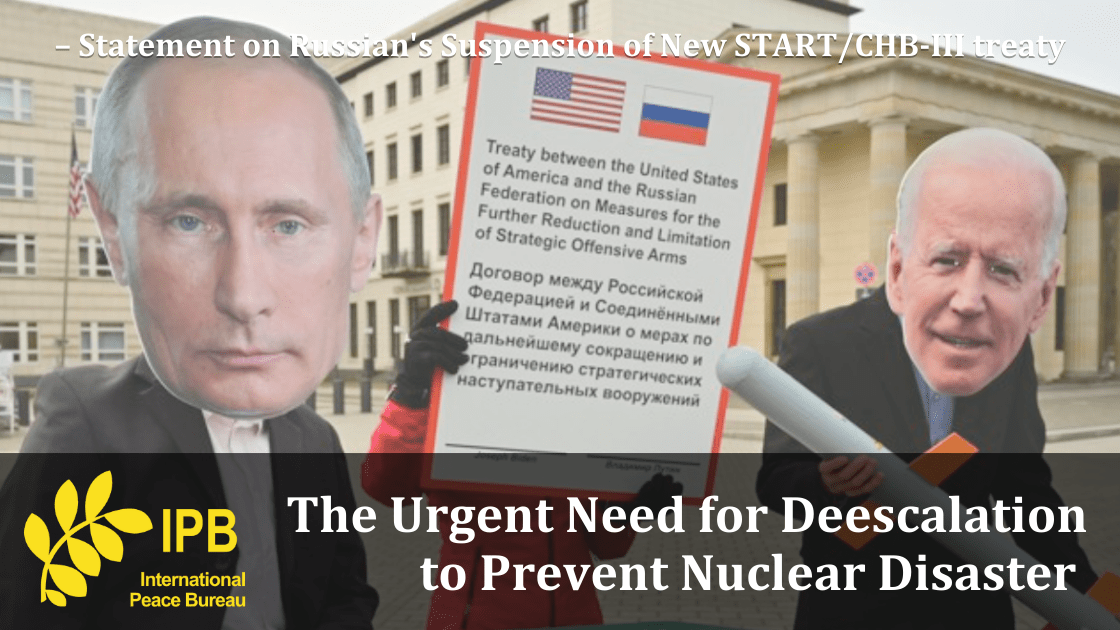
Russia’s suspension of the New START Treaty marks the latest in the dangerous and irresponsible escalation of nuclear threats since the invasion of Ukraine one year ago. The rapid deterioration of diplomatic relations between Russia and the West, alongside the intensification of the war in Ukraine and Russia’s previous nuclear threats, must serve as a wake-up call to the world: we are closer than we have ever been to nuclear annihilation.
Just prior to the Russian invasion, in January 2022, the leaders of the five nuclear-weapon states reiterated what we all know to be true: a nuclear war must not be fought and cannot be won. Instead of taking this message to heart, Russia and the West continue to rely on nuclear deterrence as a fundamental strategy for their foreign policies, including as a shield for their imperialist ventures. Both sides are guilty of eroding the nuclear arms control regime established during the Cold War – visits to US nuclear sites under New START were likewise restricted by sanctions against Russia. The threat of the use of nuclear weapons is now higher than at any point in history since the Cuban Missile Crisis.
The International Peace Bureau calls again for an immediate ceasefire in Ukraine and for all involved parties to engage in negotiations to bring the violence and bloodshed to an end. We demand that negotiations include the security concerns of Ukrainians, Russians, and Western governments to rely on common security and to immediately resume the New START treaty, as well as to work for the re-establishment of further nuclear arms control and trust-building treaties, in line with the principles of common security.
Furthermore, IPB calls for an end to the expensive modernization of nuclear weapons – a multi-billion dollar project that does nothing to ensure security – and for all nations to support the Treaty on the Prohibition of Nuclear Weapons for a safer, nuclear-free future.
–––––––––
You can download the PDF version of this Statement in English here:
➡️ Interact with us on social media especially to learn about our latest actions and activities: Facebook, Twitter, Instagram, and Youtube.
➡️ Our office is open to reply to any doubts regarding the documents that were above presented. To get in touch with us, e-mail us at info@ipb-office.berlin.
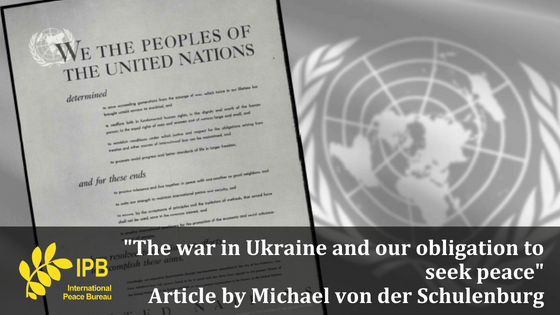
Michael von der Schulenburg, a former UN/OSCE diplomat, who has lately been working on the Vatican peace plan has published a new article on the Ukraine war, the importance of the UN-Charta and the obligation to seek peace.
“[…] The Preamble of the UN Charter states that “We the peoples of the United Nations (are) determined to save succeeding generations from the scourge of war, which twice in our lifetime has brought untold sorrow to mankind…” Unfortunately, this appeal of the UN Charter seems forgotten today. Especially, the original founding members, and hence supposed protectors, of the UN Charter, the US, UK, France and now also Russia, have repeatedly eroded its principles for their own political aims or, indeed, ignored it altogether. As permanent members of the UN Security Council with a veto power they were in a position to do this. In the Ukraine war, these four veto powers have now become direct adversaries, making a mockery of the UN Charter meant to prevent such wars. They thus bear primary responsibility for this war and its consequences vis-à-vis humanity.[…]” (20.02.2023, Michael von der Schulenburg in “The war in Ukraine and our obligation to seek peace – A call to find peaceful solutions”)
If you’re interested in reading the full article, please click here.
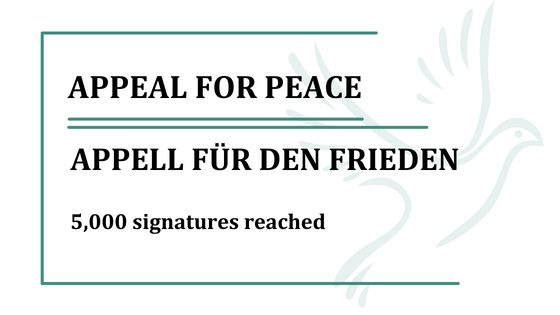
The German-Austrian appeal for peace in Ukraine, which calls for ceasefire and peace negotiations between the warring parties involved, has now exceeded the 5000 signatures mark!
Almost all German and Austrian peace organizations and peace activists have signed the appeal. It calls on the German and Austrian governments, among others, to support a UN peace initiative. The idea of a diplomatic initiative, which is now widespread in various countries, calls on governments to advocate the formation of a high-level and highly legitimized UN commission headed by the UN Secretary-General. This commission, which would be legitimized by the UN General Assembly and would have to, among others, consist of foreign ministers from influential states, has the task to bring the governments of Ukraine and the Russian Federation to the negotiating table. The goals are to achieve a ceasefire and to negotiate a binding peace order between the opposing states as a prerequisite for a European security architecture involving Ukraine and the Russian Federation.
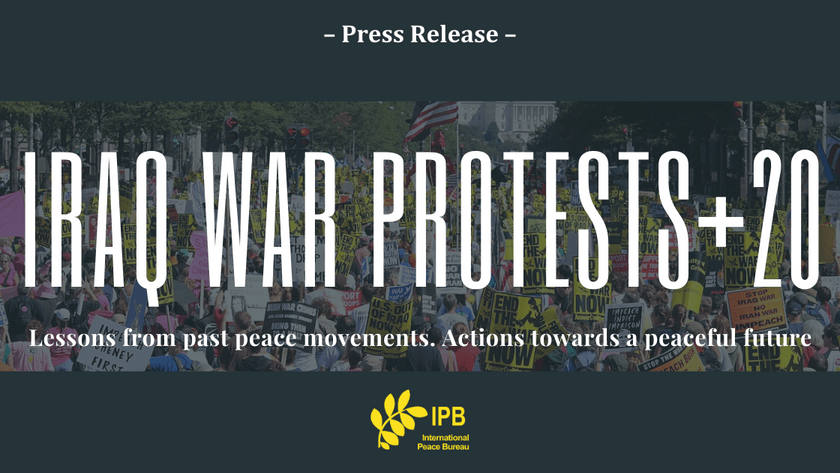
Twenty years ago, on February 15th, 2003, activists from across the globe gathered in what many social movement researchers would come to describe as “the largest protest event in human history.”[1] In more than 600 cities worldwide, coordinated protests filled the streets with people expressing their opposition to the imminent United States-led invasion of the Republic of Iraq[2]. This was part of a series of protests and political events that had begun in 2002 and continued as the invasion, the war, and the occupation took place.
Twenty years later, on February 15th and 16th, 2023, the International Peace Bureau (IPB), together with partners and supporters, organized an event to remember and discuss the preparation, organization, and consequences of these large anti-war rallies. We aim to highlight the lessons learned by the international and national peace movements and discuss further steps toward the future of peace when dealing with the current challenges of our times.
Named “Iraq War Protests +20”, the event will have three interconnected parts – parts 01 and 02 on February 15th (04:00 PM – 08:00 PM Central European Time) and part 03 on February 16th (07:00 AM – 09:00 AM CET), with the aim to address all parts of the world.
At the event we will have the participation of a variety of speakers in round tables, interviews, and other actions in different sections:
Part 01: A glance at the past – the causes and consequences of the Iraq War
Video opening with footage and comments of the documentary “We Are Many” (2014), directed by Amir Amirani. Also, footage of the documentary “The Days Before – a journey through time for peace in Iraq”, a contribution from Leo Gabriel.
Video remarks from the organizers and participators of the activities in 2003;
Interview with Ismaeel Dawood, an Iraqi Human rights defender;
Round Table on the Impact of the war on the anti-war movement;
Part 02: A glance at the present – the current state of the peace movement
Participation of Noam Chomsky about the reasons behind the war, the lessons learned, and the war’s impact on global developments;
Round Table on the current challenges the Peace Movement Faces;
Part 03: A glance at the future – where peace will take us?
Summary and Highlights of the previous day;
Round Table on how to build the future of the peace movement;
➡️ Interact with us on social media especially to learn about our latest actions and activities: Facebook, Twitter, Instagram, and Youtube.
➡️ Our office is open to reply to any doubts regarding the documents that were above presented. To get in touch with us, e-mail us at info@ipb-office.berlin.
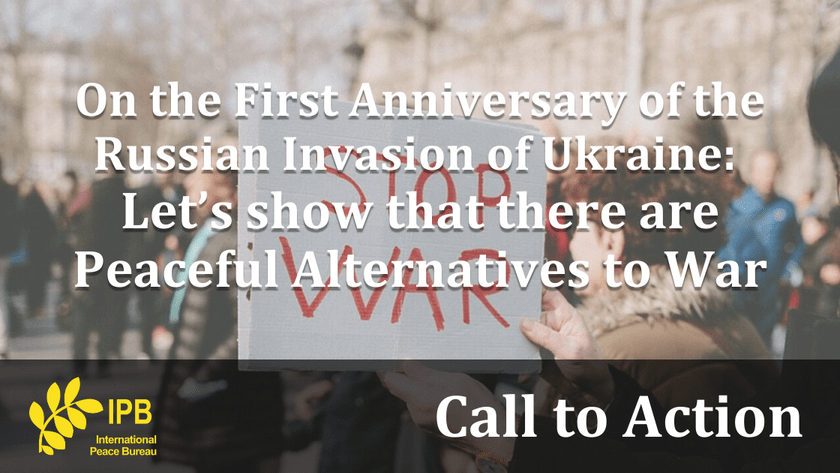
The International Peace Bureau calls on our members worldwide to take action during 24-26 February 2023 in support of peace in Ukraine. The war, which will mark its first anniversary on 24.02.2023, has already cost more than two hundred thousand lives[1] – by conservative estimates – forced millions to flee their homes[2], caused widespread destruction of Ukrainian cities, and strained already fragile supply chains that have made life more difficult for people the world over.
We know that this war is unsustainable – and, worse still, risks escalation that threatens the life and livelihood of people around the world. The nuclear rhetoric of Russia in particular is irresponsible and demonstrates the fragility of this moment. Moreover, the war’s direct and indirect impact on the climate impedes the urgent need for a green transition[3].
There is no easy solution to the war in Ukraine, but the current track we are on is unsustainable. Through global demonstrations for peace, we seek to pressure the two sides to establish a ceasefire and to take steps toward negotiations for long-term peace.
Our calls for peace are not limited to Ukraine – for all conflicts in the world, we implore governments to refuse the logic of confrontation and war, to oppose the nuclear peril, and to commit themselves to disarmament by signing the Nuclear Weapons Ban Treaty. We demand that governments and states act in favor of diplomacy, negotiation, conflict prevention, and the establishment of common security systems[4].
We call for your support and your voices for peace. Please consider joining an existing event during this weekend of action, or planning your own. Together we are stronger, and can show the world that there are alternatives to war and militarization.
Ceasefire and Peace for Ukraine: A Collection of Proposals and Possibilities for a Ceasefire and Resolution to the Conflicts between Russia and Ukraine: https://www.christmasappeal.ipb.org/peace-plans/
➡️ Interact with us on social media especially to learn about our latest actions and activities: Facebook, Twitter, Instagram, and Youtube.
➡️ Our office is open to reply to any doubts regarding the documents that were above presented. To get in touch with us, e-mail us at info@ipb-office.berlin.
You need to load content from reCAPTCHA to submit the form. Please note that doing so will share data with third-party providers.
You are currently viewing a placeholder content from Turnstile. To access the actual content, click the button below. Please note that doing so will share data with third-party providers.
You are currently viewing a placeholder content from Facebook. To access the actual content, click the button below. Please note that doing so will share data with third-party providers.
You are currently viewing a placeholder content from Instagram. To access the actual content, click the button below. Please note that doing so will share data with third-party providers.
You are currently viewing a placeholder content from Turnstile. To access the actual content, click the button below. Please note that doing so will share data with third-party providers.
You are currently viewing a placeholder content from X. To access the actual content, click the button below. Please note that doing so will share data with third-party providers.