Peace Education

Featured

The International Peace Bureau (IPB) Has Announced its Intention to Nominate Three Remarkable Organizations with a Focus on the Right to Conscientious Objection for the 2024 Nobel Peace Prize

FOR IMMEDIATE RELEASE

3 August 2023

The International Peace Bureau (IPB) Has Announced its Intention to Nominate Three Remarkable Organizations with a Focus on the Right to Conscientious Objection for the 2024 Nobel Peace Prize

Berlin, Germany – The International Peace Bureau (IPB) has announced our intention to nominate three exceptional organizations for the 2024 Nobel Peace Prize: the Russian Movement of Conscientious Objectors, the Ukrainian Pacifist Movement, and the Belarusian organization “Our House”. The decision to nominate these three organizations is a testament to their unwavering dedication in advocating for the right to conscientious objection to military service and promoting human rights and peace in their respective countries.

The Nobel Peace Prize is one of the world’s most esteemed awards, recognizing individuals and organizations that have made significant contributions to the pursuit of peace and harmony. The nomination period for the 2024 prize will open on 1 September 2023 and the nominations will be promptly submitted for consideration.

The Russian Movement of Conscientious Objectors (https://stoparmy.org/), the Ukrainian Pacifist Movement (http://pacifism.org.ua/), and the Belarusian Our House (https://news.house/) have demonstrated unparalleled excellence and dedication in their efforts as defenders of peace, conscientious objection, and human rights, especially after the Russian war of aggression against Ukraine began on 24 February 2022 and despite the considerable stigmatization each organization has faced since.

The fundamental right to conscientious objection to military service is an inherent human right, protected under the right to freedom of thought, conscience, and religion as safeguarded by Article 18 of the International Covenant on Civil and Political Rights (ICCPR). This right remains inalienable, even during periods of public emergency, as explicitly stated in Article 4(2) of the ICCPR. Embracing conscientious objection is a concrete means of contributing to peace. Hence, it becomes imperative to emphasize and safeguard this fundamental human right, especially during times of war.

Even in the face of escalating threats, the three movements persist in their dedication to aiding individuals who resist war and military mobilization. Their focus is particularly on supporting those who endure persecution, torture, and imprisonment. This commitment encompasses all instances of forced and violent recruitment into participating armies, as well as the persecution of conscientious objectors, deserters, and non-violent anti-war demonstrators.

“We are humbled and honored to nominate these three remarkable movements for the Nobel Peace Prize. Their courage in championing the right to conscientious objection and their tireless efforts to promote peace and human rights serve as an inspiration to us all,” said Philip Jennings, Co-President of IPB.

By nominating these three movements, we seek to raise awareness about the importance of the right to conscientious objection, fostering peace and human rights. Furthermore, we hope that the announcement of this intended nomination will remind and pressure governments and nations across the globe to respect the right to conscientious objection in their own countries and provide alternatives to military service for those that object. This includes the right to asylum for conscientious objectors forced to flee their own countries in order to avoid military service.

We call other organizations and particularly Nobel Peace Laureates from across the globe to support this nomination. Together our voices in support for conscientious objection can protect those who are selflessly putting their lives on the line to defend their beliefs and their compatriots who reject war and violence.

The selection process for Nobel Peace Prize laureates is highly competitive and is conducted by esteemed committees dedicated to recognizing peace efforts worldwide. We firmly believe that these three movements stand among the most deserving candidates for this prestigious recognition.

About IPB

The International Peace Bureau is dedicated to the vision of a World Without War. Our current main programme centres on Disarmament for Sustainable Development and within this, our focus is mainly on the reallocation of military expenditure.  We are a Nobel Peace Laureate (1910); over the years, 13 of our officers have been recipients of the Nobel Peace Prize.

For media inquiries or further information, please contact:

International Peace Bureau

info@ipb-office.berlin

+49 (0) 30 1208 4549

Marienstraße 19-20 10117, Berlin – Germany
Featured

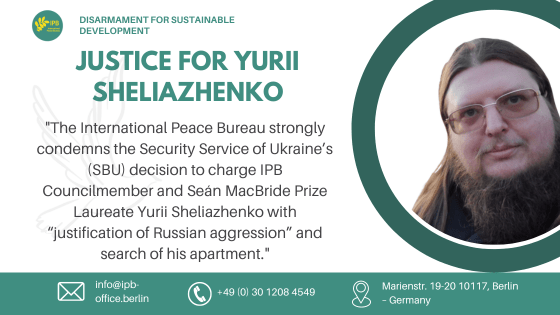
Justice for Yurii Sheliazhenko

Berlin, Germany – The International Peace Bureau strongly condemns the Security Service of Ukraine’s (SBU) decision to charge IPB Councilmember and Seán MacBride Prize Laureate Yurii Sheliazhenko with “justification of Russian aggression” and search of his apartment. The charge is based solely on Sheliazhenko’s “Peace Agenda for Ukraine and the World,” a document which explicitly condemns the Russian invasion of Ukraine and promotes peace, justice, and the right to conscientious objection to military service.

Yurii and his organization, the Ukrainian Pacifist Movement, have always opposed both sides of the current war and advocated for dialogue, negotiations, and a peaceful resolution which addresses the underlying causes of the war.

We call on the Ukrainian government and the SBU to respect the rights of conscientious objectors and the right to free speech for peace in Ukraine, rights that cannot be violated even during times of war. We vow to support Yurii’s rights and to rally international support for his freedom and wellbeing.

Yurii’s response to the charges and search can be found at https://worldbeyondwar.org/we-object-to-the-illegal-search-and-seizure-at-apartment-of-yurii-sheliazhenko-in-kyiv/

A petition for the Ukrainian government to drop the prosecution of Yurri can be found here: https://actionnetwork.org/petitions/tell-the-ukrainian-government-to-drop-prosecution-of-peace-activist-yurii-sheliazhenko/

Please see attached Press Release.

Featured

Report – 2nd Negotiations Round on a Nulcear Weapons Ban Treaty

After the successful session in March 2017 and the publication of the draft of the Convention to prohibit nuclear weapons by the Chair Ambassador Elayne Whyte from Costa Rica, the Second round of negotiations on a Convention started on June 15th.

The sprit of the 125+ participating countries is productive and dynamic and no major disagreements have been stopping the hard works of the participants from going forward. Nuclear weapons States possessors and their allies, the countries who rely on nuclear weapons in their security doctrines, have chosen to boycott the process, except the Netherlands. Continue reading “Report – 2nd Negotiations Round on a Nulcear Weapons Ban Treaty”

‘You cannot tax poverty, you cannot extort the desperate.’

The Pamoja kwa Amani Coalition expresses its profound indignation and deep concern over the escalating economic oppression imposed on civilian populations by the AFC-M23 rebel movement in the areas under its de facto administration.

Since the start of the aggression, the cities of Bukavu and Goma, along with their surrounding areas, have experienced a complete breakdown of their economies:

Continue reading “‘You cannot tax poverty, you cannot extort the desperate.’”

Four years later – Ukraine: Europe trapped in the logic of rearmament

We have therefore reached the point of celebrating the transition from the fourth to the fifth year of war in Ukraine, with the weariness of a ritual that hides a tragedy, the war, which sees no end, and which should have been avoided. Four years that have changed Europe, exposing the weaknesses, and limitations of a Union of states still tied to a nation-state vision when the challenges of the 21st century are global: the environment, demographics, rights, security. The limitations of supranational organisations and authorities have their roots in that nineteenth-century vision that fits well with the constant need to identify an enemy, invoke national security to justify the arms race, the inevitability of war, and, in the meantime, reduce freedoms, rights, and repress protest.

Continue reading “Four years later – Ukraine: Europe trapped in the logic of rearmament”

Ukraine needs peace! Stop the bloodshed!

The war in Ukraine is entering its fifth year. Since Russia invaded the country in violation of international law, death and destruction have reigned. NATO’s confrontational policies and its long-standing refusal to seek a lasting and peaceful solution through diplomatic channels have contributed to the loss of so many lives.

Continue reading “Ukraine needs peace! Stop the bloodshed!”

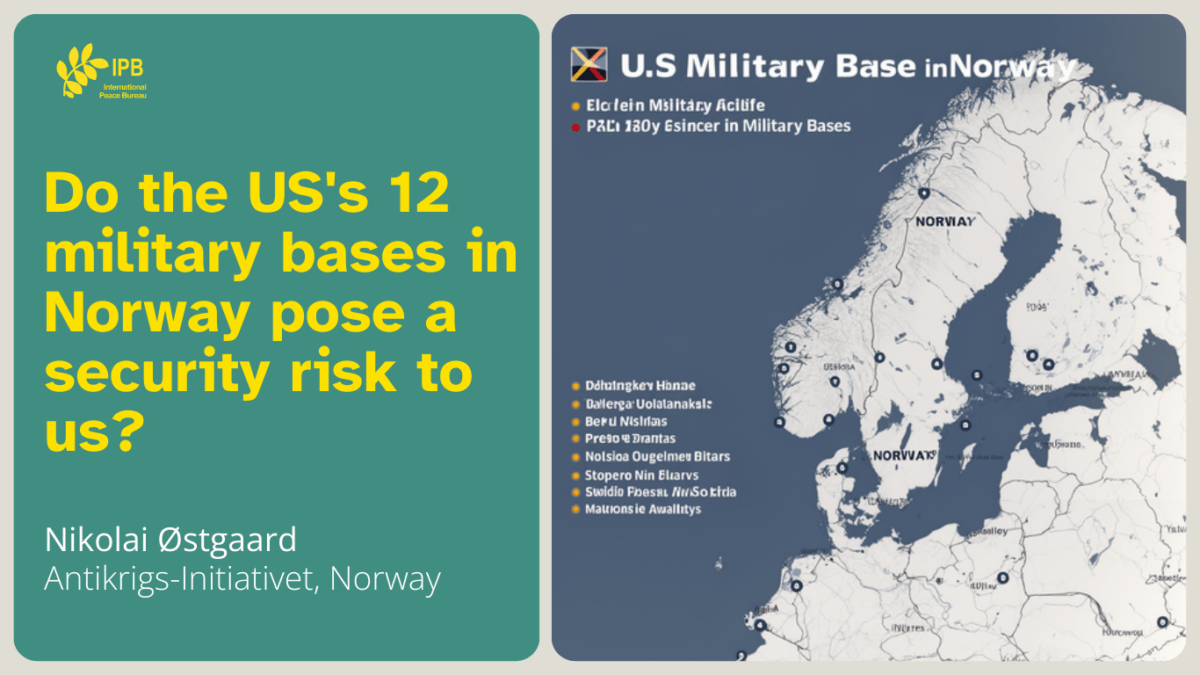
Do the US’s 12 military bases in Norway pose a security risk to us? 

The negotiations on the so-called “Agreed Facilities and Areas (AFA)” began, at the US initiative in 2018 under President Trump and Prime Minister Erna Solberg and led to 4 military bases in 2021. They were followed up by President Biden and Prime Minister Jonas Gahr Støre, and in 2024 the US received an additional 8 military bases in Norway. It was not as it is portrayed afterwards that Norwegian politicians wanted permanent US bases in Norway, as a protection against Russia. The background was a pronounced American request to have US military forces in allied countries and secure American “security inetersts”, not Norwegian ones. This is the same argument used for the US annexation of Greenland. In addition to the 12 military bases in Norway, the US has, over the past 5 years, entered into similar agreements for 35 military bases in Denmark, Sweden and Finland, so the US (not NATO) now has 47 military bases in the Nordic countries. Ten years ago, there were no such bases in the Nordic countries. If we include the Baltics, the number is 65. 

There are two big and important questions that need to be asked: Are these military bases? Do they ensure Norwegian security or do they pose a security risk to Norway? 

Continue reading “Do the US’s 12 military bases in Norway pose a security risk to us? “

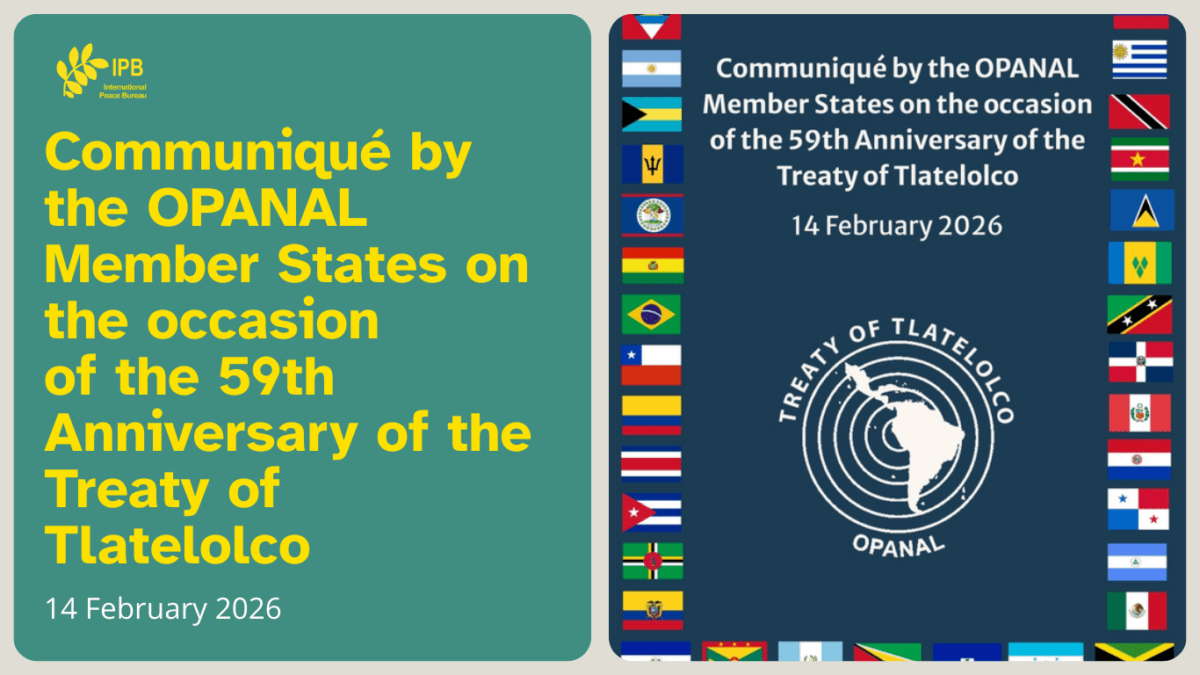
Communiqué by the OPANAL Member States on the occasion of the 59th Anniversary of the Treaty of Tlatelolco

14 February 2026

The 33 Member States of the Agency for the Prohibition of Nuclear Weapons in Latin America and the Caribbean (OPANAL):

1. Commemorate this day the 59th Anniversary of the adoption and opening for signature of the Treaty for the Prohibition of Nuclear Weapons in Latin America and the Caribbean (Treaty of Tlatelolco), which established the first Nuclear-Weapon-Free Zone in a densely populated area, has served as a source of inspiration for four other regions in the world and Mongolia.

2. Reiterate their deep concern over the threat to the survival of humankind posed by the existence of about 12,241 nuclear weapons1, as well as the catastrophic humanitarian impact and consequences of their use or any intentional or accidental detonation.

Continue reading “Communiqué by the OPANAL Member States on the occasion of the 59th Anniversary of the Treaty of Tlatelolco”

Joint Statement: 66 Years Since the First French Nuclear Explosion in Algeria

No Truth Without Transparency, No Justice Without Reparation

We, the undersigned organizations representing affected communities, Indigenous peoples, and advocates for the prohibition of nuclear weapons, environmental protection, human rights, and the promotion of peace, come together to commemorate the sixty-sixth anniversary of the first nuclear explosion carried out by France in the Algerian desert on 13 February 1960. On that day, France detonated its first nuclear bomb in Reggane under the name “Gerboise Bleue,” committing a historic wrongdoing that opened a dark chapter of human and environmental harm whose effects persist to this day.

Continue reading “Joint Statement: 66 Years Since the First French Nuclear Explosion in Algeria”

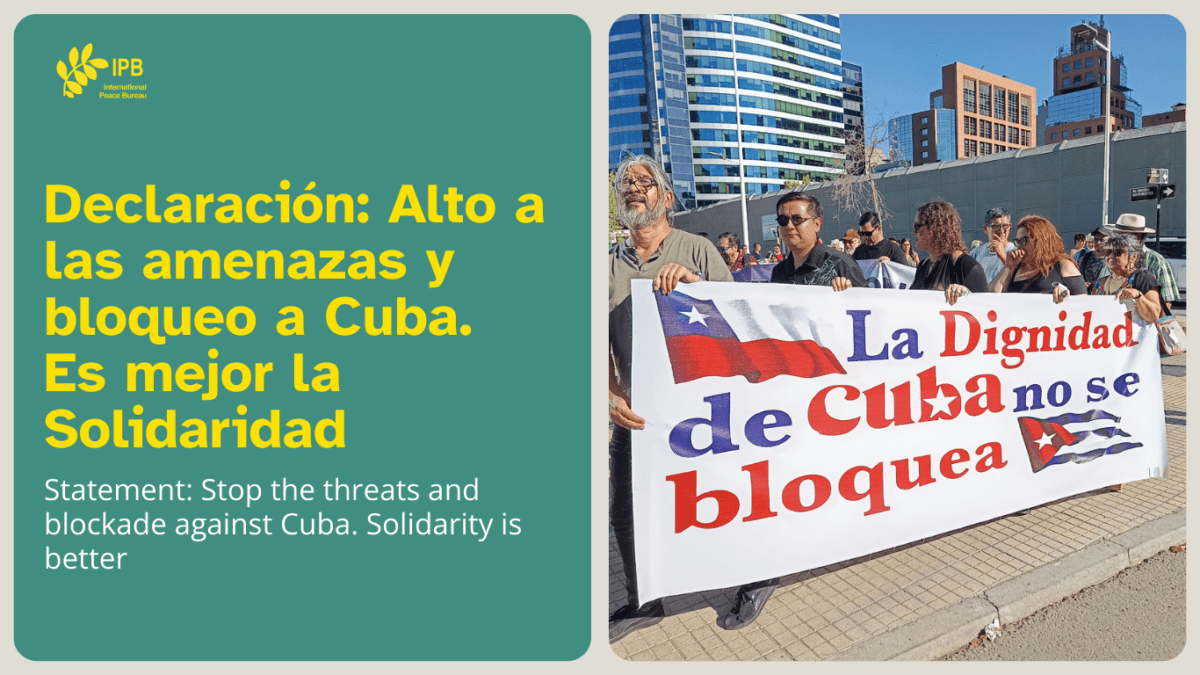
Declaración: Alto a las amenazas y bloqueo a Cuba. Es mejor la Solidaridad

Queremos expresar nuestra más profunda solidaridad con el pueblo de Cuba, frente a las recientes agresiones políticas, económicas y diplomáticas de las que es objeto por parte del gobierno de los Estados Unidos. Estas acciones no son hechos aislados, sino parte de una política histórica de hostigamiento e injerencia que busca someter la soberanía de un país que ha decidido transitar un camino propio.

Continue reading “Declaración: Alto a las amenazas y bloqueo a Cuba. Es mejor la Solidaridad”

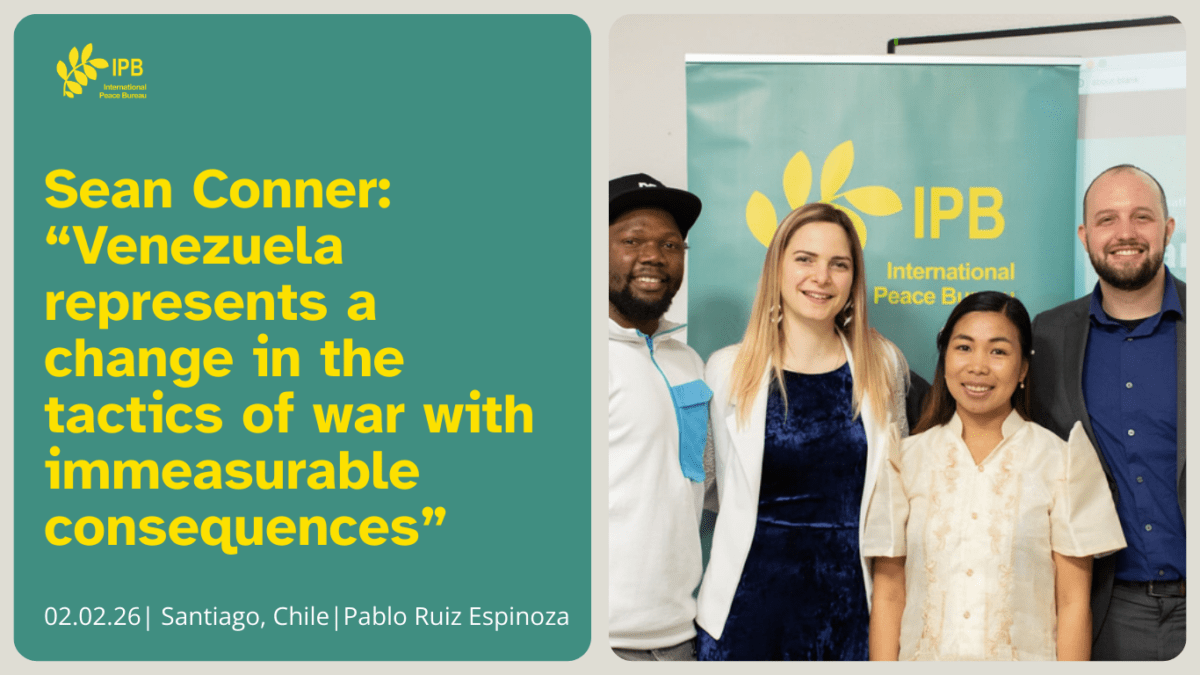
Sean Conner: “Venezuela represents a change in the tactics of war with immeasurable consequences”

02.02.26- Santiago, Chile – Pablo Ruiz Espinoza in Pressenza International

The attack on Venezuela by the United States and a series of threats, the application of sanctions and punishments, through blockades or the raising of tariffs, against Mexico, Cuba, Colombia, Iran, Canada, Greenland, among others, represent a clear threat to International Law, returning to the law of the strongest.

On the other hand, militarization continues in Europe, and four years will have passed since the start of the war in Ukraine, where efforts continue to perpetuate this conflict by sending more weapons and militarizing Europe itself.

On these topics, the following is an interview with Sean Conner, Executive Director of the International Peace Bureau (IPB). Conner holds a Bachelor of Arts degree in Intercultural and Critical Communication Studies from the State University of New York at Geneseo and a Master of Arts degree in Intercultural Conflict Management.

Continue reading “Sean Conner: “Venezuela represents a change in the tactics of war with immeasurable consequences””

Peace and Climate Circle – Regional Perspectives on the Interconnection between Militarization and Climate Justice in the Caribbean

The following report was written by La Ruta del Clima, a leading Latin American NGO on climate change, focused on political advocacy to promote citizen participation, with international recognition and standing.

On January 14, 2026, we began the year with an event that was deeply relevant to the political, social, and environmental context facing the region. This space aimed to make visible the interconnection between the climate crisis and the increase in vulnerability caused by processes of militarization in the Caribbean, promoting collective reflection and strengthening the active participation of civil society.

Continue reading “Peace and Climate Circle – Regional Perspectives on the Interconnection between Militarization and Climate Justice in the Caribbean”

Boris Kagarlitsky awarded 2025 Seán MacBride Peace Prize:’Courage endures where repression tries to break the human spirit’

Media Statement By: Boris Kagarlitsky International Solidarity Campaign, January 29, 2026

The Boris Kagarlitsky International Solidarity Campaign is proud that Boris Kagarlitsky was awarded the 2025 Seán MacBride Peace Prize, in company with the brave Palestinian human rights activists, Hania Bitar and Randa Siniora.

The prize is awarded annually by  the International Peace Bureau (IPB), of which Seán MacBride, co-founder of Amnesty International, was the chairperson from 1969 to 1974.

In her comment on the recipients of the prize, IPB co-president Corazon Valdez Fabros said:  “In a world scarred by occupation, genocide, and war, Hania, Randa, and Boris light the path forward. They show us that peace is not the quiet after violence, but the fire of resistance to injustice. Their voices rise where others are silenced. Their courage endures where repression tries to break the human spirit. We honour them and the organizations and sectors they represent — and every person who believes that justice is the only path to peace.”

Continue reading “Boris Kagarlitsky awarded 2025 Seán MacBride Peace Prize:’Courage endures where repression tries to break the human spirit’”