Press Release from the Pamoja kwa Amani Coalition Regarding the Signing of the Washington Agreements between the DR Congo and Rwanda and between These Two Countries and the United States of America

The Pamoja kwa Amani Coalition (C-PKA) is closely monitoring the various stages of the Doha and Washington peace processes.

The Pamoja kwa Amani Coalition welcomes the signing on December 4, 2025, in Washington, D.C., United States of America, by Their Excellencies Félix-Antoine Tshisekedi and Paul Kagame, of the peace agreement between the Democratic Republic of Congo and Rwanda under the auspices of US President Donald Trump.

The ratification by the two Heads of State of this agreement, which was signed by the foreign ministers of their two countries on June 27, 2025, is a significant step in the search for peaceful solutions to the incessant and repeated wars that have plunged eastern DRC into mourning for more than three decades.

The Pamoja kwa Amani Coalition also notes that, in addition to this peace agreement, other important agreements have been signed, notably the Regional Economic Integration Framework Agreement (CIER) and the bilateral agreement between the United States and the DRC on the one hand, and between the United States and Rwanda on the other.

The Pamoja kwa Amani Coalition, while welcoming these advances and thanking President Donald Trump for his involvement, notes the following:

  • While Washington and Doha are busy organizing tedious agreement signing ceremonies, the situation on the ground remains apocalyptic.

Clashes between the warring parties continue and are spreading across all fronts, exacerbating the suffering of the population, which is living in an indescribable humanitarian crisis without any assistance.

As the presidents sign in Washington, violent clashes are raging on several fronts, including Kamanyola, Kaziba, and Mwenga in South Kivu, with a heavy human toll, particularly in Kaziba, where more than 30 civilians have been killed by bombs dropped by the warring parties in the last 72 hours.

  • The total opacity and lack of transparency surrounding the Doha and Washington peace processes, and particularly the bilateral agreements signed between the various countries today in Washington, are not conducive to transparency and effective citizen control of all these agreements and mining deals.

Local communities, the primary victims of this security crisis in the east, have never been approached or listened to. The perpetrators agree and decide on the fate of their victims without the slightest consideration for them.

  • Agreements signed in complete illegality and illegitimacy. By deciding to sign agreements that bind the entire nation without involving the people, even through their representatives in Parliament, the President of the Republic is exceeding his powers and exposing the Congolese people of today and tomorrow to agreements relating to important issues, including natural resources and the territorial integrity and sovereignty of the entire nation. This peace agreement between the DRC and Rwanda must first be submitted to Parliament through a formal, not informal, referral, as stated by the spokesperson for the President of the Republic, in accordance with the spirit and letter of Article 214 of the Constitution.
  • The worrying absence of legally binding provisions and mechanisms, accompanied by a clearly defined system of sanctions likely to encourage the parties to strictly comply with their commitments, reduces the chances of all these agreements being implemented.

In light of all of the above, the Pamoja kwa Amani Coalition:

  • Urgently calls on President Donald Trump and the various US decision-making bodies to rectify the situation very quickly by:
  • Including legally binding mechanisms applicable in all relevant agreements, including targeted sanctions, verification mechanisms, specific timelines, and defined consequences for non-compliance, in order to compel stakeholders to end the war and suffering of the populations of eastern DRC and the entire Great Lakes sub-region. Without binding provisions, the chances of this agreement being respected by the parties involved are extremely low. Hence the legitimate concerns of the populations of eastern DRC.
  • By working to include local communities in all peace processes so that their legitimate expectations and demands are fully taken into account;
  • The President of the Democratic Republic of Congo to work for greater transparency and accountability in all actions involving the nation in accordance with the laws of the Republic and not to treat the resolution of this crisis as his private and personal affair;

The belligerents to show a sense of responsibility by actively working to end the war and violence that for three decades have continued to sow death, desolation, and suffering among a population that knows nothing of all these wars imposed upon it. End.

Done on December 5, 2025.

The Pamoja kwa Amani Moderation Team

Free Marwan: A Call for Freedom

November 29th is the International Day of Solidarity with the Palestinian People, and on this day, we are calling on organisations, solidarity movements, and community groups everywhere to raise their voices and demand the Release of Marwan Barghouti.

The International Campaign to Free Marwan Barghouti is providing files to print posters, flags and stickers to all groups wanting to join the call for Marwan’s release.

Continue reading “Free Marwan: A Call for Freedom”

Climate Collateral (2025 update): Why the military’s impact on climate change can no longer be ignored

The Core Conflict: Military Spending vs. Climate Action

The global arms race is overshadowing the urgent struggle for climate justice, even as temperatures hit record highs. In 2024, global military expenditure surpassed $2.7 trillion, a sum that fuels significant greenhouse gas emissions, drains essential resources from climate initiatives, and escalates the geopolitical tensions that hinder multilateral climate cooperation. A mere 5% reallocation of this military spending would yield $135 billion—more than enough to meet the long-overdue $100 billion global climate finance target.

Continue reading “Climate Collateral (2025 update): Why the military’s impact on climate change can no longer be ignored”

2025 Seán MacBride Peace Prize: A recognition of individual efforts towards peace and justice

21 November 2025, Berlin, Germany

The Seán MacBride Peace Prize, named after the Nobel Peace Laureate and IPB co-founder Seán MacBride, honors individuals and organizations who conduct outstanding work for peace, disarmament, and human rights.

Continue reading “2025 Seán MacBride Peace Prize: A recognition of individual efforts towards peace and justice”

Open Letter to MEPs ahead of the Budget 2026 vote by the StopRearmEurope Campaign

20 November 2025 – OPEN LETTER to the Members of the European Parliament (MEPs)

Over 800 organisations call Euro-parliamentarians to move the money from war to peace!

The StopReArm Europe (SRE) Campaign — of which IPB is one of the initiators and which is now supported by more than 800 organizations across Europe and beyond, with numbers still growing — has drafted an open letter to Members of the European Parliament, urging them to take a stand for peace during next week’s budget vote.

You can read and download the full letter on www.stoprearm.org, here: SRE Open Letter to MEPs 2025, and below.

Translations into other languages will also be published below and on the official website as soon as they are ready (disclaimer: only the original English version is authoritative).

If you would also like to receive the letter by email, together with additional information, you can still sign the SRE call on the website www.stoprearm.org and directly support our joint effort!

For any inquiries, you can also reach out to the coordination group using the following email address: contact@stoprearm.org.

Citizen Barometer of Peace, Security and Human Rights News

Citizen Barometer of Peace, Security and Human Rights (Issue 08, October 2025) | Written and produced by the Pamoja kwa Amani Coalition

This issue of the Citizen Barometer of Peace, Security and Human Rights (October 2025) by the Pamoja kwa Amani Coalition presents a grim assessment of the deteriorating situation in eastern Democratic Republic of Congo (DRC), despite ongoing international peace processes.

The report highlights the escalating conflict between the Congolese army (FARDC), their Wazalendo allies, and the Rwandan-backed AFC-M23 rebels. A central case study is the sudden and controversial closure of the Lomera gold mining site in South Kivu by AFC-M23 in August 2025. This decision has had devastating humanitarian consequences, leaving over 30,000 people destitute, triggering widespread unemployment, increasing insecurity, and leading to human rights abuses, including forced recruitment and summary executions. The Coalition suggests the closure may be linked to plans for large-scale, illicit exploitation by the rebels or foreign interests to fund their war efforts.

The document details widespread ceasefire violations by all parties, with significant civilian casualties and displacement. A table for South Kivu in October 2025 alone records 95 killings, 195 abductions, and 60 recovered corpses, illustrating the severe human cost. The security vacuum has also led to the proliferation of poorly regulated Wazalendo armed groups, which commit serious human rights violations, recruit children, and contribute to general lawlessness.

The report condemns the exploitation of natural resources as a primary driver of the conflict, noting AFC-M23’s control over numerous mining sites. It also raises alarms over the militarization of World Heritage sites like Kahuzi-Biega National Park and the AFC-M23’s imposition of its own administrative systems and visas in controlled areas, seen as steps towards the “balkanization” of the country.

In conclusion, the Coalition argues that current peace agreements are failing due to a lack of binding enforcement. It issues an urgent appeal to US President Donald Trump to apply decisive pressure on the belligerents. It also welcomes the establishment of a UN Commission of Inquiry and calls for international support to ensure justice, end impunity, and achieve a sustainable peace that includes local communities.

4Days4Peace in Barcelona

4Days4Peace – Barcelona, October 23–26, 2025
Organized by the International Peace Bureau (IPB) and the Centre Delàs d’Estudis per la Pau

From October 23 to 26, 2025, Barcelona hosted 4 Days 4 Peace, a series of events co-organized by the Centre Delàs d’Estudis per la Pau and the International Peace Bureau (IPB), with the support of the Barcelona City Council. The gathering brought together peace builders, researchers, and activists from various fields around the world to exchange perspectives, coordinate strategies, and strengthen the global movement for peace and disarmament.

The event opened on Thursday, October 23, with the Centre Delàs Annual Conference 2025, titled Darkest before dawn. Pacifism in times of genocide and rearmament.” Held at Sala Sandaru, the conference reflected on two years of genocide in Gaza, Western complicity, and the growing normalization of militarism. Participants called for non-violence and alternatives to the policies of rearmament and authoritarianism.

The conference featured two main sessions: a dialogue on “Business and Complicity in the Genocide and Occupation of Palestine” with Shir Hever and Maha Abdallah, moderated by Laura Ferre Sanjuan (recording available on YouTube here); and a roundtable on “Rising Militarism and Power Politics in the International Arena” with Katerina Anastasiou, Joseph Gerson, and Corazon Valdez Fabros, moderated by Antonella Di Matteo (recording available on YouTube here).

On Friday, October 24, participants took part in workshops and strategy sessions organized around four thematic areas:

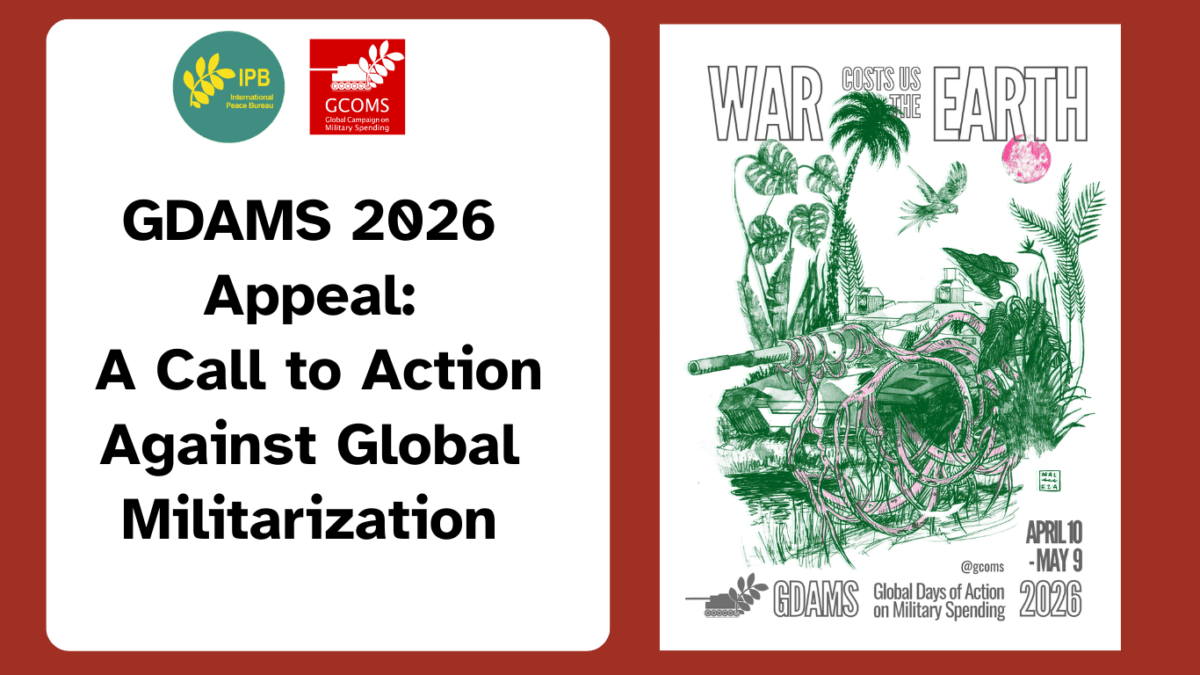
  1. Global Disarmament and Militarization – the risks of global rearmament and the need for civil society–led disarmament initiatives was addressed. Topics such as the impact of militarization on austerity policies and public welfare, the diversion of resources from social, environmental and next-generation programs, and ethical concerns related to war and genocide where discussed. Initiatives such as GDAMS, StopRearmEurope, the No to NATO network, the 10% for All campaign agreed to build synergies between the campaigns for stronger collective impact and proposed setting a common global mobilization date to unify efforts and increase visibility.
  2. Geopolitical Shifts and Global Governance Reform – how to strengthen international law, multilateralism, and the UN system to respond to current crises was explored. Proposed future visions included decentralizing global power structures, democratizing global institutions, reforming the UN system and redefining the notion of security. For each of these proposals, the role of IPB was discussed, highlighting the importance of focusing on areas of greatest impact like using IPB’s network to promote peace education, advocacy, and mobilization, facilitating dialogues around Common Security to review and revitalize the concept regionally, strengthening cross-movement cooperation and functioning as a knowledge exchange hub where alternative assessment reports are elaborated, deepening IPB’s distinctive voice.
  3. Solidarity with Palestine and Peoples Impacted by Militarism Worldwide – coordinating civil society action in solidarity with affected communities in Palestine, Sudan, DRC, Cameroon, Myanmar, and Ukraine was the focus of the workshop. Solidarity platforms, webinars, conferences linking movements across regions, workshops integrating different analyses and investigative journalism efforts exposing violations of human rights were highlighted as examples of current strategic actions. Looking forward, it was suggested that solidarity strategies are framed by decolonial and justice-based lenses that prioritize the following: ensuring solidarity is interactive and grounded in local realities, strengthening the promotion of democratic and peace-oriented initiatives and broadening anti-imperialist analysis, among others.
  4. Stronger Together: Linking Peace, Climate, Social, and Gender Justice – examining the interconnected nature of the conflicts and global issues we are facing today. Participants highlighted the need to give space to underrepresented voices, bridge generational and regional divides, and remain mindful of power dynamics that can replicate forms of oppression even within peace movements; they also highlighted the gap between state and human security – noting that as the former expands, the latter often declines – and called for peace work rooted in people’s daily realities. Concrete examples included cooperation between U.S. and Russian students through joint photography projects, union engagement for peaceful redistribution and workplace democracy, and cross-movement trust-building between peace and environmental activists. The Helsinki+50 process was recognized as an opportunity to foster East–West and North–South dialogue. The session concluded with a proposal to organize joint actions around Earth Day (April 26). 

The weekend of October 25–26 was dedicated to the Triennial Meeting and General Assembly of the International Peace Bureau (IPB), the organization’s highest decision-making body. The event brought together 19 Board and Council members in person from the different regions in the world and 16 Board and Council members online, along with several individual members and external observers who joined both onsite and remotely—bringing the total to over 50 participants. Representatives of member organizations and partner networks engaged in formal and informal discussions, reviewed the progress made since the last Annual Council Meeting in 2024 and the last Triennial in 2022, and contributed to shaping IPB’s strategic direction for the coming years.

During the meeting, 19 new organizational members that had applied in 2025 were formally approved, expanding IPB’s global network to a total of more than 400 organizational members and 450 individual members. In addition, five resolutions were provisionally adopted:

  1. Global Governance in a Shifting Geopolitical Landscape
  2. The Importance of Cross-Movement Collaboration during Overlapping Crises
  3. The Urgency of Disarmament Revitalization
  4. Digitalizing IPB’s Data Management and Expanding Communication Platforms and Budget
  5. Consolidation of IPB Consultants into a Formal Experts Group

The Assembly also approved the financial report for the previous year and adopted the 2026 budget.

All reports, materials, and resolutions adopted during the Triennial Meeting and General Assembly meeting will be made available shortly on the IPB website.

4 Days 4 Peace reaffirmed the commitment of IPB and Centre Delàs, as well as all the other participants, to challenge militarization, promote common security, and strengthen solidarity among global peace movements working toward a just and sustainable future.

UNSILENCE FORUM

[Press Release: Act X Palestine]

With figures such as Youmna El Sayed and Wael Al Dahdouh, who were Al Jazeera’s voices in Gaza, paying an enormous personal price; lawyer Raji Sourani, who is leading the effort to bring the Israeli government before the International Criminal Court; and Iranian activist Sanam Naraghi-Anderlini.

The UNSILENCE FORUM brings to Barcelona a historic debate on the future of democracy and peace in the Euro-Mediterranean region

From 14 to 16 November, journalists, human rights defenders and activists from more than 20 countries will gather in Barcelona to think, create and resist in the face of genocides, occupations and rearmament, with first-hand testimonies from Gaza and across the region, in a unique gathering framed within the global call ACTxPALESTINE.

Continue reading “UNSILENCE FORUM”

The International Peace Bureau Calls for Action to Protect Civilians in Darfur, Sudan

El Fashir, the last standing city in Darfur, Sudan, has fallen to the Rapid Support Forces (RSF). And civilians are facing mass humanitarian atrocities. 

For more than 550 days, the city had been under siege, devastated by the systematic cut off of aid, food, and medicine. Thousands were killed through execution, bombardment, starvation & severe malnutrition. In two days, more than two thousand people have been killed. 460 patients and their families were massacred inside the Saudi Maternity Hospital, medical staff were abducted, and an estimated 180,000 people remain trapped inside with no safe passage out. While the Rapid Support Forces broadcast videos of their own crimes, parading victims, and committing documented executions. The world’s response to these atrocities has been shameful.

IPB Co-President Joseph Gerson stated:

“In pursuit of arms sales profits and Sudan’s resources, cynical forces have made medieval brutality possible. It must stop, and the people of Darfur must be permitted to rebuild their lives and futures without fear.”

The International Peace Bureau does not accept the status quo of brutal violence, mass murder, and dominance, and we stand with the people of Sudan. We recognise that the first, fastest responders are the local networks of volunteer medics, community kitchens, and emergency response rooms, who continue to provide lifesaving assistance despite the collapse of state protection. Supporting these actors is central to saving lives and affirming human dignity during this systemic and unacceptable violence.

The International Peace Bureau calls on citizens, media, and governments alike to keep Sudan and their work visible, to challenge indifference, and to sustain public pressure for a cease-fire and opening of unrestricted humanitarian corridors to all affected areas in Darfur.