
By: Peace Movement Aotearoa
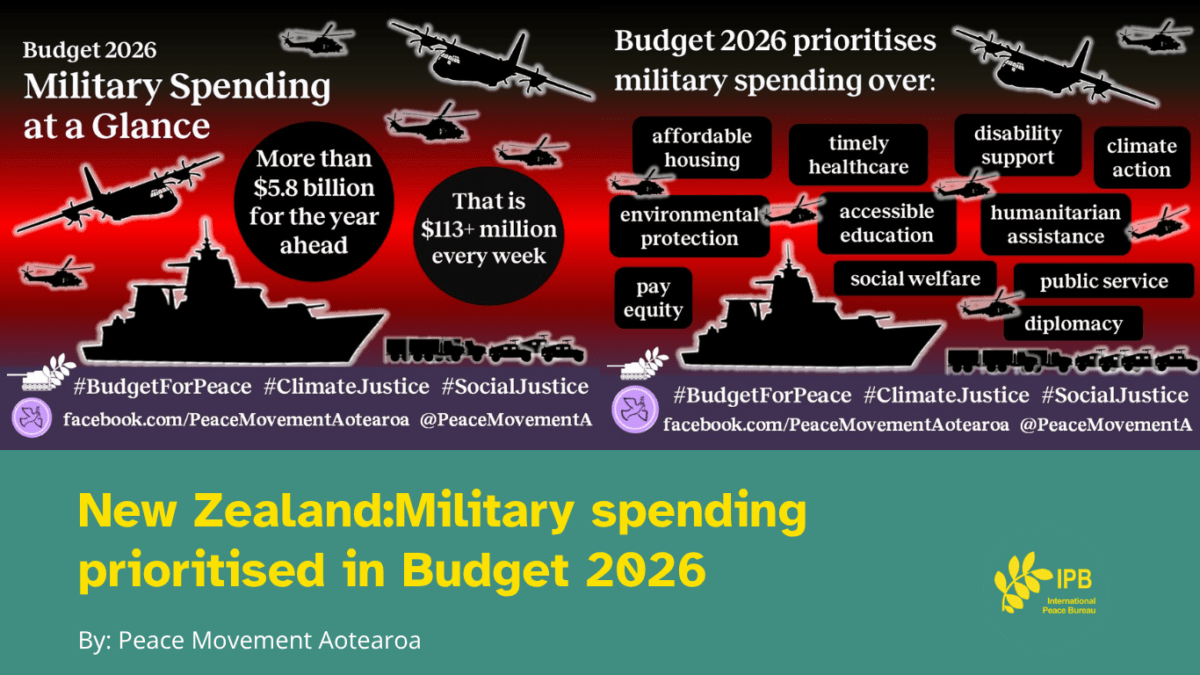
Military spending is prioritised again in this year’s Budget as New Zealand continues to pursue a range of militaristic fantasies as it seeks to be a combat capable “force multiplier” with “enhanced lethality and deterrent effect”.
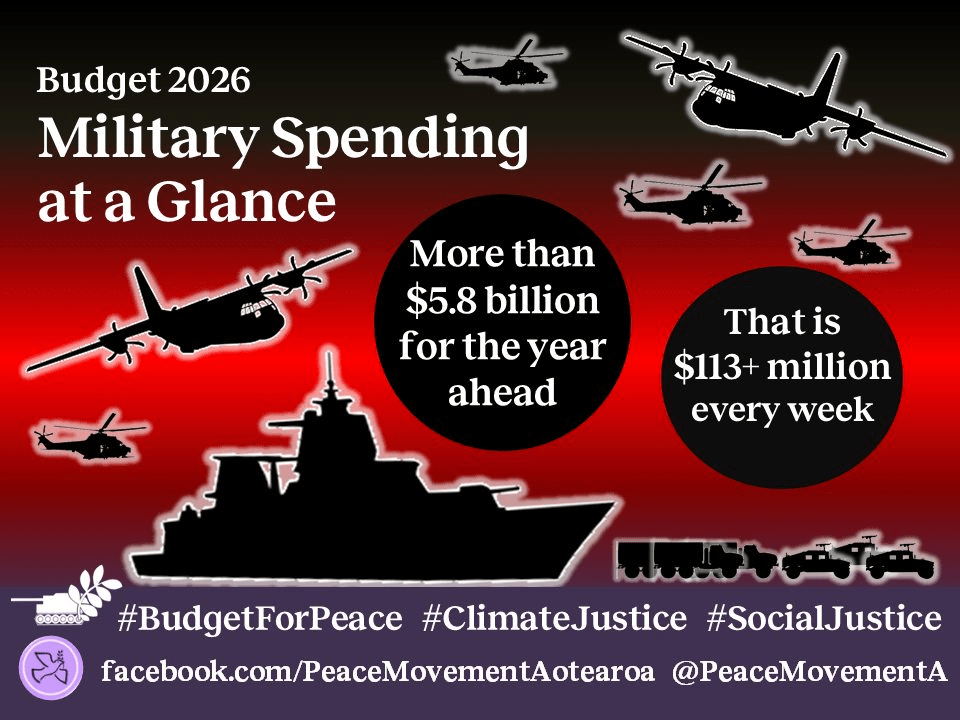
Amidst cuts to public services to eliminate “wasteful spending”, the rapidly escalating climate emergency and the desperate need for more funding for failing social services, military spending allocated this year increased to $5,882,661,000 [1] – an increase of more than 9.3% over actual military spending in the past financial year, which averages out to more than $113.1 million every week. This once more illustrates a government stuck in the same old thinking about ‘security’, choosing to focus on an outdated narrow concept of military security rather than real security that gives all New Zealanders the chance to flourish.
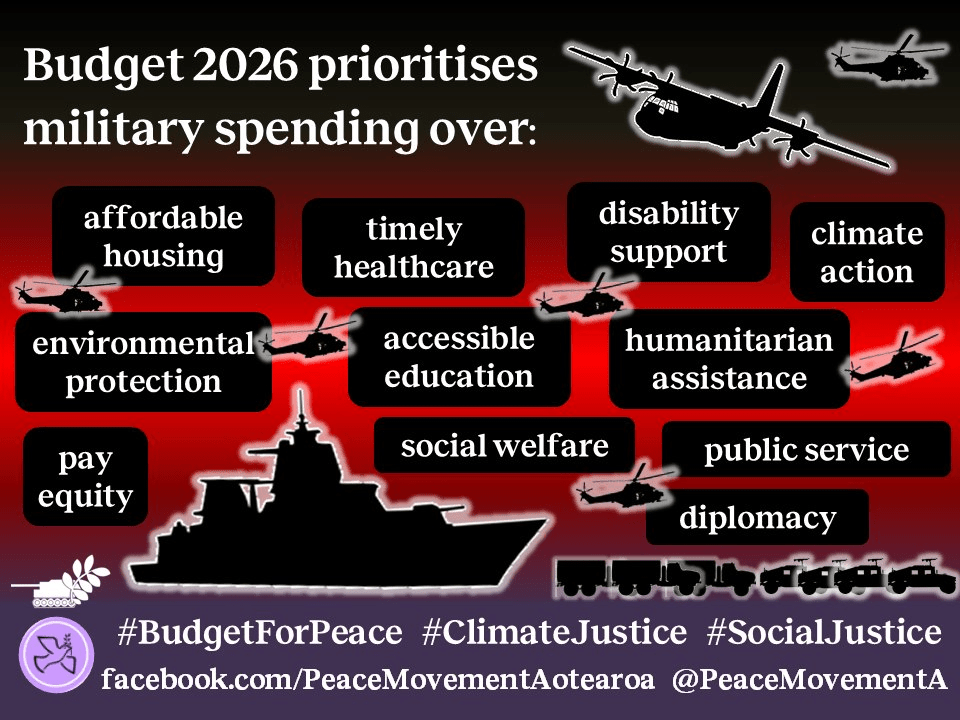
It is deplorable that public funding for combat-ready armed forces continues to be a spending priority when there are so many other major issues facing Aotearoa: the urgent need for climate action and assistance for communities impacted by severe weather events; the shameful levels of poverty and social inequality with more than half a million New Zealanders accessing food banks every month to feed themselves and their families, and one in seven children living in households contending with material hardship; the lack of affordable housing, especially as 84,000 households in social housing are having substantial rent increases imposed on them, and appalling levels of homelessness; the failing health system and substandard hospital buildings; the already inadequate level of support for persons with disabilities, recently cut again; significant public service job losses as thousands more public servants are to be replaced with AI, despite the 2026 Budget Policy Statement prioritising delivery of core public services; and a range of other areas requiring urgent attention.
Military spending negatively impacts all of these by diverting resources that could be put to better use.
While diplomacy and negotiation are clearly more positive ways for New Zealand to relate to communities in other parts of the world than deploying combat-ready armed forces overseas, the total allocated for the Ministry of Foreign Affairs (including all overseas development assistance and international climate financing) is one-third of the amount allocated for military spending.
Pacific leaders have repeatedly stated that the escalating climate emergency is the single biggest security threat to the region, but New Zealand continues to ignore that reality and refuses to move away from the destructive deadly ideology of militarism which harms the future of humanity and the planet. Combat capability cannot stop the rising tides, or protect us from catastrophic climate change: military activity is the ultimate in damaging unsustainability, with military emissions estimated to be at least 5.5% of the global total.
We urgently need to transition from combat-ready armed forces to civilian agencies that meet the wider security needs of all New Zealanders and our Pacific neighbours. Given New Zealand’s comparatively limited resources, it simply makes no sense to continue to spend billions on combat equipment and military activities every year.
Fisheries and resource protection, border control, and maritime search and rescue could be better done by a civilian coastguard with inshore and offshore capabilities, equipped with a range of vehicles, vessels and aircraft that are suitable for our coastline, Antarctica and the Pacific, which – along with equipping civilian agencies for land-based search and rescue, and for humanitarian assistance here and overseas – would be a much cheaper option as none of these require expensive combat hardware. [2]
That would also surely be a more useful contribution than New Zealand continuing to be involved in destructive full-scale combat assaults on land and sea through day-to-day military training, and military ‘exercises’ such as RIMPAC that are not only costly, but also harmful to the environment, marine and other life, while increasing New Zealand’s climate-destroying emissions and wasting non-renewable resources.
New Zealand could – and should – be leading the way to a positive future. Instead of continuing down the path of spending billions every year and allocating billions more over the next few years for “enhanced lethality” – including upgraded frigates, aircraft, missiles, vehicles, and drones – this is an opportune time to choose a new and better way forward. While unarmed drones for fisheries and resource surveillance make some sense in the context of New Zealand’s geographical position, it would be far more sensible to embed these drones within a civilian coastguard rather that a costly military context.
A transition from combat-ready armed forces to civilian agencies, along with increased funding for diplomacy, climate justice and social justice, would ensure New Zealand makes a far more positive contribution to wellbeing and security here in Aotearoa and at the regional and global levels, than it can by continuing to maintain and re-arm small but ridiculously expensive armed forces.
Military spending is a clearly identifiable area for enduring savings, and reducing it substantially was absolutely essential to achieve a Budget that really does eliminate wasteful spending of public funds: failing to do that due to indulgence in militaristic fantasies and a shameful enthusiasm for being an integral part of the global cycle of violence has resulted in a tragically missed opportunity to lay the foundations for a better future where all New Zealanders have a real chance to flourish.
Where you can get more information
• Further information is available on the Aotearoa New Zealand Campaign on Military Spending page, http://www.converge.org.nz/pma/gdams.htm
References
[1] Budget 2026 figures across the three Budget Votes where most military expenditure is itemised total $5,882,661,000 (Vote Defence Force $5,491,151,000; Vote Defence $309,071,000; and Vote Education $82,439,000 [cost of military-style service academies]
[2] For more information about the multiple costs of maintaining combat-ready armed forces and better ways forward, see ‘Submission: Budget Policy Statement for 2026’, Peace Movement Aotearoa, 4 February 2026, at https://www.converge.org.nz/pma/budget2026sub.pdf and ‘Submission: Defence Policy Review’, Peace Movement Aotearoa, 29 April 2023, http://www.converge.org.nz/pma/def-rev-sub,apr23.pdf
Disclaimer: This article was originally written by the author(s). The views expressed do not necessarily represent the official position of the International Peace Bureau.
This article comes from Peace Movement Aotearoa.