Militarism and major powers’ determination to maintain the status quo obstruct climate action, deepen extractivism, and exacerbate social inequalities and vulnerabilities.
This article was originally published in Ojo al Clima.
By Fiona Corr, a master’s student in Social Work at the University of Chicago.
02/09/2026
The role of military operations in international politics places the war machine above the survival of the planet, human dignity, and human rights. As a representative of the Human Rights and Climate Change Working Group stated during a meeting at the SB64 climate conference: this is no coincidence, but a deliberate choice made by the world’s major powers.
The interests of a handful of countries obstruct and undermine climate action. These countries provide military strength, funding, and support for armed conflicts, military occupation, and genocide. The international community’s prioritisation of militarism does not happen in isolation.
The pressures arising from human mobility, the climate crisis, and violence overlap and form a feedback loop, reinforced by international and domestic policies, governance systems, and social institutions and structures.
Growing militarism around the world promotes an extractive economy while exploiting, harming, and displacing vulnerable communities through direct violence, the wider impacts of war, and the consequences of climate change. Militarism not only reinforces rigid national border controls and extractivism, but also intensifies armed violence and oppression.
Unfortunately, the world is moving in the opposite direction from the solutions we need. Global military spending increases every year, worsening climate conditions and reinforcing dependence on fossil fuels.
In April 2026, the Stockholm International Peace Research Institute (SIPRI) reported that global military spending reached $2.887 trillion in 2025. The United States, China, and Russia were the three largest military spenders, with combined expenditure of $1.48 trillion, or 51% of the global total.
The wars of recent years have clearly exposed the problems associated with the link to fossil fuels. The inconsistency between obligations and actions extends beyond those directly involved in armed conflicts to other international actors that continue to purchase energy resources from aggressors. This relationship ultimately finances and supports countries such as Russia, the United States, and Israel, strengthening the use of energy as a weapon.
Another aspect of this problem concerns military greenhouse gas (GHG) emissions and uncertainty surrounding up-to-date data. There is a critical gap in the data provided by the countries with the highest military spending—the United States, Russia, and China—with information either incomplete or entirely absent. These countries’ lack of transparency and accountability must be addressed.
Military investment must be redirected towards climate finance, social support, and sustainable energy alternatives, prioritising human rights, peace, and justice.
The pursuit of justice through international courts must take account of both dimensions of war’s impacts. On the one hand are the direct consequences of war. On the other are its less obvious effects: vulnerable populations facing the wider consequences of these conflicts in the form of climate-related loss and damage.
Central America, for example, is a vulnerable region facing multiple environmental threats because of its diverse and distinctive characteristics. A 2021 publication by the International Organization for Migration (IOM) explains the multiple climate-related disasters and hazards facing Central American countries, including droughts, hurricanes, and changing rainfall patterns.
Among those most vulnerable to these events are women, children, Indigenous Peoples, fishing communities, and small-scale or subsistence farmers.
The pressure climate change places on existing problems makes it a “threat multiplier”: conditions already present within a society are intensified by the climate crisis, forming a mutually reinforcing relationship.
Central America’s population faces a precarious situation, despite the region’s minimal contribution to climate change. Countries such as Costa Rica have historically pursued peace and environmental protection, but they cannot achieve climate justice without international cooperation.
Militarism and its links to the climate crisis represent an enormous obstacle both to Central American countries seeking climate justice and to the international climate regime as a whole in fulfilling its obligations.
The connection between climate change and militarism can sometimes be difficult to uncover because of missing data or the complex relationships involved. This lack of data constitutes structural violence driven by the interests of those who profit from war and oil. The world’s major powers depend on this situation to pursue their own interests, evade responsibility, and withhold international cooperation.
The fact that much loss and damage is not immediately visible allows countries responsible for conflicts to maintain the status quo without facing intervention. As a result, they evade responsibility, avoid acknowledging the harm caused, and fail to fulfil their obligation to provide the corresponding climate reparations. This is precisely why the United Nations Framework Convention on Climate Change (UNFCCC) exists.
The struggle must continue, guided by robust science and just policies. Achieving a fairer future requires recognising militarism’s role as a barrier to climate peace.
Fiona Corr completed an internship with La Ruta del Clima, researching and writing about the complexities of international climate politics. Her work is inspired above all by human experience, the role of community, the relationship between nature and human beings, and climate justice.
This article was originally published in Ojo al Clima.
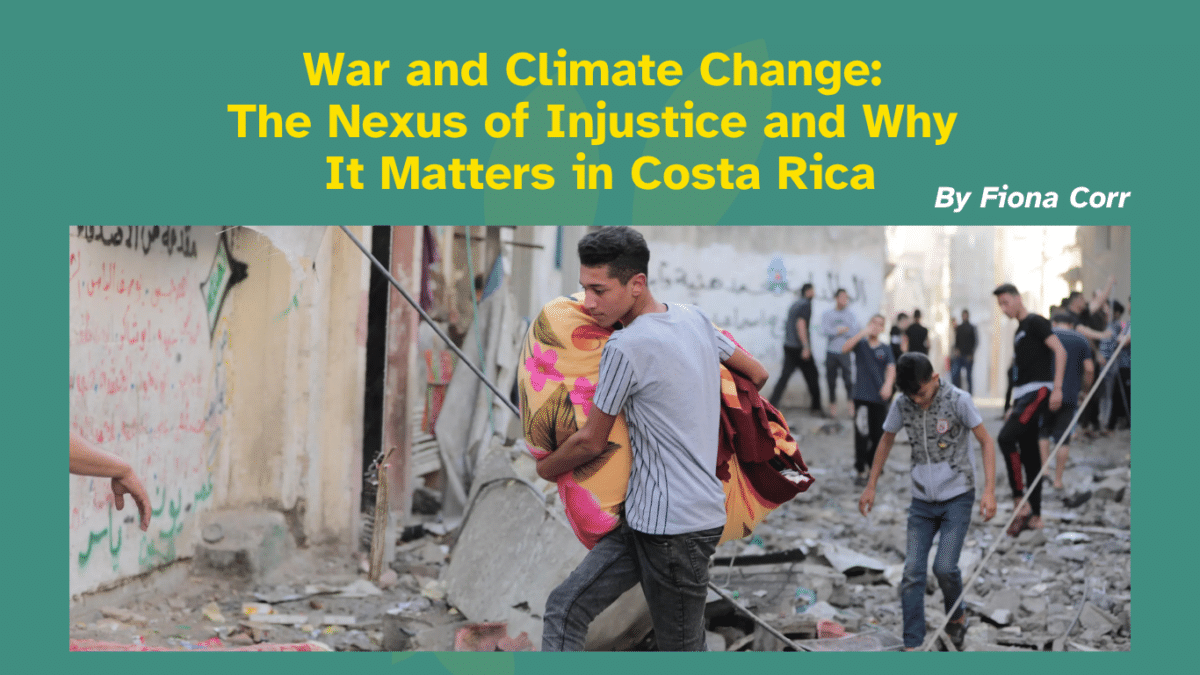
Image credit: hosny salah / Pixabay.