Pablo Ruiz E.*
Spanish | English. Please see the English translation below.
Desde América del Sur observamos con mucha preocupación la política, maniobras y ejercicios militares que realizan los países miembros de la OTAN en el mundo y que pueden desencadenar una tercera guerra mundial que tendría consecuencias devastadora para todos los países, incluida América Latina, ya que una tercera guerra mundial contra Rusia o China, eventualmente, podría involucrar armas nucleares.
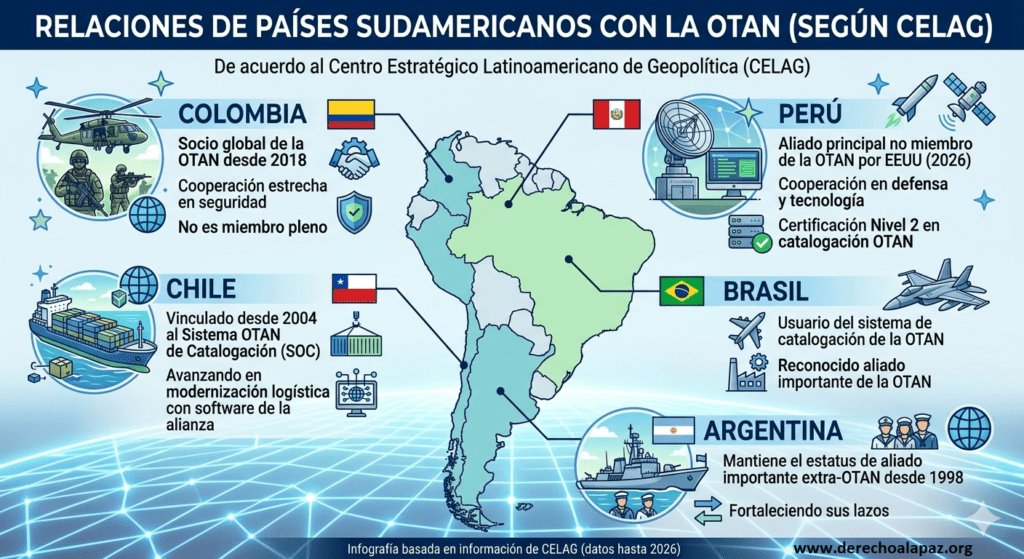
De acuerdo al Centro Estratégico Latinoamericano de Geopolítica (CELAG):
- Colombia: Es socio global de la OTAN desde 2018, lo que implica una cooperación estrecha en seguridad, aunque no es miembro pleno.
- Perú: Designado en 2026 como aliado principal no miembro de la OTAN por EEUU, facilitando cooperación en defensa y tecnología. Además, cuenta con certificación Nivel 2 en catalogación OTAN.
- Argentina: Mantiene el estatus de aliado importante extra-OTAN desde 1998, fortaleciendo sus lazos.
- Chile: Vinculado desde 2004 al Sistema OTAN de Catalogación (SOC), avanzando en modernización logística con software de la alianza.
- Brasil: Usuario del sistema de catalogación de la OTAN y reconocido aliado importante de la OTAN.
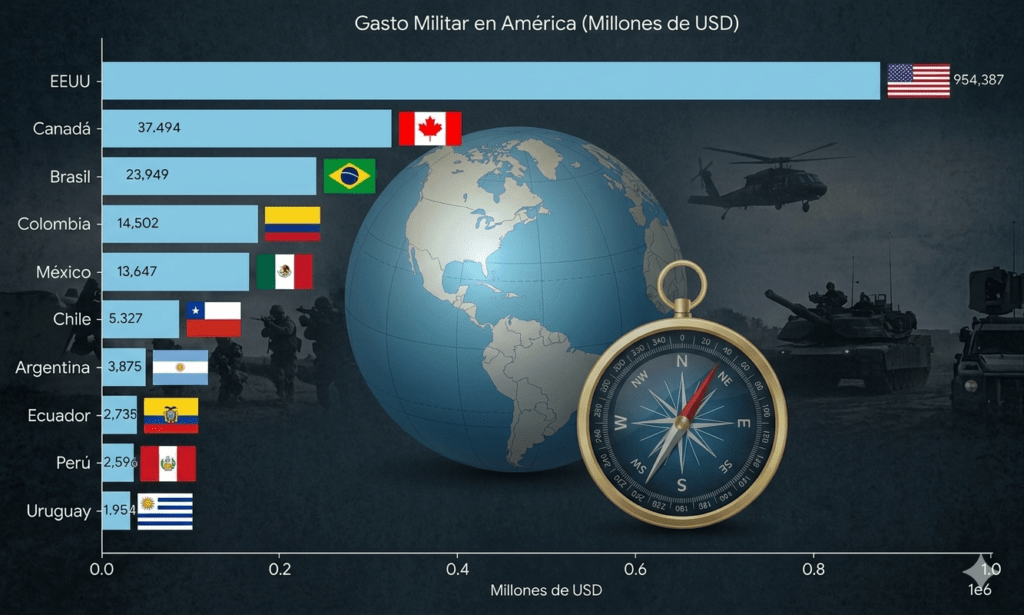
Todos estos países, Brasil, Colombia, Chile, Perú y Argentina, tienen los más altos gastos militares en América Latina. Por supuesto, en nuestro continente está el aliado más importante de la OTAN que son los Estados Unidos y también está Canadá con los más altos gastos militares.
En el caso de Chile queremos denunciar que el año 2025 la ex ministra de Defensa, Adriana Delpiano, y la embajadora de Alemania en Chile, Susanne Fries-Gaier, firmaron una “acuerdo técnico con Alemania que apunta a facilitar el intercambio de material militar” que, de paso, permitirá “el acceso a la logística del sistema OTAN -Organización de Tratado del Atlántico Norte-“.
La firma del acuerdo con Alemania es parte de una serie de requisitos de la OTAN para que Chile avance al Nivel 2, lo que permitirá al país catalogar sus propios productos y ofrecerlos en esta vitrina internacional.
El año pasado también, el diario electrónico El Mostrador denunció que existía una operación secreta entre Chile y Alemania. Alemania pedía a Chile la transferencia de al menos 30 vehículos de combate de infantería Marder 1A3. Estos carros de combate, posteriormente, serían enviados a la guerra en Ucrania que es de público conocimiento el gobierno alemán le está enviado equipamientos y armas a Ucrania en esta guerra contra Rusia.
Como organizaciones manifestamos al Ministerio de Defensa de Chile nuestro rechazo a esta venta o transferencia de estos carros de combate y pedimos al gobierno neutralidad y que pusiera fin a esta operación. No estamos de acuerdo que Alemania involucre a Chile en ninguna guerra.
Como ven, Alemania está muy activa en asuntos militares y sumemos a esto que un informe del Organismo Internacional de Energía Atómica (OIEA) señala que Alemania ha alcanzado, en secreto, las capacidades para fabricar sus propias armas nucleares. Aunque digan que no tienen intenciones nosotros no creemos lo que dice el gobierno alemán porque en la práctica podrían fabricar armas nucleares en muy poco tiempo lo que es concordante con su discurso belicista y sus intenciones de construir el ejercito mas poderoso de Europa y su apoyo a la política de disuasión nuclear que impulsa la OTAN.
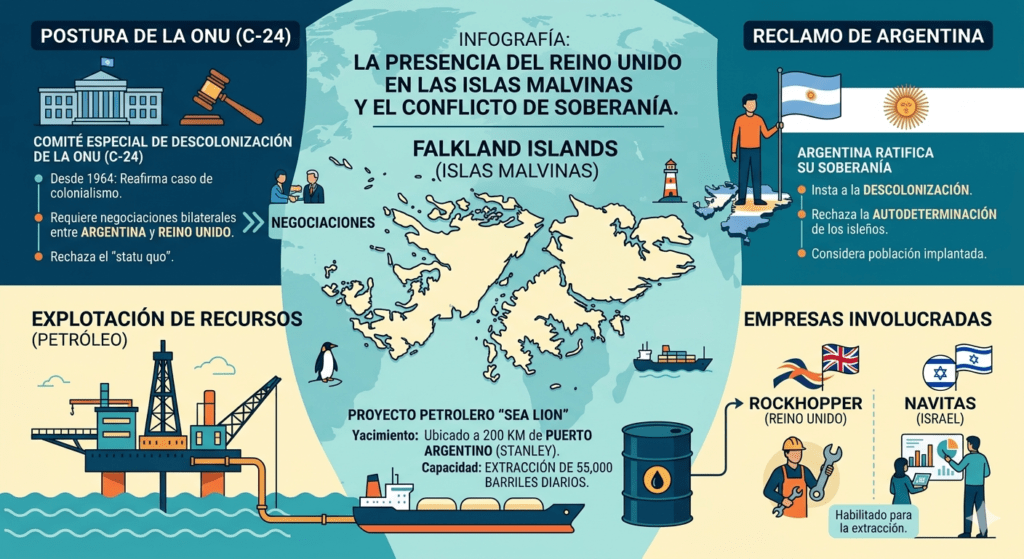
También es preciso señalar que en América Latina sigue la presencia del Reino Unido en las Islas Malvinas donde han realizado en estos años diversos ejercicios militares para asegurar el control estratégico del Atlántico.
El Comité Especial de Descolonización de la ONU (C-24) examina anualmente la “Cuestión de las Islas Malvinas” desde 1964, reafirmando que es un caso de colonialismo que requiere negociaciones bilaterales entre Argentina y el Reino Unido. Argentina ratifica su soberanía e insta a la descolonización, rechazando la autodeterminación isleña.
Asi mismo, Página 12, denunció “un nuevo avasallamiento del Reino Unido sobre la soberanía argentina y sus recursos, el gobierno local de las Islas Malvinas habilitó el proyecto de las petroleras Rockhopper, del Reino Unido, y Navitas, de Israel, para extraer 55 mil barriles diarios en el yacimiento Sea Lion, ubicado a 200 kilómetros de Puerto Argentino”.
La OTAN es un instrumento para la guerra y para que las grandes empresas de armamento sigan haciendo negocios y lucrándose con la muerte y la destrucción. Al mismo tiempo, son instrumentos para el saqueo de recursos naturales y para la geopolítica del petróleo.
Denunciamos el ataque a Venezuela y la extorsión que realiza el gobierno de los Estados Unidos y las sanciones impuestas unilateralmente contra el pueblo venezolano.
Denunciamos el bloqueo unilateral contra Cuba y las amenazas constantes que hace Estados Unidos de atacar a este país considerado por Washington como una amenaza. Denunciamos que EEUU sigue manteniendo control ilegal en Guantánamo que no es solo una base militar sino también una cárcel.
Finalmente, manifestamos nuestro apoyo con las diversas iniciativas de la Red Internacional No a la Guerra, No a la OTAN ya que es deber de todos defender la paz y el derecho a la autodeterminación de los pueblos.
* Este artículo ha sido preparado y compartido en el webinario “OTAN: ¿sigue expandiéndose a nivel global?” organizado por IPB y la Red Internacional No a la Guerra, No a la OTAN.
Pablo Ruiz es periodista egresado de la Universidad Academia de Humanismo Cristiano. Es coordinador del Observatorio por el Cierre de la Escuela de las Américas en Chile (organización afiliada a World BEYOND War y a la International Peace Bureau). Es editor de la Revista El Derecho de Vivir en Paz www.derechoalapaz.org
Fuente: https://www.derechoalapaz.com/america-latina-no-a-la-guerra-no-a-la-otan/


English version using automated translation.
Latin America: No to War, No to NATO
From South America, we observe with great concern the policies, maneuvers, and military exercises carried out by NATO member states around the world, which could trigger a third world war with devastating consequences for all countries, including Latin America. A global war against Russia or China could ultimately involve nuclear weapons.
According to the Latin American Center for Geopolitics (CELAG):
- Colombia has been a NATO global partner since 2018, implying close security cooperation, although it is not a full member.
- Peru was designated by the United States in 2026 as a Major Non-NATO Ally, facilitating defense and technology cooperation. It also holds NATO Level 2 cataloguing certification.
- Argentina has maintained Major Non-NATO Ally status since 1998, strengthening its ties with the alliance.
- Chile has been linked to the NATO Codification System since 2004 and has advanced its logistical modernization using NATO software.
- Brazil uses NATO’s cataloguing system and is recognized as an important NATO partner.
These countries—Brazil, Colombia, Chile, Peru, and Argentina—have the highest military expenditures in Latin America. Of course, the continent is also home to NATO’s most important ally, the United States, as well as Canada, both of which have very high military spending.
In Chile, we wish to denounce the fact that in 2025 former Defense Minister Adriana Delpiano and the German Ambassador to Chile, Susanne Fries-Gaier, signed a “technical agreement with Germany aimed at facilitating the exchange of military equipment,” which would also provide “access to the logistics of the NATO system.”
The agreement with Germany forms part of a series of NATO requirements for Chile to advance to Level 2 status, enabling the country to catalogue its own products and offer them through this international system.
Last year, the online newspaper El Mostrador reported on a secret operation between Chile and Germany. Germany reportedly requested the transfer of at least 30 Marder 1A3 infantry fighting vehicles from Chile. These vehicles would later be sent to the war in Ukraine, where Germany is publicly known to be supplying equipment and weapons.
As organizations, we expressed our opposition to the Chilean Ministry of Defense regarding the sale or transfer of these combat vehicles and called on the government to maintain neutrality and end the operation. We do not agree with Germany involving Chile in any war.
Germany is highly active in military affairs. In addition, an International Atomic Energy Agency (IAEA) report is said to indicate that Germany has secretly acquired the capability to manufacture its own nuclear weapons. Although German authorities deny any such intention, we do not trust these assurances because, in practice, Germany could develop nuclear weapons in a very short period of time. This aligns with its militaristic rhetoric, its ambition to build the most powerful army in Europe, and its support for NATO’s nuclear deterrence policy.
It is also important to note the continued presence of the United Kingdom in the Falkland Islands (Islas Malvinas), where military exercises have been conducted in recent years to maintain strategic control of the South Atlantic.
The UN Special Committee on Decolonization (C-24) has examined the “Question of the Falkland Islands” annually since 1964, reaffirming that it is a case of colonialism requiring bilateral negotiations between Argentina and the United Kingdom. Argentina continues to assert its sovereignty claim and calls for decolonization, rejecting the principle of self-determination for the islanders.
Likewise, the newspaper Página 12 reported what it described as “a new encroachment by the United Kingdom on Argentine sovereignty and resources,” after the Falkland Islands government approved a project by the British company Rockhopper and the Israeli company Navitas to extract 55,000 barrels of oil per day from the Sea Lion field, located about 200 kilometers from Puerto Argentino.
NATO is an instrument of war that allows major arms corporations to continue profiting from death and destruction. At the same time, it serves as a mechanism for the exploitation of natural resources and the geopolitics of oil.
We denounce the attacks on Venezuela, the pressure exerted by the United States government, and the unilateral sanctions imposed on the Venezuelan people.
We also denounce the unilateral blockade against Cuba and the constant threats made by the United States against the country, which Washington considers a threat. We further denounce the continued U.S. control of Guantánamo, which is not only a military base but also a prison.
Finally, we express our support for the various initiatives of the International No to War, No to NATO Network, as it is the duty of all people to defend peace and the right of peoples to self-determination.
This article was prepared and presented during the webinar “NATO: Is It Still Expanding Globally?” organized by the International Peace Bureau (IPB) and the International No to War, No to NATO Network.
Pablo Ruiz is a journalist who graduated from the Academy of Christian Humanism University. He coordinates the Observatory for the Closure of the School of the Americas in Chile (affiliated with World BEYOND War and the International Peace Bureau) and is editor of the magazine The Right to Live in Peace (El Derecho de Vivir en Paz).