
By: Francesco Vignarca, Rete Italiana Pace e Disarmo, English and Italian
Militarism is deeply connected to the climate crisis. By prioritizing the domination and extraction of fossil fuels, it fuels conflict and causes environmental damage. Military operations require enormous amounts of energy, and armed forces are among the largest institutional consumers of fossil fuels and leading emitters of greenhouse gases worldwide.
As military spending continues to rise, it not only fuels wars and increases emissions but also diverts vital resources away from urgently needed climate solutions.
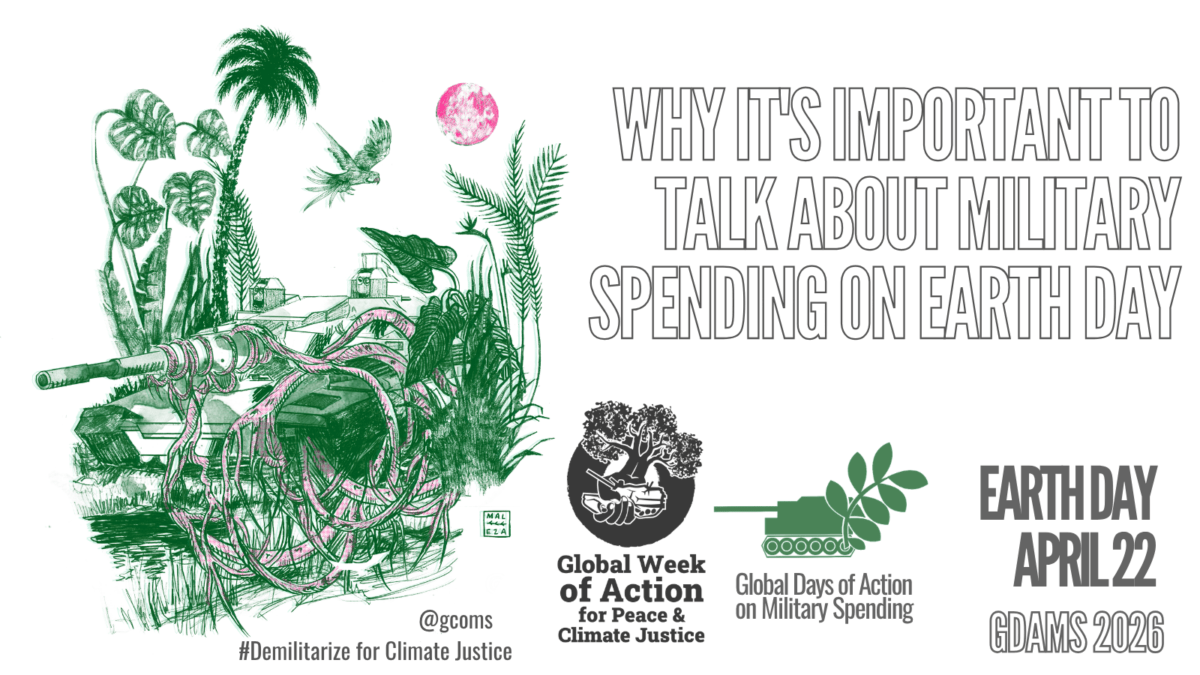
This Earth Day, it is important to highlight these issues within the framework of the Global Days of Action on Military Spending to demand concrete and urgent change from governments. This initiative, coordinated by the Working Group on Arms, Militarism and Climate Justice, reflects a growing awareness that peace and climate justice are closely interconnected.
Let’s fight for reduced military spending and to redirect resources towards climate action , care, and a just transition.
Join us on Earth Day 2026 in support of the Global Campaign Against Military Spending and its international GDAMS days: Demilitarize for Climate Justice!
Militarism and the Climate Crisis: Key Points
Militarism and the climate crisis are deeply intertwined, yet this connection often remains invisible in public debate. The military is among the world’s largest institutional consumers of fossil fuels, powering jets, warships, military bases, and vast global supply chains that generate enormous—yet largely unreported—greenhouse gas emissions. Globally, militaries are estimated to be responsible for approximately 5.5% of annual emissions; if they were a country, they would rank as the fourth-largest emitter, after China, the United States, and India. The U.S. military alone is the largest institutional emitter of greenhouse gases in the world.
The scale of the problem is staggering. Every additional $100 billion in military spending generates approximately 32 million tons of CO₂ equivalent—roughly the annual emissions of 23 million cars. Global military spending reached at least $2.7 trillion in 2024 and continues to rise, with projections suggesting it could reach $6.6 trillion by 2035. The top twenty military spenders have generated at least 10 billion tons of CO₂ equivalent in military-related emissions in the first quarter of the 21st century, while collectively spending around $40 trillion on their arsenals since 2001.
The relationship between militarism and fossil fuels extends beyond direct emissions. Control over oil and gas reserves has long fueled geopolitical conflict: between 25% and 50% of interstate conflicts since 1973 have been linked to oil. Fossil fuel extraction is frequently militarized, with armed forces and private contractors deployed to protect infrastructure and suppress local resistance. Between 2012 and 2023, more than 1,900 environmental and land defenders were killed worldwide, with Indigenous peoples and women disproportionately affected.
Armed conflict further accelerates environmental destruction. Israel’s war in Gaza generated an estimated 33.2 million tonnes of CO₂ equivalent in its first 15 months—comparable to Jordan’s annual emissions. Russia’s war in Ukraine has caused climate damage estimated at 311 million tonnes of CO₂ equivalent. Between 1950 and 2000, nine out of ten armed conflicts occurred in biodiversity-rich areas, leading to deforestation and long-term ecological damage that persists long after fighting ends.
Proposals to “green” the military offer a false solution. There is little evidence that armed forces can decarbonize at the scale or speed required. Weapons systems being deployed today—such as F-35 fighter jets, expected to remain in service well beyond 2050—lock in fossil fuel dependence for decades. Military emissions are typically excluded from national climate targets, and existing commitments remain vague and insufficient.
At the same time, the world’s wealthiest countries spend thirty times more on their militaries than they allocate to climate finance for vulnerable nations. Yet reallocating just 15% of global military spending in 2024—approximately $387 billion—would be enough to cover the annual costs of climate adaptation in developing countries.
Reducing military spending and redirecting resources toward ecological transition is not only possible—it is one of the most powerful tools available to address the climate crisis while building a more just and peaceful world.
This version is an English translation. Please see the Italian version of the original article.