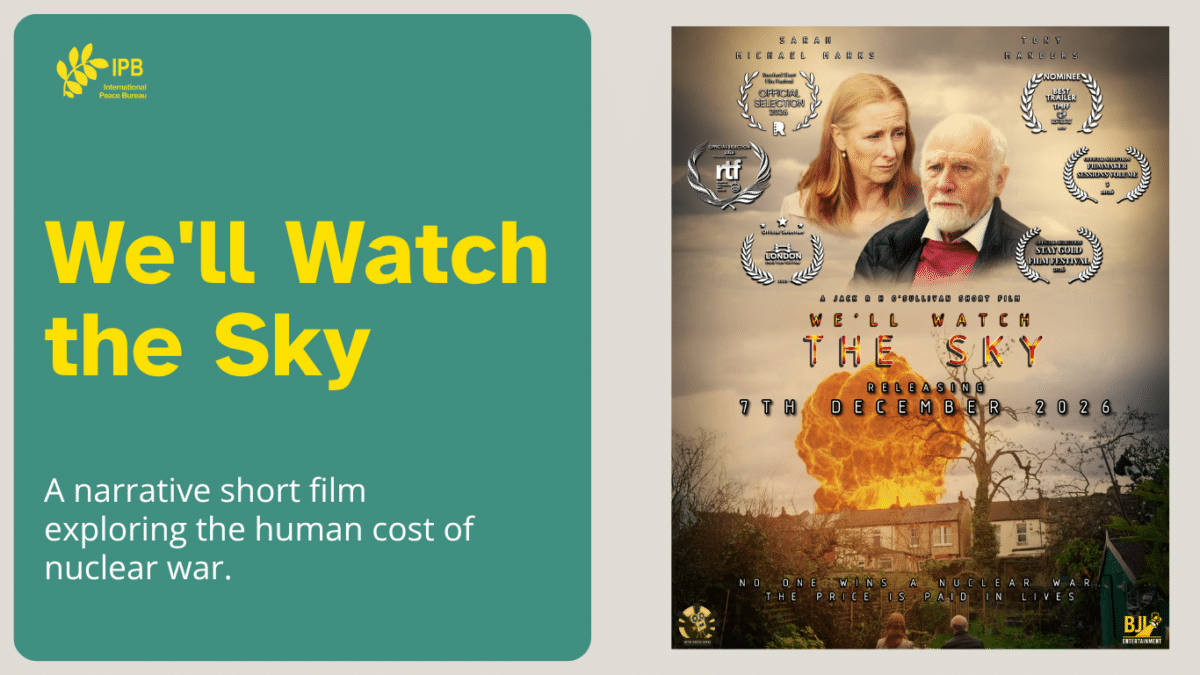
A short narrative film exploring the human cost of nuclear war through the people, relationships, and choices left in its final moments.
The film follows two estranged partners who find each other again in the final moments of a nuclear attack. Rather than focusing on the politics or mechanics of nuclear weapons, the film deliberately focuses on the people affected, asking what nuclear war actually means for ordinary people, relationships, and the people we would try to find when everything else has disappeared.
The film team is inviting organizations interested in screenings, educational events, awareness campaigns, online content, or discussions on the humanitarian consequences of nuclear war to get in touch. Visit https://moviemakingmedia.co.uk/
Directors Statement
I wrote ‘We’ll Watch the Sky’ in response to a persistent unease. Nuclear escalation is often framed as historical, yet its language remains present and increasingly normalised. The threat exists at a distance, but it is absorbed into daily life.
This film brings that distance closer. It focuses on Marian and Arthur, two people living within the quiet routines of later life, whose world is shaped by decisions made far beyond their reach.
The approach is deliberately restrained. The film stays with small actions and familiar rhythms. Conversation, hesitation, shared space. Their attempts at reconnection unfold in fragments, shaped as much by what is unsaid as what is spoken. These moments are ordinary, but they carry weight because they are fragile.
The political dimension emerges through attention. Public language reduces catastrophe to abstraction, but lived experience resists that scale. The film insists on the value of what is usually overlooked. A conversation in a kitchen. The act of staying. The possibility of forgiveness.
By the time the outside world begins to rupture, the intention is not to shock, but to clarify. Loss is no longer conceptual. It is specific, personal, and irreversible.
This film is concerned with proximity. Not the spectacle of destruction, but the intimacy of what disappears. –
Jack RH O’Sullivan