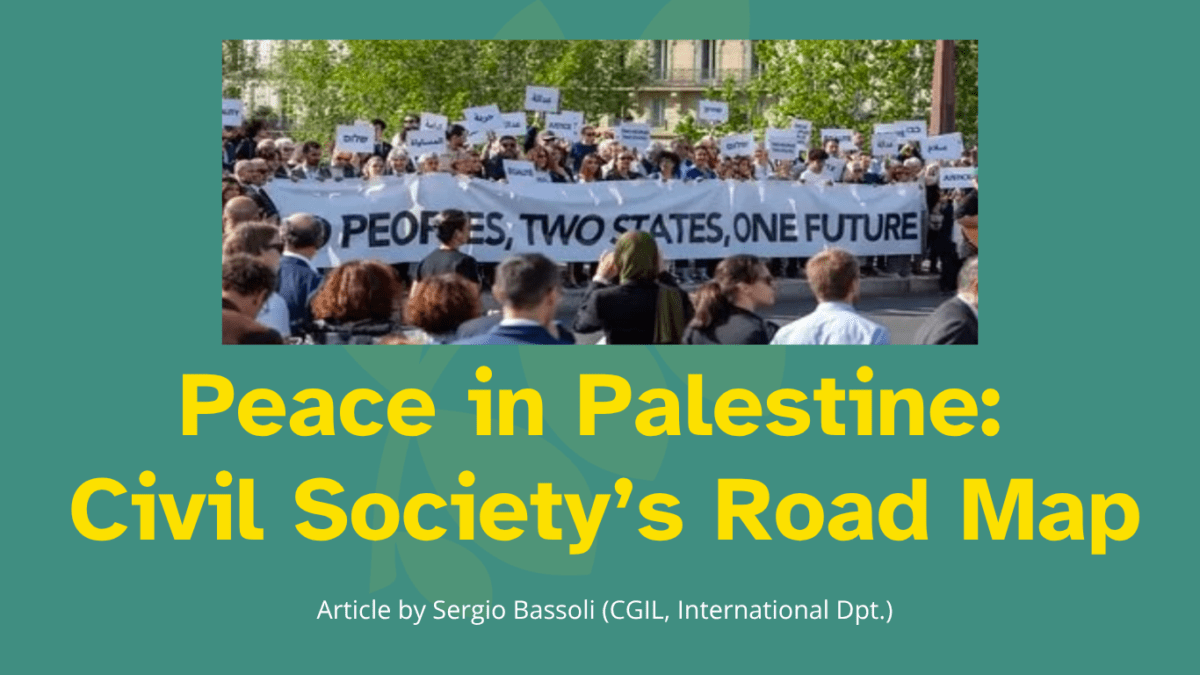
A conference entitled ‘Two peoples, two states, one future’ was held in Paris, during which an alternative proposal to the ‘Trump plan’ was drawn up. Numerous governments were present, but not Italy
On Friday 12 June in Paris, at the magnificent headquarters of the Arab World Institute, the second conference for peace between Israelis and Palestinians was held, convened by the French government under the banner of “2Peoples2States1Future”. This extraordinary event, attended by over 150 representatives of Israeli and Palestinian civil society, was initiated and organised with great commitment and involvement by the Minister for Europe and Foreign Affairs, Jean Noël Barrot, who placed the Palestinian and Middle East issues on the agenda of the G7 summit, chaired by France, thereby giving a voice and legitimacy to the proposals of Israeli and Palestinian civil society organisations committed to a lasting peace and coexistence between the two peoples.
A process that began precisely with a passage and a commitment set out in the G7 declaration, adopted in Italy (2024), where heads of state and government recognised the need to coordinate with one another “… to closely coordinate and institutionalise our support for civil society’s peace-building efforts, ensuring that these efforts form part of a broader strategy aimed at laying the necessary foundations for a negotiated and lasting peace between Israel and Palestine.” This was almost an admission of their own failures, but also an important and unusual opening for dialogue with civil society, which was immediately seized upon by Israeli and Palestinian networks that have been working for years – long before the dramatic crisis of 7 October – for the recognition of the State of Palestine, for equal rights and for shared security, but which had previously been systematically ignored.
And so, the Two-State Coalition, the Alliance for Peace in the Middle East and other important mixed networks and coalitions, comprising Palestinians and Israelis, have resumed the path of dialogue with commitment, courage and hope, through meetings, gatherings and a difficult but essential exchange of views, which has produced a package of concrete proposals, agreed upon by both sides, for a new road map to put an end to the ongoing wars and violence. This process has involved a number of key milestones: the first Peace Summit for the two-state solution, held in June 2025, again in Paris, and promoted by the French government, which produced the first declaration and the document of recommendations drawn up by Palestinian and Israeli civil society, which were presented at the United Nations during the High-Level International Conference on the Peaceful Resolution of the Palestinian Question and the Implementation of the Two-State Solution, co-chaired by France and Saudi Arabia, which served as the basis for the New York Declaration (July 2025), subsequently adopted by 147 states at the UN General Assembly in September 2025 – a genuine road map for reopening the peace process, learning from the mistakes of the past.
In a courteous manner, given the diplomatic and institutional context of the G7, this approach – along with the proposals, endorsements and participation of states and governments (represented at the Paris conference by ministers from Brazil, Switzerland, Canada, Norway, Ireland, Iceland, Andorra, Luxembourg, Norway, the United Arab Emirates, Qatar, Egypt and Turkey), represents an alternative to the peace plan promoted by the US administration, without breaking with the latter, but offering a political and diplomatic way out of an initiative that has failed to complete even phase 1 – the ceasefire and humanitarian assistance to the people of Gaza – let alone create the conditions for tackling the subsequent phases, ranging from disarmament to the withdrawal of the Israeli army, and from reconstruction to funding.
In any case, the final declaration is another step forward in the international dialogue that has opened up between governments and Palestinian and Israeli civil society, calling on all parties to fulfil their responsibilities through concrete proposals rather than mere declarations. However, in addition to the Declaration, the work carried out during the conference, first through the five working groups on: 1)Mutual Security for Palestinians and Israelis, 2) Humanitarian Aid and Reconstruction for Gaza, 3) Implementation of the Two-State Solution and Countering the Threats of Annexation, 4) A New Narrative, Democracy and Reforms, 5) Regional Integration, and subsequently through the plenary debates, has confirmed the strength and maturity of this process and of Palestinian and Israeli civil societies, which, whilst representing a minority of voices in the public arena, embody the silent majority within both societies.
The absence of our government and of other European governments from this dialogue is a source of bitterness and concern. “Time is now!” – as Palestinians and Israelis who are courageously working for equal rights and an end to violence continue to say – for decisions, not mere declarations. Two people, two states, one future: It couldn’t be clearer than that!
By: Sergio Bassoli (CGIL, International Dpt.)
Disclaimer: This article was originally written by the author(s). The views expressed do not necessarily represent the official position of the International Peace Bureau.