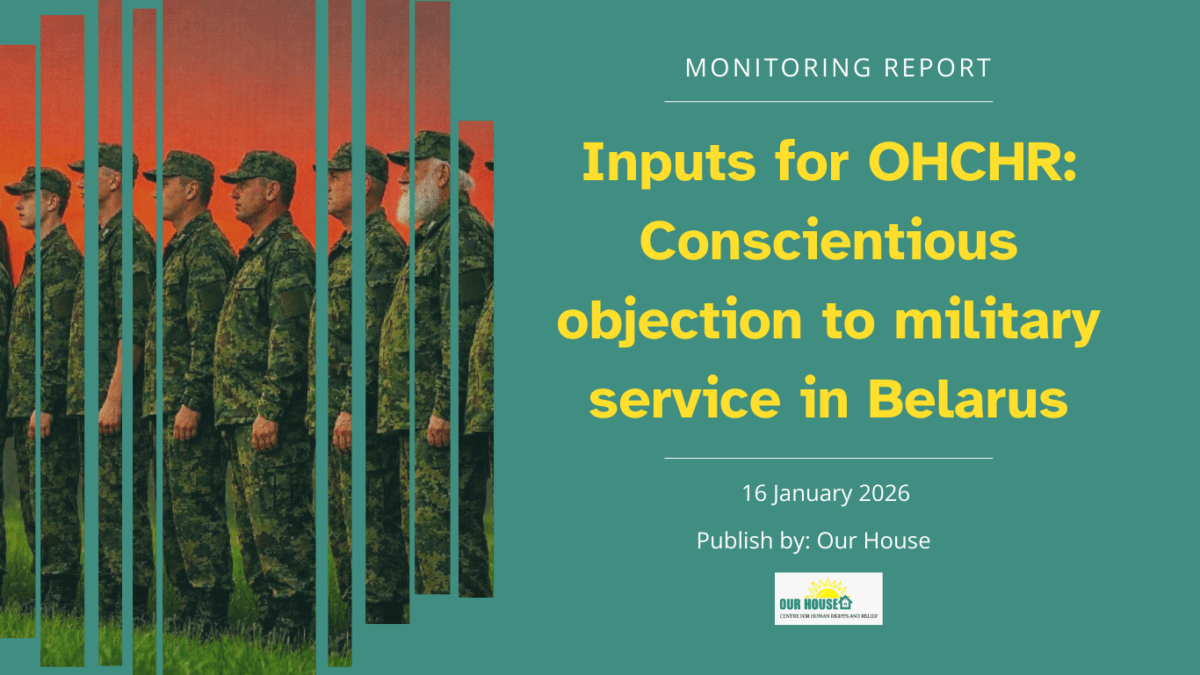
Belarus systematically suppresses conscientious objection, expanding criminal penalties, militarization, and coercive recruitment while undermining international human rights standards.
January 15, 2026
1. Brief summary
Belarus maintains compulsory military service for male citizens of conscription age (18-27 years), with conscription generally taking place twice a year. IIn 2025, this is confirmed by official documents on spring and autumn conscription.1 2
After completing their fixed-term military service, citizens are subject to enlistment in the reserve and continue to perform military duties until they reach the maximum age for remaining in the reserve, as established by the Law of the Republic of Belarus “On Military Duty and Military Service.” Depending on the reserve category and military category, this age is in some cases up to 60 years, and for certain categories of conscripts, up to 65 years.3 4
In wartime or when mobilization is declared, the law allows for the expansion of the age range for conscripts.5
2. Developments in 2025
2.1. Law on changes in criminal liability
On 17 February 2025, the President signed a law amending criminal legislation, including provisions related to Article 435 of the Criminal Code6 7, which increased liability for evasion of conscription and failure to report to military authorities.8
2.2. Preservation of conscription and the “trained soldier” concept
In 2025, official statements reaffirmed the preservation of compulsory military service and the emphasis on a “trained soldier,” alongside initiatives aimed at expanding public involvement in defence, including so-called “people’s militias.”9
3. Key challenges
3.1. Limited recognition
In Belarus, the right to refuse military service on grounds of conscience is limited: alternative civilian service is provided mainly on religious grounds10 and is in fact only available to a narrow circle of religious communities whose pacifist beliefs are recognised by state authorities (in particular, Jehovah’s Witnesses).11
As a result, persons with non-religious beliefs, as well as representatives of other religious denominations, are denied equal access to alternative service, which is discriminatory in nature.
3.2. Punitive alternative service
For many years, Belarusian society, including families of conscripts and human rights initiatives, has expressed concerns about the conditions of military service, including harsh drill, hazing, humiliation, and suicides, and other serious violations of military personnel’s rights.
In 2024, Alexander Lukashenko publicly acknowledged systemic problems in the Belarusian army, linking fear of military service to excessive drill and humiliation.12
In turn, alternative civilian service in Belarus is punitive in nature in terms of duration, since, in accordance with the Law of the Republic of Belarus “On Alternative Service“13, its term is 36 months, and for citizens with higher education – 24 months, which is twice as long as the term of compulsory military service (18 and 12 months, respectively).
3.3. Criminal sanctions
Given the limited access to alternative civilian service, the risk of criminal prosecution for refusing military service becomes a significant factor of pressure on individuals whose beliefs do not meet the narrow criteria for recognition as conscientious objectors. In 2025, changes were made to Article 435 of the Criminal Code of the Republic of Belarus, emphasizing tougher penalties for evading conscription.14
It is important to note that in Belarus, not only evading military service or desertion is punishable by law, but also assisting evaders or deserters, punishable by imprisonment for up to five years. This further restricts access to legal, humanitarian, and informational assistance.15
International standards recognize that the right to refuse military service on grounds of conscience should cover situations where beliefs are formed or changed after the start of service (“late crystallization of beliefs“). However, in Belarus access to alternative civilian service remains limited, and mechanisms for the recognition of conscientious objection after conscription or for reservists are effectively absent, preventing the full realization of this right. 16
An additional risk factor is the tightening of criminal policy. In 2023, Belarus expanded the application of the death penalty: amendments to Article 356 of the Criminal Code allowed the death penalty for “treason” committed by officials or military personnel.17 18
3.4. Criminalization of assistance
In Belarus, human rights and civil society organizations, as well as informal initiatives providing legal, humanitarian, and informational assistance to conscientious objectors and conscripts, are subject to systematic criminalization.
Criminalization is carried out, among other things, by recognizing organizations, initiatives, online resources, and materials assisting conscientious objectors as “extremist,” including online chats and information channels used to support conscripts.19
In particular, the human rights organization «Our House” and its affiliated websites and monitoring resources have been declared extremist, which significantly limits the ability to document violations and provide assistance to persons exercising their right to conscientious objection to military service.20
3.5. Conscientious objection and militarization
Although Belarus has not formally declared war, in 2025 official sources repeatedly emphasized the need to take into account the experience of modern armed conflicts, in particular the war in Ukraine, and to develop military training for the population while maintaining the model of compulsory military service.21
In this context, protecting the right to refuse military service on grounds of conscience takes on added significance, as it is intended to prevent the coercion of persons whose conscience or beliefs conflict with military activity from participating in such activity.22
3.6. Militarization of children
Public data and civil society monitoring indicate the systematic involvement of children and adolescents in military-patriotic programs linked to state security structures.23 State sources confirm the scale of these programs: according to the Ministry of Internal Affairs, 186 military-patriotic clubs operate nationwide, involving more than 6,000 schoolchildren.24
There have been reports of an expansion of military-patriotic camps and programs for certain categories of children, including those in residential care and from socially vulnerable families, with the participation of law enforcement agencies and other institutions.25
Such early and systematic militarization puts pressure on freedom of conscience even before conscription age.
3.7. Coercive recruitment
In October 2022, Belarus passed a law updating the grounds for granting deferrals from military service and reducing the number of persons eligible for deferral.26 In particular, the changes affected students studying abroad: deferrals were retained only for persons sent to study by the state.27 28
The procedures for notifying citizens of conscription activities were also expanded. Military commissariats were given the opportunity to inform citizens of the need to report for duty via SMS messages, in addition to the traditional written summons.29 30
At the same time, administrative control mechanisms for conscripts are being strengthened. As part of the military registration system, state authorities collect extensive personal data on conscripts, including information about their place of work, education, and parents and close relatives.31
In this regard, telecommunications operators are required to provide state authorities with access to data that allows them to identify potential conscripts, which is used, among other things, for military registration and mobilization planning purposes.32
For persons who refuse military service on grounds of conscience, coercive measures are comprehensive in nature and affect not only criminal and administrative liability, but also access to basic social rights. The absence of military registration documents is used as a basis for restrictions on employment (requirement to present military registration documents)33, when registering/changing registration at the place of residence (requirement for a military ID/conscript certificate with a military registration mark)34, as well as when accessing certain administrative procedures and documents.35
3.8. Right to international protection/refugee status
Public statements by international organizations emphasize that persons refusing military service and facing persecution may require international protection. In particular, in 2025, appeals were published on the need to protect Russian and Belarusian COs in the EU.36 Some human rights reviews report problems in providing protection to persons leaving Belarus due to conscientious objection (including cases documented in Lithuania).37
4. Recommendations
- Recognize the right to conscientious objection to military service for all individuals, including those with non-religious beliefs, in line with international standards.
- Provide alternative civilian service that is non-punitive in duration and conditions and genuinely civilian in nature.
- End criminal prosecution of conscientious objectors; ensure that the 2025 amendments on criminal liability are not used to increase pressure on conscientious objectors; and end the criminalization of human rights defenders and civil society organizations assisting them.
- Ensure that national security and military discipline regulations do not result in disproportionate sanctions against military personnel and persons associated with military service, including through the extension of the death penalty for “treason.”
- Repeal measures that narrow the grounds for deferrals and increase coercion into military service, and ensure that deferrals and exemptions are applied in a non-discriminatory manner.
- End and prevent the militarization of children and adolescents by ensuring that military-patriotic clubs, camps, and programs exclude military training, weapons handling, and recruitment elements, and allow independent monitoring of such programs.
- Eliminate coercive and non-transparent mechanisms for notifying and summoning conscripts, ensuring that electronic notifications are not used as a tool of pressure or to create a presumption of guilt, and guarantee legal certainty and the right to appeal.
- Ensure that the risk of persecution for conscientious objection is recognized as grounds for international protection, and that receiving states provide fair asylum procedures for such persons.
1 Decree No. 96 of 6 March 2025 On retiring and drafting personnel for active military service and reserve service | Official Internet Portal of the President of the Republic of Belarus
2 Decree No. 302 of 12 August 2025 On retiring and drafting personnel for active military service and reserve service | Official Internet Portal of the President of the Republic of Belarus
3 «О воинской обязанности и воинской службе» – тематические подборки НПА на Pravo.by
4 Предельный возраст состояния в запасе. Разряды запаса
5 Maximum Age Of Belarusians Subject To Mobilization Determined – Belarusian News – Charter’97
6 Lukashenko signs law on amendments to Codes on Criminal Liability | Belarus government official documents
7 Новое в уголовном законодательстве
8 Important Change For Conscripts Introduced In Belarus – Belarusian News – Charter’97
9 Lukashenko: Drones are the new reality, but nothing replaces a trained soldier | Belarus political events |Session in Belarus | Belarus legislation | Belarus elections
11 international_fellowship_of_reconciliation_belarus.pdf
12 Публичное выступление А. Лукашенко на заседании Республиканского совета ректоров; видеозапись и фрагменты речи опубликованы в официальных и провластных медиаканалах (Telegram-канал А. Лукашенко «Пул Первого», перепечатки в государственных и негосударственных СМИ
13 Закон Республики Беларусь от 04.06.2015 г. № 276-З «Об альтернативной службе» – Pravo.by
14 Important Change For Conscripts Introduced In Belarus – Belarusian News – Charter’97
17 Belarus: New Law Expands Application of Death Penalty and Extends Detention for Treason | Library of Congress
18 Amendments introducing death penalty for officials for treason to take effect in Belarus on March 25
19 Microsoft Word – 2025-04-07_Final_Belarus_UPR.doc
20 Microsoft Word – 2025-04-07_Final_Belarus_UPR.doc
21 Lukashenko: Drones are the new reality, but nothing replaces a trained soldier | Belarus political events |Session in Belarus | Belarus legislation | Belarus elections
22 httpOHCHR and conscientious objection to military service | OHCHR
23 How Children in Belarus Are Turned Into “Defenders of the Regime”
24 186 military-patriotic clubs operate under Interior Ministry’s auspices in Belarus
25 Belarus Ramps Up ‘Military-Patriotic’ Camps For Orphans And Other Vulnerable Children
27 Belarusian Students Studying Abroad To Be Drafted Into Army – Belarusian News – Charter’97
28 Cancellation of Military Deferment for Belarusian Students Studying Abroad – OUR HOUSE
29 Belarusians Subject To Military Duty Receiving Summonses En Masse – Belarusian News – Charter’97
30 Оповещение граждан — Военный информационный портал Министерства обороны Республики Беларусь
31 BELARUS: The brutal trap: How Belarus turns young men into hostages of the military machine | Human Rights Without Frontiers
32 Draft notices in Belarus will be issued via messages: Lukashenkо signs law | RBC-Ukraine
33 Статья 26 ТК РБ. Документы, предъявляемые при заключении трудового договора – Трудовой кодекс Республики Беларусь 2026
34 Регистрация по месту жительства граждан Республики Беларусь, иностранных граждан и лиц без гражданства, постоянно проживающих в Республике Беларусь
35 Belarus | European Bureau for Conscientious Objection
36 Joint statement on the protection of Russian and Belarusian conscientious objectors in the EU — IFOR
37 Belarus | European Bureau for Conscientious Objection
This monitoring report is written by Our House.