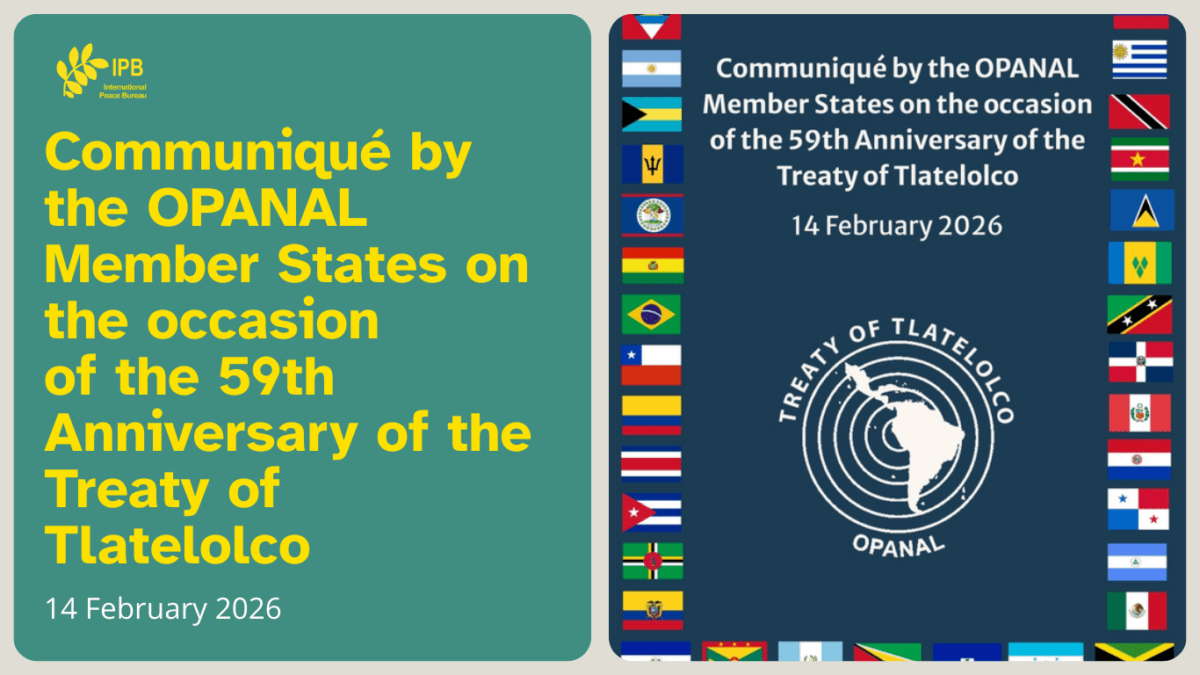
14 February 2026
The 33 Member States of the Agency for the Prohibition of Nuclear Weapons in Latin America and the Caribbean (OPANAL):
1. Commemorate this day the 59th Anniversary of the adoption and opening for signature of the Treaty for the Prohibition of Nuclear Weapons in Latin America and the Caribbean (Treaty of Tlatelolco), which established the first Nuclear-Weapon-Free Zone in a densely populated area, has served as a source of inspiration for four other regions in the world and Mongolia.
2. Reiterate their deep concern over the threat to the survival of humankind posed by the existence of about 12,241 nuclear weapons1, as well as the catastrophic humanitarian impact and consequences of their use or any intentional or accidental detonation.
3. Stress their great concern about the prevalent international situation, especially the increasing threat, explicit or veiled, of use of nuclear weapons; because many of those are on alert status, in a context of geopolitical tensions and armed conflicts and threats of terrorism. Demand that States that possess this type of weapons cease the qualitative and quantitative improvement and modernization programs of their nuclear arsenals, the development of new types of such weapons and of new scenarios and procedures for the development and employment of new types of such weapons, which is inconsistent with international law, in particular with the obligation to adopt effective measures towards nuclear disarmament.
4. Condemn once again unequivocally any use or threat of use of nuclear weapons, whether they be explicit or implicit and irrespective of the circumstances.
5. Demand that nuclear weapons never be used again, by any actor and under any circumstance. This can only be assured through the prohibition and subsequent transparent, verifiable, and irreversible elimination of all nuclear weapons.
6. Reiterate that, although the Nuclear-Weapon-Free Zones do not constitute an end in themselves, they do represent a step towards general and complete disarmament under effective international control. Therefore, encourage the establishment of new nuclear-weapon-free zones by means of arrangements freely arrived at among States of the respective regions.
7. Emphasize that the Nuclear-Weapon-Free Zones promote peace and stability at the regional and international levels by prohibiting the possession, acquisition, development, testing, manufacturing, production, stockpiling, deployment, and use of nuclear weapons; and reaffirm the priority of verifiable, irreversible, transparent and complete nuclear disarmament.
8. Reaffirm that the unequivocal and legally binding negative security assurances granted to the States belonging to Denuclearized Zones against the use and threat of use of nuclear weapons are a fundamental element for the nuclear non-proliferation regime and constitute a legitimate interest of the international community.
9. Call once again on the four States Parties to the Protocols I and II to the Treaty of Tlatelolco that issued interpretative declarations contrary to the letter and spirit of the Treaty2 and to international law, to continue examining them together with OPANAL aiming at revising or eliminating them in order to provide full and unequivocal negative security assurances to the States of the Nuclear-Weapon-Free Zone in Latin America and the Caribbean, and to respect the militarily denuclearized character of the region.
10. Reiterate their commitment to continue promoting the dialogue and cooperation among nuclear-weapon-free zones, including Mongolia. Regret that the Fourth Conference of Nuclear-Weapon-Free Zones and Mongolia has not been held to date, in accordance with resolution 73/71, adopted by the United Nations General Assembly on 13 December 2018.
11. Welcome the adoption of the United Nations General Assembly resolution A/RES/79/241 entitled “Comprehensive study of the question of nuclear-weapon-free zones in all its aspects”, promoted by the States Parties to the Treaty of Tlatelolco, as a contribution to the strengthening of existing nuclear weapon free zones and the establishment of new zones; and the convening of the Group of Qualified Experts by the UN Secretary-General, which is preparing the aforementioned study.
12. Commit to work constructively to the success of the 2026 Review Conference of the Parties to the Treaty on the Non-Proliferation of Nuclear Weapons (NPT), which will be held from 27 April to 22 May 2026, in New York, as this Treaty constitutes the cornerstone of the international nuclear nonproliferation and disarmament regime.
13. Take note that the First Review Conference of the Treaty on the Prohibition of Nuclear Weapons (TPNW), will be held from 30 November to 4 December 2026, in New York under the presidency of South Africa. Note that Latin America and the Caribbean is the region with the largest number of States Party to this international instrument, as well as that the TPNW has joined the Treaty of Tlatelolco and the NPT, on the path towards the elimination of these weapons of mass destruction in a transparent, verifiable, and irreversible manner.
14. Commend the firm conviction and permanent commitment of Latin America and the Caribbean to continue promoting complete and verifiable nuclear disarmament as a priority objective, and in manner consistent with the Proclamation of Latin America and the Caribbean as a Zone of Peace, reaffirming, in this regard, this condition in light of the current circumstances, in which the Member States reiterate their historic commitment to the principles of International Law, respect for sovereignty and territorial integrity, the prohibition of the use and threat of use of force, and the peaceful settlement of disputes.
15. Acknowledge that the current international environment, marked by the erosion of arms control mechanisms and the persistence of doctrines based on nuclear deterrence, calls for intensified collective efforts in support of nuclear disarmament and non-proliferation.