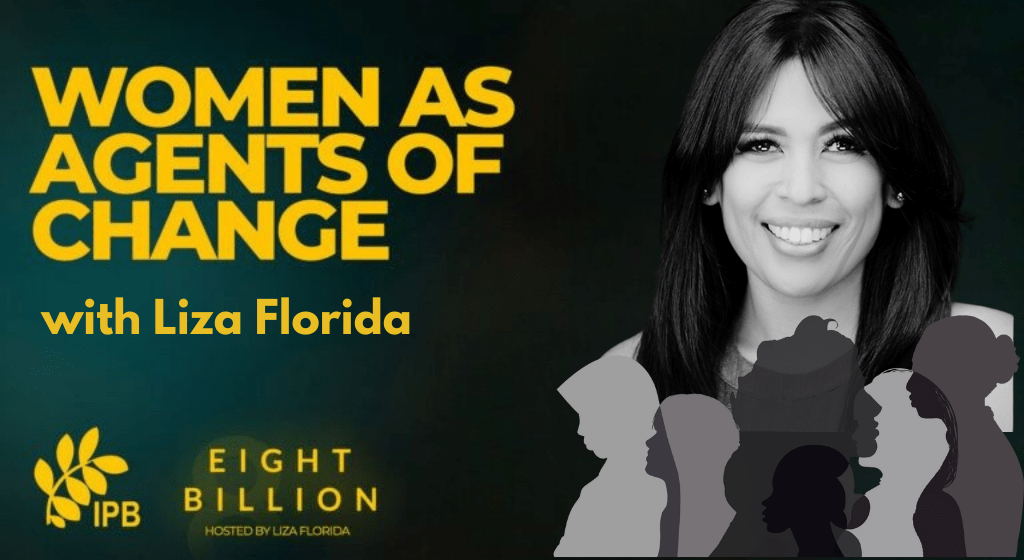
Presented by the International Peace Bureau in collaboration with the Eight Billion Podcast, this series celebrates the wisdom, vision, and transformative power of women working around the world to create a more peaceful, just, and sustainable future.
Women from diverse backgrounds have long been at the forefront of positive change. As pillars of peacebuilding and social transformation, their impact transcends generations. Through activism, the arts, community leadership, and cultural preservation, women continue to inspire movements for justice and shape societies through creative expression.
In each episode of Women as Agents of Change, Liza Florida speaks with inspiring women leaders from around the globe about their journeys, work, and visions for creating lasting peace and positive change.
Watch our Video Playlist on IPB YouTube:
Listen on your favorite podcast platform via Eight Billion Podcast Channels:
Episode 1: From Fabric to Flags: Runa Ray’s Global Call for Peace, Sustainability & the Power of Women
Fashion environmentalist and peace advocate Runa Ray joins host Liza Florida to explore how textiles, activism, and spirituality can transform global narratives. From her childhood in Bangalore to presenting her work at the UN, Runa shares a visionary journey that turns garments into peace offerings and seaweed into sustainable innovation.
Episode 2: Healing as Revolution: Trauma, Resilience & Human Rights with Esset Samatova
Explore the powerful intersection of trauma healing, human rights, and social change in this profound conversation with psychologist and poet Esset Samatova.
Esset shares her journey from a ninth-grade fascination with psychology to the front lines of activism, where she pioneers a unique approach integrating trauma healing into the core of social change. She discusses the critical need to address both individual and systemic trauma, the mentors who shaped her path, and her work with the UN Minority Fellowship.
This isn’t just a conversation about activism. It’s about building resilient, whole, and effective movements from the inside out.
Episode 3: Empowering Change: Palestinian Women, Resilience, and Global Solidarity with Randa Siniora
Dive into a powerful conversation on human rights, resilience, and the fight for justice with Randa Siniora, a leading Palestinian feminist and human rights activist.
Randa, a Human Rights Defender and General Director of the Women’s Center for Legal Aid and Counseling in Palestine, shares her deeply personal journey, shaped by a legacy of displacement and a lifelong defiance of patriarchal norms. She discusses the critical intersection of colonial occupation and patriarchal structures, specifically how they disproportionately impact Palestinian women.
This isn’t just a conversation about activism; it’s a testament to unwavering persistence, the vital importance of global solidarity, and the enduring power of hope in the face of overwhelming odds.
Episode 4: Unbreakable Spirit: Cameroun’s Fight for Justice with Cyrille Rolande Bechon
In this powerful episode, Cyrille Rolande Bechon, Executive Director of Nouveaux Droits de l’Homme (New Human Rights) Cameroun, shares her incredible journey from growing up in a large polygamous family, where she first learned to fight for her voice, to becoming a leading activist for democracy and human rights in her nation. She provides a raw, firsthand account of the pressing human rights violations in Cameroun, fueled by an authoritarian regime and widespread conflict.
This is a story of profound courage. Cyrille details the devastating physical and cyberattacks on her organization this year, which resulted in the loss of 15 years of work. Yet, through it all, her spirit remains unbroken. This conversation is a testament to the power of community, the crucial role of data-driven advocacy, and the unwavering passion that fuels activism even in the darkest of times.
Episode 5: The Heartbeat of Humanity: A Global Treaty for Mother Earth with Auntie Ivy Smith
In this deeply moving episode, Auntie Ivy Smith, a powerful voice for indigenous peoples worldwide, shares the sacred story behind her facial tattoo (tā moko), a global message for humanity. She recounts her decade-long, self-funded journey to over 30 countries to connect with frontline communities, find truth, and build alliances.
This conversation goes beyond talk and into the heart of action. Auntie Ivy introduces her vision for a global treaty—one not owned by governments, but held in reverence for Mother Earth and stewarded by the next generation. She speaks on the power of ancestral technology, the urgent need for collective healing, and the critical solutions indigenous communities have always held. This is not just a podcast episode; it is a call to remember who we are, heal the past, and unite to protect our planet for a better tomorrow.
Episode 6: Unyielding Grace: Shirine Jurdi and the Feminine Force for Justice
In this essential episode, Shirine Jurdi, President of the Lebanese section of the Women’s International League for Peace and Freedom (WILPF), shares how her childhood experiences during the 1982 Israeli invasion of Lebanon shaped her lifelong mission for a just peace. She offers a critical analysis of how Lebanon’s colonial and sectarian history has created systemic barriers to gender equality, challenging the external perception of Lebanon as a progressive nation for women.
This conversation goes to the heart of what true solidarity means. Shirine powerfully rejects the label of “resilience,” arguing it romanticizes suffering and absolves the world of its responsibility. Through personal stories, including a heartbreaking realization from her young nephew, she illustrates the deep psychological scars of perpetual conflict. This is not a story of victimhood; it is a demand to be seen as a leader, a call for the international community to stop, listen, and co-create solutions rooted in human rights and genuine care.
Episode 7: The Princess of Peace: Bai Rohaniza Sumndad-Usman on Healing Generations Through Education
In this powerful episode, Bai Rohaniza Sumndad-Usman, whose life story is a testament to the power of turning personal history into a global mission. Ate. Honey recounts how her formative years, marked by the sirens and fear of the Gulf War, planted a deep longing to help children affected by conflict. Guided by her unique interfaith family roots—a Maranao Muslim father and a Catholic-born mother who embraced Islam—she embodies a message of unity that transcends cultural and religious divides.
This conversation explores the heart of her work with the Teach Peace Build Peace Movement, a vision she brought to life in 2013. Ate. Honey explains her core philosophy: that peace is not merely a concept to be studied but a skill to be practiced daily, just like math or science. Through innovative programs like the “Peaceable Classroom,” she is equipping children with tools for mindfulness, empathy, and conflict resolution. This isn’t a story about passively hoping for a better world; it is a blueprint for actively building one, child by child, classroom by classroom, proving that those closest to the chaos are also closest to the solution.
Episode 8: The Heartbeat of Sudan: Fatima Medani on Grassroots Power and Transformative Justice
In this vital episode, Fatima Medani, whose work bridges global policy with local, on-the-ground resilience in Sudan. Fatima shares her deeply personal connection to her homeland, explaining how the inherent self-reliance and interconnectedness of Sudanese communities have given rise to powerful, women-led initiatives. Long before the recent conflict, these groups were filling the institutional gaps left by formal mechanisms.
This conversation dismantles the outdated and harmful donor-recipient narrative. Fatima powerfully argues for a shift towards transformative justice—not fixing what is broken, but transforming the relationships that allow harm to occur. Through vivid examples like the Community Kitchens and the evolution of Resistance Committees into Emergency Response Rooms, she illustrates how local women are sophisticated leaders in logistics, safety, and care. This is not a story about victims waiting to be saved; it is a demand for international actors to see these women as equal partners, co-creators, and the true experts in building a sustainable peace.
Episode 9: Students of Serbia
After the Fall of the Canopy – The Birth of a Nation of Students (Episode 1)
On November 1, 2024, a canopy collapsed at the Novi Sad railway station, claiming sixteen lives and shattering the sense of normalcy across Serbia. What followed was not only a period of national grief, but the beginning of a profound civic awakening.
This episode lays the historical foundation for a two-part podcast series on the Students of Serbia—tracing the year that followed the Fall of the Canopy and the conditions that gave rise to one of the most significant student-led movements in modern European history.
Through remembrance rituals, silent vigils, democratic plenums, long-distance marches, and mass mobilizations, Serbian students transformed grief into collective action. As institutions faltered and pressure intensified, women emerged at the frontlines—holding space, organizing, protecting, and sustaining the movement with courage, clarity, and care. Episode 1 focuses on:
- The aftermath of the canopy collapse and its national impact
- How student organizing evolved in the months that followed
- The emergence of silence, solidarity, and remembrance as forms of resistance
- The role of women in holding the moral and emotional center of the movement
- The events leading up to the pivotal March 15 gathering in Belgrade
This episode does not seek to sensationalize tragedy. It exists to document history, honor lives lost, and provide context for understanding how a generation chose unity over division—and love over fear.
The Moment We Chose Each Other: The Students of Serbia and the Power of Solidarity (Episode 2.1)
This episode brings listeners from the historical context established in Episode 1 directly into the lived experience of Serbia’s student movement. Through the voices of Katica, Nina and Natalija, we move beyond chronology and into conscience—into the moment when collective grief transformed into collective action.
What began as a tragedy in Novi Sad became a reckoning for an entire generation. This conversation captures the point where history stopped being something observed—and became something lived, organized, and defended.