Date/Time
Date(s) - Monday - Jul 27, 2026
6:00 pm - 8:00 pm
Categories
Preparatory Zoom Call
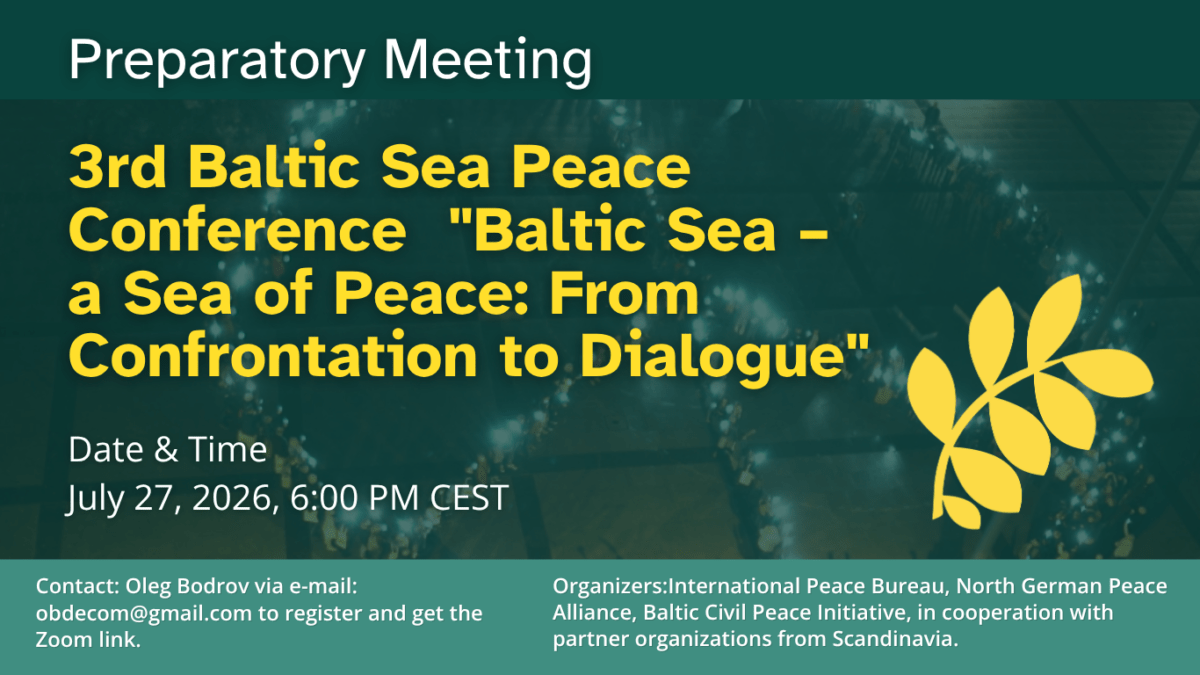
A preparatory Zoom call will be held to discuss the main ideas and content of the conference.
Date & Time: July 27, 2026, 6:00 PM CEST
To participate: Please send a confirmation to Oleg Bodrov at obdecom@gmail.com or +7 921 745 26 31, and the Zoom link will be provided.
Organizers
International Peace Bureau, North German Peace Alliance, Baltic Civil Peace Initiative, in cooperation with partner organizations from Scandinavia.
Main Conference – Tentative Plans
We invite you to participate in the 3rd Baltic Sea Peace Conference, which will take place online (Zoom) this November.
The conference is organized by the International Peace Bureau (IPB), the North German Peace Alliance, and the Baltic Civil Peace Initiative (a network of peace activists, scientists, and ecologists from Russia), with the active involvement of peace and environmental organisations from Scandinavia, as well as civil activists, experts, and representatives of local communities from all Baltic Sea region countries.
The conference is a strictly non-partisan, non-governmental civil initiative, independent of any government, and open to all individuals and groups sharing the goals of peace, demilitarisation, and environmental security in the Baltic region.
Our Shared Vision
The Baltic Sea must remain a sea of peace, cooperation, and common environmental security. Today, however, we are witnessing a spiral of mutual militarisation that has reached unprecedented levels. The region is being integrated into strategic war planning, military budgets are rising, new bases are being built, and the possibility of deploying nuclear weapons is openly discussed.
The dangerous dynamic is inextricably linked to the ongoing war in Ukraine; the drift of the conflict into the Baltic – through drone attacks on ports and oil infrastructure – makes dialogue and de-escalation here a matter of survival for all states in the region. These actions not only increase the risk of direct military confrontation between NATO and Russia/Belarus, but also create an environmental threat of planetary scale. More than 30 nuclear reactors and numerous radioactive waste storage sites are located in the Baltic Sea catchment area. Their destruction during hostilities would render the region uninhabitable for an indefinite period. The history of the Baltic Sea is already scarred by the environmental devastation of two world wars, the consequences of which we live with to this day. Militarisation has immense and immediate consequences for the environment – from pollution to destruction of soil and poisoning of water.
The vision of the Baltic as a Sea of Peace is not new. In the late 20th century, serious proposals were advanced to create a Nordic–Baltic nuclear-weapon-free zone. We return to this legacy, seeking modern forms of détente fit for the 21st century.
Our goal is to mobilise civil society, experts, and regional policymakers to promote dialogue, reduce risks, and develop practical steps towards détente. We want to deepen the understanding of the dialectical relationship between war and the environment.
Conference Objectives
1. Present an objective picture of the threats – military, environmental, socio-economic – for the 90 million inhabitants of the region.
2. Identify “door-openers” – concrete first steps towards de-escalation: demilitarisation, peaceful relations, talks, contacts, joint radiation monitoring, environmental projects, humanitarian and cultural initiatives.
3. Build a transnational civil society coalition ready to issue joint statements and implement projects across political borders, focusing on peace and the nexus between militarisation and the environment.
4. Adopt a Baltic Peace Declaration affirming a shared rejection of war and a commitment to common security principles.
5. Advance the establishment of a politically independent, citizen-based radiation monitoring network involving civil society from all countries of the catchment area.
Key Themes
- Escalation in the Baltic Sea Region: risks of direct military confrontation and pathways to peace.
- Environmental and nuclear safety: risk map, accident consequences, the need for independent monitoring.
- Economy of confrontation vs. economy of cooperation: losses for coastal communities, fisheries, tourism.
- The role of civil society in reducing tensions: experiences of “quiet diplomacy”, successful cases.
- Cultural and educational bridges: how shared values help maintain dialogue.
- The need for disarmament to solve the ecological and social challenges of the region.
Potential participants
- Peace and environmental initiatives from Finland, Sweden, Norway, Denmark, Germany, Poland, the Baltic states, Russia.
- Scientists and experts in nuclear safety, radiation monitoring, marine ecology.
- Representatives of regional parliaments (especially environment and natural resource committees).
- Former senior diplomats and military officers advocating for détente, as well as specialists from OSCE and UNEP.
- Journalists committed to responsible coverage of disarmament and peace.
- Local communities, including fishers, coastal residents, youth, and indigenous peoples (e.g., the Sámi).
Format
Online (Zoom). A hybrid option with limited in-person attendance may be arranged upon request.
To ensure a safe space for open exchange, all sessions will be conducted under the Chatham House Rule. Upon request, anonymous participation and the protection of individual speakers’ personal data can be provided.
Preliminary Programme
Time & Session
11:00 – 11:15 Welcome and opening remarks
11:15 – 12:00 Keynote: “Escalation in the Baltic Sea Region – risks of direct military confrontation and pathways to peace” (two speakers from different countries)
12:00 – 12:15 Discussion
12:15 – 14:00 Lunch break (informal networking)
14:00 – 16:15 Country reports (Finland, Denmark, Sweden, Norway, Germany, Poland, Estonia, Latvia, Lithuania, Russia) – up to 7 min each + discussion
16:15 – 16:30 Break
16:30 – 17:30 Prospects for peaceful development – first steps to peace and environmental protection
17:30 – 18:00 Joint discussion of projects and initiatives
18:00 – 18:15 Adoption of the Baltic Peace Declaration (draft circulated in advance)
18:15 Closing remarks
Working Language: English. Interpretation into Russian will be provided.
Post-Conference Plans
- Establish a Standing Civil Society Committee for the Baltic Region to coordinate projects.
- Produce a detailed expert report on the environmental consequences of the militarisation of the Baltic Sea.
- Conduct joint environmental expeditions and cultural events (photo exhibitions, concerts, bike-and-eco conferences).
- Present the Baltic Peace Declaration to the OSCE, UN, European Parliament, and national parliaments